Apartments
Cultural Events
Zisterzienserinnenabbey St. Jöris

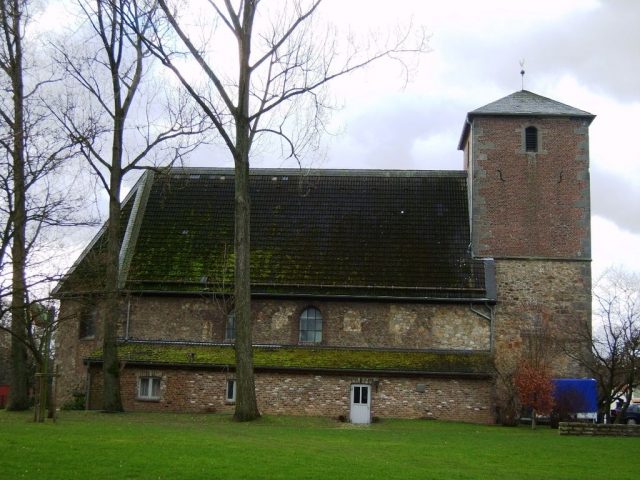
The Cistercian convent of St. Jöris (Latin: monasterium s. Georgii ad Rubum) is a former Cistercian convent in the Eschweiler district of St. Jöris in the Aachen district. Only a few buildings of the original complex, which dominated the village, remain today and are now used as an event venue and apartments.
The nearest motorway junctions are Eschweiler-West on the A 4 and Broichweiden on the A 44. The nearest train station is Eschweiler Hbf on the DB line Aachen – Eschweiler – Düren – Cologne.
In 1274, Winrich and Jutta von Kinzweiler founded the Cistercian convent, which was built on a clearing in the Propsteier Wald and named after St. George, the patron saint of the Knights of Kinzweiler. Nothing from the 13th century remains today in terms of building history. The head relic of Saint Regina in the Kinzweiler parish church, like the triumphal cross, is one of the numerous relics of the monastery from the 14th century. Art historically, the cross belongs to the Rhenish "Crucifixi dolorosi".
The ecclesiastical supervision of the monastery passed to the Abbot of Clairvaux in the 18th century after rivalries between the Cistercian abbeys of Heisterbach and Marienstatt. In 1759, he commissioned the Abbot of Altenberg with the supervision and renovation of the monastery, which had been neglected and run down and had at times faced dissolution.
Over the centuries, the village of St. Jöris developed around the monastery. New buildings were constructed in the 15th and 17th/18th centuries; the current complex dates from the latter period. The present monastery church is a single-nave rubble stone building from the 15th century, as are the two lower tower floors. Brick-up arch openings on the northern wall of the nave suggest a lower side aisle. The upper floor made of bricks is of more recent date.
In April 1783, the von Hatzfeld family took possession of Kinzweiler Castle, a significant agricultural estate at the time, whose tenant became farmer Franz Wüsten after the von Hatzfeld family left Kinzweiler Castle shortly after 1800. He became an alderman of the city or Mairie Eschweiler and built the "Wüstenhof" near Propsteier Wald around 1797. At that time, the region was part of the French Département de la Roer. Kinzweiler, St. Jöris and the Propstier Wald, which then still stretched from the Aachener Reichswald to Aldenhoven, belonged to Eschweiler, which in turn was the seat of the Canton of Eschweiler until 1815, when the Rhineland came to Prussia.
After Napoleon I issued a decree on the secularization of church property on June 9, 1802, the Cistercian abbey was also dissolved, and the Probsteier Wald became free, which until then had been owned by the cathedral provosts of Cologne and was now sold piece by piece. In 1804, Franz Wüsten bought the monastery and built a large manor farm. In 1805, the monastery church was reopened, and in 1815, it was closed again.
On May 8, 1809, Edmund, the son of Franz Wüsten, was born at Kinzweiler Castle. He later inherited the monastery farm and turned it into an exemplary large-scale operation. On March 8, 1846, the monastery farm – referred to as "Landgut Georgenbusch" in a document – was elevated to a knight's estate. Edmund was also the builder of the Steinbachshochwald manor farm on the southwestern edge of the Propsteier Wald around 1830. As a knight's estate owner, he even had the right to a seat in the state parliament, and during his military training, he achieved the rank of royal cavalry captain.
During the Second World War, the monastery complex was severely damaged in 1944, and in 1973, the south wing partially collapsed. In 1982, the "Förderverein Zisterzienserinnenkloster St. Jöris" (Friends of the Cistercian Convent of St. Jöris) was founded, which in 1983 acquired the old monastery church from the city of Eschweiler for 10 DM and was able to save the monument from decay. In March 1986, the rebuilt monastery church was inaugurated as the cultural center of the village. Today, it is occasionally used for Protestant services and, since 2003, for weddings.
Take Mobile History with you
You are reading this text for free. Premium adds what matters on the road: descriptions read aloud, sites found through your camera, whole regions taken offline.
- Every description, including the ~17,700 Premium sites
- Audio guide: have descriptions read to you on location
- AR finder: see sites through your camera, with distance and bearing
- Unlimited saved sites
14 days free, then from €2.99 a month. Cancel anytime.
Source: Wikipedia · Licence: CC BY-SA 4.0 · Image: http://de.wikipedia.org/wiki/Datei:Stjoerisklosterkapelle.jpg
This description draws on the facts documented in the linked Wikipedia article; Wikipedia content is licensed under CC BY-SA 4.0. Wording and editing: Mobile History.
Location: 50.8353, 6.2108