FortressCoesfeld

Citadel Ludgerusburg

Citadel Ludgerusburg

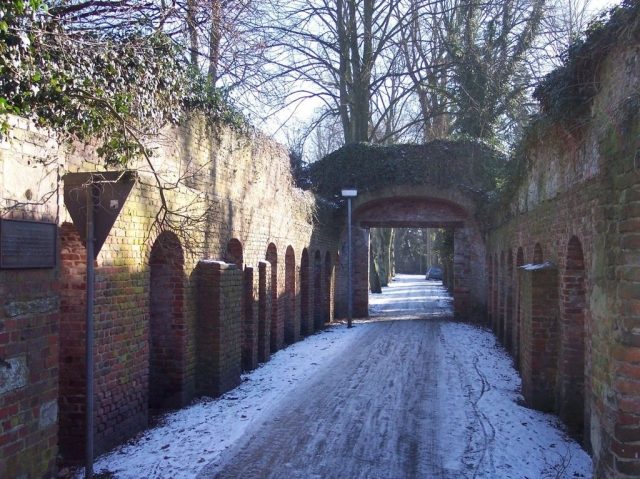
The remains of the Citadel can be visited

The Ludgerusburg is a razed star-shaped citadel in the north of Coesfeld in North Rhine-Westphalia, whose construction and destruction fell into the second half of the 17th century. It was the princely residence of Christoph Bernhard von Galen, named after Saint Ludgerus, the first bishop of the Diocese of Münster.

As late as 1651, three years after the Peace of Westphalia had drawn a line under the turmoil of the Thirty Years' War, Hessian troops were stationed in Coesfeld. In the peace negotiations, Amalie Elisabeth von Hanau-Münzenberg, widow of Wilhelm V, Landgrave of Hesse-Kassel, had been promised a high compensation, until the full repayment of which Coesfeld was to remain as a pledge under Hessian occupation. Christoph Bernhard von Galen, the new Prince-Bishop of the Prince-Bishopric of Münster, made the liberation of the city one of his most urgent tasks and, through advance payments and negotiating skill, managed to ensure that the Hessians withdrew from Coesfeld on July 1, 1652.

Against the backdrop of his disputes with the city of Münster, von Galen intended to develop Coesfeld into a princely residential city. The fortifications, which had already been strengthened during the occupation, were further expanded and supplemented by a spacious citadel, called Ludgerusburg, which was built from 1655 in front of the Viehtor in the north of the city. Already the year before, the weirs for damming the Berkel were renewed to keep the water in the moats.

The footprint of the citadel roughly corresponded to that of Coesfeld at the time. The complex had a square layout and was connected to the city's fortifications via one of its corners. The four bastions each carried a cavalier. The fortress was surrounded by a wide water-filled moat. Along the main wall on the castle side ran a lower wall, the Fausse-Braie, with a rear walkway, which was intended to protect the curtain walls and flanks. Between and in front of the bastions, four ravelins and demi-lunes located in the moat protected the blind spots of the fortress.

The lands required for the construction of the citadel were expropriated, and the affected citizens of Coesfeld were compensated for giving up their properties. On August 28, 1655, 600 soldiers of the Prince-Bishop began the work. The following year, on July 17, 1656, the foundation stone for the gatehouse was laid, whose magnificent architecture is attributed to Peter Pictorius the Elder. However, he is considered the fortress builder, Pictorius was rather the person entrusted with the execution. His plans for the construction of a central castle complex inside the citadel were never completed. Christoph Bernhard von Galen therefore moved into a wing originally intended as an outbuilding in 1659.

After the death of the Prince-Bishop, von Galen died on September 19, 1678, in Ahaus, his successors Ferdinand Freiherr von Fürstenberg († 1683) and Maximilian Heinrich von Bayern († 1688) initially still had an interest in preserving the citadel and the castle. Directly after Maximilian's death, however, the cathedral chapter in Münster, which had again replaced Coesfeld as a residential city, had the complex largely razed. The remaining city fortifications of Coesfeld were largely destroyed in the Seven Years' War.

Remains in Modern Times+

Not much of the Ludgerusburg remains in Coesfeld's current cityscape. However, all facilities of Coesfeld's current "Kulturmeile", including the , the WBK, the cinema, the CoeBad, and the school center, are located on the grounds of the former fortress. The ruin of the gatehouse at the entrance to the city park on Osterwicker Straße is the most famous relic of the former citadel. In the courtyard behind the town hall, located between the municipal baths and the cinema, a barrel vault is preserved as another ruin, whose former purpose and integration into the complex can no longer be unequivocally determined today. North of the railway line from Coesfeld to Münster, in the Citadelle development area, the largely preserved St. Johannes Ravelin has been protected as an archaeological monument. The street in its immediate vicinity bears the name Am Ravelin. A neighboring biotope is a remnant of the former castle moat. At the entry of the Berkel into the city, the former ramparts and entrenchments can still be seen today. The Fürstenwiesen, named after von Galen and located to the right of the river, can be flooded during high water to protect the city center of Coesfeld from damage.

Not much of the former city fortifications has survived to the present day either. Only the Berkel bypass along the former eastern ramparts, the Walkenbrückentor, rebuilt after the Second World War, which formerly led to the esplanade in front of the citadel, and the Pulverturm, renovated at the beginning of the new millennium, are preserved today. The latter now serves as the domicile of the local history association. The Coesfeld Promenade runs along the former ramparts once around the city center.

Take Mobile History with you

You are reading this text for free. Premium adds what matters on the road: descriptions read aloud, sites found through your camera, whole regions taken offline.

  • Every description, including the ~17,700 Premium sites
  • Audio guide: have descriptions read to you on location
  • AR finder: see sites through your camera, with distance and bearing
  • Unlimited saved sites

14 days free, then from €2.99 a month. Cancel anytime.

Source: Wikipedia · Licence: CC BY-SA 4.0 · Image: http://de.wikipedia.org/wiki/Datei:Coesfeld_Ludgerusburgruine_2.jpg

This description draws on the facts documented in the linked Wikipedia article; Wikipedia content is licensed under CC BY-SA 4.0. Wording and editing: Mobile History.

Location: 51.9499, 7.1715