The remains of the Roman fort can be visited.
Ancient BuildingAardenburg
Roman fort Aardenburg
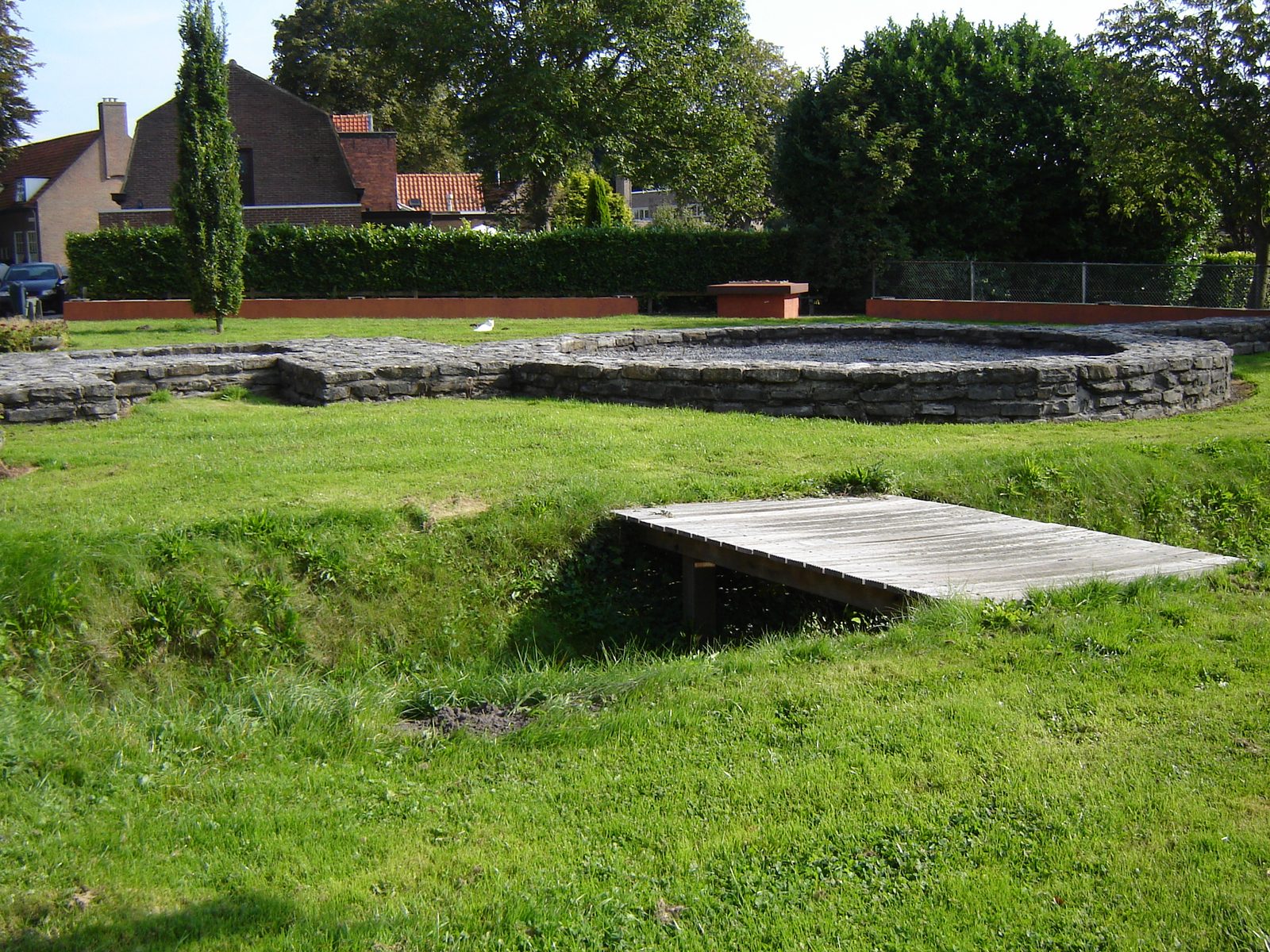
The castellum Aardenburg was a Roman castellum in the Dutch city of Aardenburg, province of Zeeland. The fort served for coastal surveillance of the borders of the Roman Empire and offered protection against raids from the sea. It measured 150 by 240 meters and accommodated approximately 300 soldiers, both infantry and cavalry.
History+
Around 150 AD, there was already Roman habitation at the site of Aardenburg. The inhabitants were mainly engaged in the production of fish sauce. Due to invasions by the Chauci, the Romans built various forts along the North Sea coast. In Aardenburg, the first fort was built in 170 AD. Around the year 190, it was succeeded by a fort with an earthen rampart, a headquarters, and barracks. Around 220, a renovation followed, in which the headquarters was expanded and an extra moat was dug around the fort. A small temple was also built within the fort, which may indicate civilian habitation instead of a garrison. In 240, this fort was destroyed. Around 260, the destroyed fort was rebuilt by the Gallic Empire in natural stone, with round towers and surrounded by a 15-meter wide moat. Attacks by Saxon pirates around 274 led to an evacuation of the garrison. Eventually, the fort was abandoned around the year 290, with the Romans tearing down the walls so that the pirates could not use the fort. In the Middle Ages, the monks of the Ghent Saint Bavo's Abbey tried to cultivate the area, but attacks by Vikings made this difficult. In the early 10th century, peace was restored and the abbey founded the Sint-Bavokerk within the former fort. Stones from the old fort were used for this.
Research+
Much archaeological research was carried out in Aardenburg, and the first provincial archaeologist of Zeeland, ir. Jan Trimpe Burger, even moved to Aardenburg for that research. The first excavation took place in 1949, but it was not until 1955 that the first Roman remains were found. Roman Aardenburg covered an area of approximately two square kilometers, within which the castellum occupied a central place. The settlement was a regional center with roads, a bathhouse, and a cemetery. The discovery of 27 ovens shows that there was industry present prior to the construction of the fort, largely focused on the production of fish sauce. In 1976, remains of the western gatehouse were found at a depth of two meters on Burchtstraat. The location of the gate has been made visible in the streetscape. The gate was flanked by two heavy round towers about six meters high. Finds from the castellum are exhibited in the Museum Cultuurforum Aardenburg. Castellum Aardenburg is also featured in Museum Het Bolwerk.
Take Mobile History with you
You are reading this text for free. Premium adds what matters on the road: descriptions read aloud, sites found through your camera, whole regions taken offline.
- Every description, including the ~17,700 Premium sites
- Audio guide: have descriptions read to you on location
- AR finder: see sites through your camera, with distance and bearing
- Unlimited saved sites
14 days free, then from €2.99 a month. Cancel anytime.
Source: Wikipedia · Licence: CC BY-SA 4.0 · Image: LimoWreck · Wikimedia Commons · CC BY-SA 3.0
This description is a machine translation of an excerpt from the linked Wikipedia article. The source text was written by its authors, the translation is by Mobile History; like the original it is licensed under CC BY-SA 4.0.
Location: 51.2726, 3.4466