The church can be visited
ChurchGörlitz
Görlitz Church of the Holy Trinity
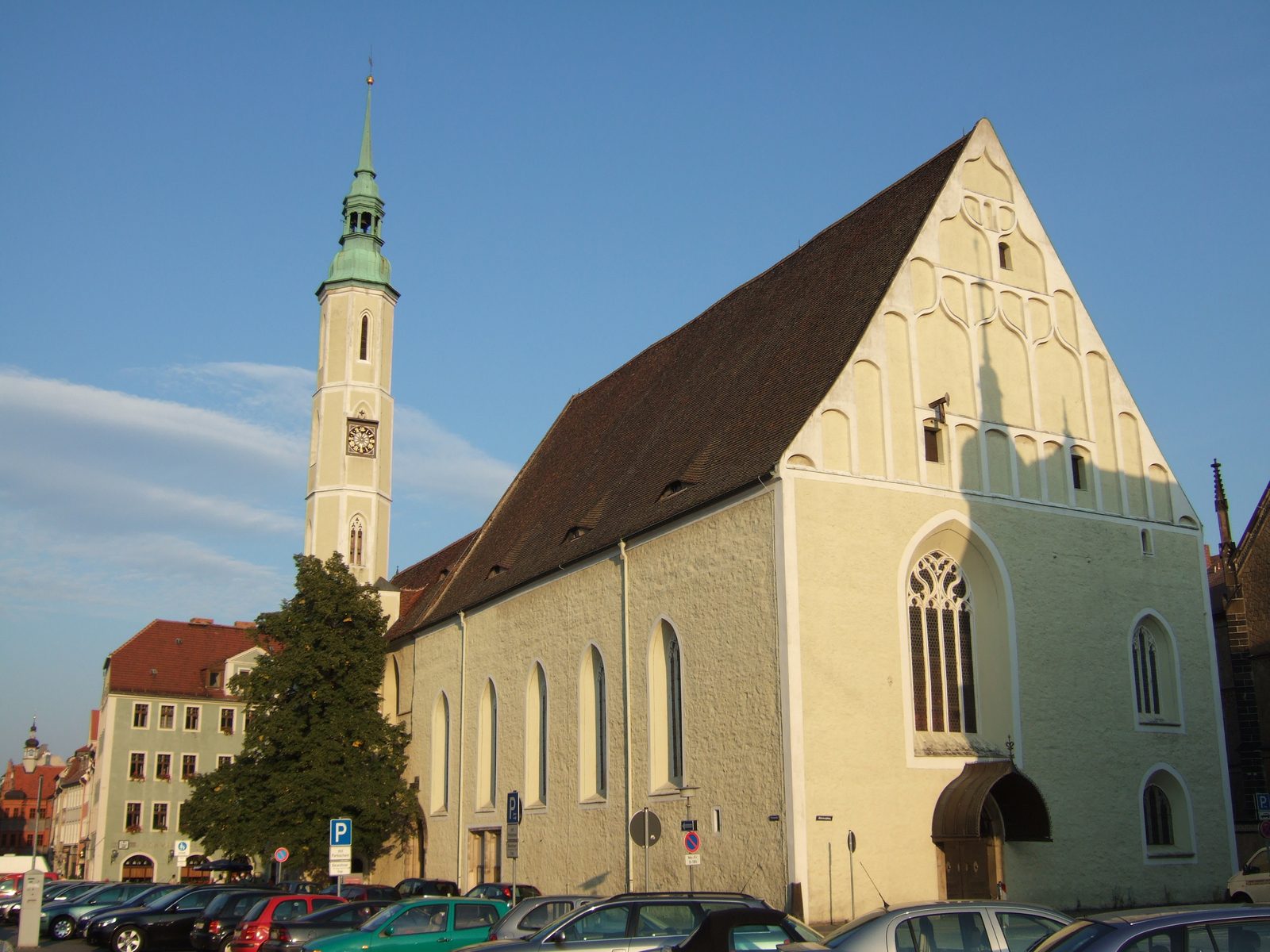
The Trinity Church is a Protestant church in Görlitz. It was built between 1234 and 1245 as the monastery church of the Franciscan monastery on today's Obermarkt. In 1564, the monastery was converted into a grammar school, and the church served as a school church and, since 1712, as a parish church.
History+
Around 1200, the city of Görlitz was founded in the area between Lunitz, Neisse, today's Elisabethplatz and Brüderstraße. At that time, still outside the city walls, the brothers of the Franciscan order, founded in 1210, probably began building the monastery and the church in 1234. It belonged to the Saxon Franciscan Province (Saxonia). The noble family of Wirsynge donated the land. Since the Franciscans usually built their monasteries within the city walls, it is possible that the expansion of the city was already intended at this time. On August 21, 1245, the Monday after the Assumption of Mary (August 15), Bishop Konrad of Meißen consecrated the church in honor of the Blessed Virgin Mary and Saint Francis of Assisi. From then on, the celebration of the church consecration (Kirmes) was always to take place on the Monday after August 18 – until the 20th century, this was also the beginning of the Görlitz Kirmesmarkt. In 1388, the provincial chapter of Saxonia met in the Görlitz convent. When the convent preacher was to be transferred to another monastery in 1416, the Görlitz city council asked the provincial minister to keep the popular Franciscan in Görlitz. On May 23, 1458, the provincial chapter meeting in Braunschweig decided to establish a study house for young friars in Görlitz, where 8 to 10 brothers were to be trained by "two understanding and well-behaved lecturers [...] according to God, discipline, honor and honesty of the order." The studies became known beyond the borders of the Saxonia province. As a result, the convent's library grew from 77 books in the mid-14th century to over 300 by the end of the 15th century. After being relocated during World War II, the collection is now almost completely preserved in the University Library of Wrocław.
In the middle of the 15th century, the so-called Observant movement gained influence within the Franciscan order, working towards a reform of monastic life towards a stricter observance of the order's rules. Despite a preaching tour by Johannes Capistranus, which also led him to the Görlitz Franciscan convent at the turn of 1452/1453, the Observants, unlike in Bohemia, where they enjoyed the support of the Bohemian king and Görlitz sovereign Vladislav II, could not prevail. Also at the insistence of the city council, the monastery was reformed in 1462 during a two-week visit by Provincial Nikolaus Lackmann, but it followed the more moderate poverty direction according to the Martinian Constitutions, an "Observant movement outside the Observance" to which, after an attempt at mediation by Pope Martin V in 1430, many monasteries of the Franciscan province of Saxonia joined. The Görlitz city council also actively participated in the redesign of monastic life, in the spirit of the Franciscan vow of poverty. On the one hand, it was concerned with the quality of monastic pastoral care, but on the other hand, also with its influence on the monastery's property, which it managed through its right of appointment for the procurator's office in the interest of the monastery and the founders. Specifically, it was hoped that the share of the monastery's property managed by the council would increase, as the reform prescribed not only personal poverty for the friars but also propertylessness for the convents. In general, for the Franciscans, due to their rejection of property and monetary transactions required by the order's rule, they were largely dependent on the citizenry and the councils of the cities in which they settled. This dependence was very convenient for the Görlitz citizens in the "beer dispute" with the pastor of the Görlitz main church, Johannes Behem. When the council forbade him to serve imported beer in 1488, Behem promptly placed the city under interdict. Only in the monastery, for which the secular cleric's order did not apply, and in the Holy Cross Chapel, where an exception permit was obtained from the Meißen bishop for 1490 and 1491, could the Görlitz citizens now attend church services. The dispute could only be finally settled in 1501 with Behem's resignation. Regarding the question of to whom the monastery should be subordinate after it had joined the Martinian reform movement, a long-standing dispute broke out in 1498 between Johannes Heymstede, the provincial minister of Saxonia elected that year, and the city council. The Martinian monasteries formed their own custody within the Saxon Franciscan Province with a Visitator regiminis as superior, to which the Görlitz monastery demonstrably belonged at least since 1476. While the provincial minister demanded that the convent be again subordinate to the custos of the Goldberg custody, the council insisted that the monastery remain subordinate to the Visitator regiminis of the Martinian Franciscan monasteries of Görlitz, Zwickau, Leipzig, and Schweidnitz. With the threat of otherwise joining the even stricter Observant movement, and with the involvement of Cardinal Protector Giuliano della Rovere, the council finally prevailed. On July 28, 1498, Heymstede had to appoint the Schweidnitz lecturer Benedikt von Löwenberg as Visitator regiminis. In 1503, the convents of Berlin, Dresden, Frankfurt a.d. Oder, Gransee, Wittenberg, Zerbst, and Zwickau were also placed under him, and he led his own seal. Provincial Johannes Heymstede declared this to the Görlitz council on July 10, 1503. As late as 1508, there are admonishing words from the council to Heymstede's successor Ludwig Henning that the council could not vouch for the order's discipline if he wished to subordinate the Görlitz monastery to the custody. Henning then assured in a letter that he would do nothing that could be detrimental to spiritual discipline. In 1506, the situation changed again when della Rovere, elected Pope Julius II in 1503, ordered every Franciscan convent to join either the Martinian or the Observant movement with two bulls; in 1510, the Pope reiterated this in the bull Decet Romanum Pontificem. It was now the council's endeavor to prevent the monastery from joining the strict Observant movement. Corresponding negotiations were already held in 1511 between Provincial Henning and the custodies of Goldberg and Breslau. The council then prevented the Görlitz Franciscans from participating in the provincial chapter. At the same time, it asked the Bohemian king and the Franciscan General, Philipp de Bagnacavallo, for intervention. Indeed, the status quo was again confirmed by the latter. The disputes with the Franciscans also show again the great influence that the council could exert not only on the monastery but also on higher levels of the order's organization. As late as 1521, the city council instructed the guards at the city gates not to let any Franciscans into the city without the knowledge of the guardian of the Franciscan monastery. When the Franciscan order was divided into the Observants (Ordo fratrum minorum regularis observantiae, henceforth called Franciscans) and the Conventuals (Ordo fratrum minorum conventualium, the Minorites or Conventuals) in 1517 by the bull Ite et vos, Görlitz remained with the Franciscans. When the General Chapter of the order reclassified the custody of Breslau and the monasteries of Liegnitz and Goldberg from the Saxon to the Bohemian Franciscan Province in 1523, Görlitz briefly became the seat of its own custody in Saxonia for the remaining convents of the Goldberg custody. Immediately at the beginning of the Reformation – the first Lutheran sermons are documented in Görlitz for the year 1521 – the Franciscans in Görlitz also began to leave the monastery, so that in 1563, Urban von Weißbach, the last of them, handed over the monastery to the city. He did so on the condition that the council established a school in the buildings, which it did in 1565. In 1565, the last Franciscans left Görlitz. In 1568, the first Protestant sermon was held in the sacred building, now serving as a school church, by the Protestant school pastor Melchior Scheffler. In 1712, the church finally received its own parish and was consecrated in 1715, after three years of renovation, as the Church of the Holy Trinity. Since 1951, there has again been a Franciscan branch, when the Silesian Franciscan Province (Silesia) founded a monastery in the Weinhübel district. Due to a lack of new recruits, Silesia had to give up the branch in 1989, which was taken over by Polish Franciscans.
Building History+
The original monastic church was a simple hall church. It thus corresponded to the Franciscans' endeavor to outwardly reflect their vow of poverty. According to the order's rule valid in the 13th century, the church of a Franciscan convent was not allowed to be higher than 30 feet, and the other monastery buildings not higher than 20 feet. The churches were also not to have a bell tower and, apart from the choir, no colored windows, and stone should be avoided as much as possible when building the monastery. In the 14th century, the Franciscans turned to a more representative style of building, which is also reflected in the construction activities at the Görlitz Franciscan monastery.
Between 1371 and 1381, the late Romanesque apse was extended by the Gothic choir and the bell tower, also called "Mönch" (monk), was added. Its clock, by the way, is still seven minutes fast today. This peculiarity dates back to the Middle Ages; it was intended to ensure that the city guard always started their duty on time. The choir is the oldest Gothic building in Görlitz. This itself was only built from 1450 to 1470. The vaulting of the originally flat-roofed nave was possibly carried out by Conrad Pflüger, who concluded a contract with the city council in 1490 for his appointment as city architect. Assuming that the city expansion was already decided at the start of construction, the monastery complex – it originally extended over the Klosterplatz to the city wall, approximately at the height of today's Elisabethplatz – is located within the city walls, and on the main traffic axis of medieval Görlitz. The monastery is also located in the immediate vicinity of the craftsmen's and poverty quarters, with regard to the social strata to which the Franciscans dedicated special attention. All of this is typical for Franciscan monastery complexes. The interior of the church is dominated today by the Baroque high altar, in front of which the pews of the friars are still located. The new altar had to replace the church's actual jewel, the late Gothic Marian altar, which now adorns the Barbara Chapel, during the renovation from 1712 to 1715. In 1670, the church received a pulpit decorated with depictions of the apostles on the north wall.
Renovation with funds from the "Altstadtmillion"+
Between 1996 and 2015, numerous renovation works were carried out, which were financed by the Altstadtstiftung Görlitz from the Altstadtmillion. For example, the tower clock was repaired in 2004, and from 1996 onwards, the reveals of the altar windows were restored. The roof truss was also renovated in several steps.
Church Furnishings+
Baroque high altar by Caspar Gottlob von Rodewitz Choir stalls from 1484 with a chronicle inscription on the history of the Görlitz Franciscan monastery. The parts of the choir stalls, considered lost since 1945, have been in Poznań Cathedral since the 1950s, where they are installed and used in the presbytery. In the course of a renovation in 1909/1910, Gothic paintings were discovered in the vault under the galleries of the south aisle, uncovered, and restored in the taste of the time. In a total of six bays, elaborate ornamental and floral designs are shown, with the eastern bay with a large concert of angels deserving special attention. This depiction with 32 angels playing late medieval musical instruments is a picture cycle of the Ambrosian hymn Te Deum, the complete text of which is reproduced in the ribbons of the angels. The creation time of the painting is estimated to be around 1425 to 1435. The exposed presentation has left unmistakable traces; a renovation is planned as part of a fundamental structural repair and restoration of the Trinity Church.
The organ of the Trinity Church was rebuilt in 1955 by Eule Orgelbau in the old casing by Julius Röhle (1910) with parts from Ladegast (1873). The instrument has 28 speaking stops on two manuals and pedal.
Couplers: II/I, I/P, II/P
Barbara Chapel+
Between 1450 and 1475, the Trinity Church was further extended. During this time, the Barbara Chapel was added on the south side of the church. Indications of this construction period are given by coats of arms on vault corbels in the chapel. The Bohemian Lion and the Austrian Bindenschild point to the construction period in the mid-15th century, when the Habsburg Albrecht II and his son Ladislaus Postumus were kings of Bohemia and sovereigns of Upper Lusatia. The Barbara Chapel houses the most precious medieval furnishings of the Trinity Church. The oldest Görlitz tombstone is preserved here. It was erected for Johann Berka von Dubá, a son of the then Upper Lusatian Landvogt Beneš Berka von Dubá. Further sights in the chapel:
Sculpture "Christ in Repose" The wooden sculpture, created around 1500, shows Christ meditating on his way to his death. The figure of Christ belonged to a group of sculptures, all of which were commissioned by the Görlitz merchant and mayor Georg Emmerich.
The Lamentation Group (also Entombment Group) In 1492, Hans Olmützer began work on the Lamentation Group, now in the Barbara Chapel, which was also donated by Georg Emmerich. The sandstone block was originally located on the southern choir wall of the frontal altar of the monastery church. Christ, taken down from the cross, is mourned by his mother Mary, John the Evangelist, Nicodemus, and Joseph of Arimathea. The inscription reads: Sit pius ille mihi quem fles dulcissima virgo ("May he be merciful to me, whom you mourn, sweetest Virgin"). The former altarpiece was revised in 1607. It was relocated during World War II and returned from Poland in 1962.
Winged Altar The "Golden Mary" The late Gothic winged altar stood on the former high altar in the choir until 1713. It came to the Barbara Chapel in 1910. It is an altarpiece, a movable altar with a shrine and two movable pairs of wings. Contrary to the inscription on the predella (base), it was created later than 1488, probably between 1510 and 1515, in a Wrocław workshop. When open, it shows the Madonna and Child in a halo, accompanied by three angels. The side wings show scenes from the life of Mary. When the wings are closed, the depictions of the stations of Christ's Passion can be seen in eight pictures. When the altar is presented closed, the depiction of the Crucifixion, Entombment, Resurrection, and Rebirth of Christ with Mary and John the Baptist is shown. After its restoration in September 2001, on Open Monument Day, the winged altar was made accessible to the public again and is thus completely visible and fully functional for the first time in 20 years.
Take Mobile History with you
You are reading this text for free. Premium adds what matters on the road: descriptions read aloud, sites found through your camera, whole regions taken offline.
- Every description, including the ~17,700 Premium sites
- Audio guide: have descriptions read to you on location
- AR finder: see sites through your camera, with distance and bearing
- Unlimited saved sites
14 days free, then from €2.99 a month. Cancel anytime.
Source: Wikipedia · Licence: CC BY-SA 4.0 · Image: DanielGu at German Wikipedia ( Original text: DanielGu ) · Wikimedia Commons · Public domain
This description is a machine translation of an excerpt from the linked Wikipedia article. The source text was written by its authors, the translation is by Mobile History; like the original it is licensed under CC BY-SA 4.0.
Location: 51.1554, 14.9887