Church visitable
ChurchGörlitz
Görlitz Church of Saints Peter and Paul
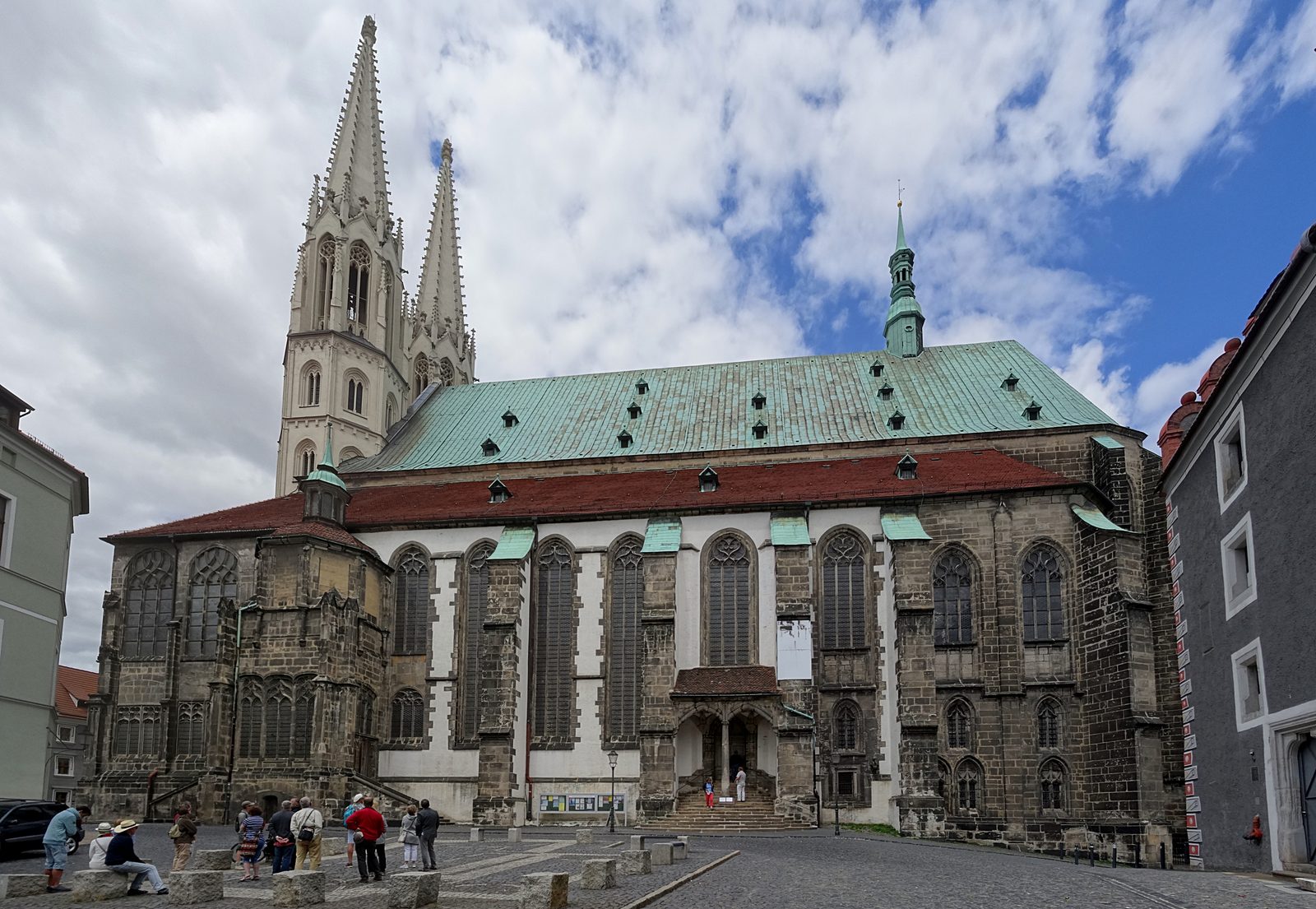
The city church of St. Peter and Paul in Görlitz, briefly called Peterskirche, is the former main and council church of the city and parish church of the inner-city community. With its copper-covered high roof and the widely visible twin towers, it dominates the historic old town and is a landmark of the city on the Neisse.
History+
As early as around 1230, a basilica stood on this site, of which only the western structure has been preserved to this day. It had a short three-aisled nave and a transept that protruded only slightly. In the 14th century, this building underwent significant changes. In 1378, the Georgenkapelle (St. George's Chapel) was first mentioned. The current hall church was begun in the first decade of the 15th century. The oldest parts of the hall are the western bays of the outer southern aisle, including the vestibule, which was altered externally after 1691. The foundation stone for the choir was laid in 1423 under the direction of Hans Knobloch and Hans Baumgarten. The expansion of the building site to the east required extensive substructures and the construction of the Georgenkapelle, consecrated in 1457, as a crypt, which today forms the basement of the choir. In 1465, the two-story sacristy with the singers' gallery above it was completed. After the enclosing walls were largely in place by 1490, the church was vaulted between 1490 and 1497 under the direction of Conrad Pflüger with the master masons Blasius Börer and Urban Laubanisch and completed in its essential parts. A first renovation took place from 1590 to 1596. In 1590, Gregor Richter became a preacher at St. Peter and Paul; from 1606 until his death in 1624, he was the senior pastor. He fought against the theological views of his parishioner Jakob Böhme. During the city fire of 1691, the upper open floors of the western structure and the inventory were destroyed, including 36 altars and a 20-meter-high sacrament house. The roof could be renewed by 1712. At the same time, the church was re-equipped in the Baroque style. In 1702, the composer and musician Christian Ludwig Boxberg (1670–1729) began his service as organist at the church. Boxberg became known primarily for his cantatas and the opera Sardanapalus (1698). In 1704, he also published a description of the sun organ located in the church, built by Eugenio Casparini. In 1835, the interior of the church was repainted. The two towers were raised to a height of 84 meters between 1889 and 1891 with the upper floors and spires made of concrete. With the demolition of the Old Town Bridge on May 7, 1945, by the German Wehrmacht (which had no strategic military significance whatsoever), all stained glass windows, except for one, were destroyed by the pressure wave, and tracery and roof were partly severely damaged. In the years 1948–61, the window tracery and the lower church were restored. Further restoration of the exterior was carried out from 1978–1981 and of the interior from 1981–1992, whereby the 1500 version and the interior furnishings were restored.
Architecture+
St. Peter and Paul, with a length of 72 meters, a width of 39 meters, and a nave height of 24 meters, is one of the largest and most significant hall churches in eastern Germany. The five-aisled church consists of three equally high aisles in the sense of a hall church and two significantly lower outer aisles. Their vault crowns are below the impost height of the middle aisles, making them pseudo-basilical. Their tile-covered lean-to roofs are set off from the copper-covered main roof of the church. The nave is seven bays long, the choir ends in a staggered choir with three polygonal apses. In the southern aisle, various chapels are placed between the buttresses. The outer aisles continue to the west side of the late Romanesque western structure. A large splayed portal is inserted into the west side, which was renewed in Renaissance forms in 1595/96 by Jonas Rosskopf and Melchior Kunze, based on the late Romanesque design. Inside, slender profiled pillars without capitals support net vaults over the aisles and vaults with star shapes in the nave. The northern aisle partly shows richer windows with fish bladder tracery similar to those in the southern aisle of Bautzen Cathedral. The other narrow windows are equipped with simpler tracery forms made of intersecting arch motifs. In the western part of the outer aisles, the vault springings are supported by console heads. The interior of the southwestern vestibule is a late Gothic architectural masterpiece in the tradition of Peter Parler, which resulted from a combination of a rectangular space with an inserted three-sided baldachin. Figure niches with wide standing surfaces and a hanging frieze with console heads are attached to the sides of the portal.
Furnishings+
Altar+
The altar structure was made in 1695 from sandstone and polished stucco marble by George Heermann from Dresden. The architectural structure is divided into a plinth story with side passages, a curved three-part main story with columns, pillars, and gables, and a high superstructure with a broken pediment, and is richly decorated with figures. In the main story, the instruments of Christ's Passion are depicted, in the side volutes of the lower story are angel figures; above the main cornice are the Evangelists and, as a conclusion above the superstructure, the Christian virtues. The main painting shows the Ascension of Christ, inspired by Raphael's Transfiguration; in the predella, the Entombment of Christ is depicted. The iron altar railing dates from 1698.
Pulpit+
The pulpit, dated 1693, with its body and ascent made of sandstone and rich plant ornamentation in white and gold, is supported by a life-sized angel. The coat of arms above the angel commemorates the donor, the Leipzig merchant August Kober. On the basket, the four Evangelists can be seen. On the wooden soundboard, various apostles, prophets, and saints are depicted. The pulpit was probably created by the sculptor Johann Conrad Buchau.
Stalls+
The council stalls were created in 1694–1695 by Johann Conrad Buchau. They are located in a prominent position under the organ gallery, with a view of the entire church interior. Above the stalls is the four-part Görlitz city coat of arms, as granted by Emperor Charles V. The flanking carvings show allegorical figures of wealth and justice. In the Peterskirche, there used to be numerous special seats reserved for certain families or landowners. In total, the church had 3180 seats in 1696. Parishioners had to pay an annual fee for these. At the eastern end of the aisles stand three magnificent wooden confessionals. The confessional in the outer northern aisle was made in 1717 by Caspar Gottlob von Rodewitz, the two in the northern and southern side apses around 1694.
Epitaphs and further furnishings+
Numerous epitaphs complete the church's furnishings. The most magnificent epitaph was probably also made after a design by Caspar Gottlob von Rodewitz for the city clerk Christian Moller von Mollerstein († 1714) from alabaster, marble, and sandstone by Johann Matthäus Oberschall and installed in the north aisle. Further epitaphs for the city clerk Gottfried Gerlach († 1737) from 1741 and for Baron Rudolph Ferdinand Silwer von Silwerstein with extremely rich framing are also found in the north aisle. On the altar pillars, the monument for the clergyman Christoph Seifert († 1702) with angels and foliage can be found, who was the senior pastor at the time of reconstruction after the fire of 1691. Also there is the monument for Christiane Luisa von Gersdorf († 1779) from 1783. Several portraits of pastors from the 16th to 19th centuries are attached to the sacristy wall. The baptistery in the western bay of the outer north aisle is delimited by a rich wrought-iron grille created by Hans Mantler in 1617. A stained glass window from 1893, depicting the twelve-year-old Jesus in the Temple, survived the demolition of the Neisse bridge in World War II.
Sun Organ+
Particularly noteworthy is the facade of the Sun Organ from 1703 by Johann Conrad Buchau, for the former organ by Eugenio Casparini. The current organ work is by the Swiss company Mathis Orgelbau from 1997/2004/2006 and now has 91 stops on four manuals and pedal after a final expansion in 2021. A total of 17 suns are distributed over the entire facade, around each of which organ pipes of equal length are arranged, as it were, as "sunbeams." Four of these suns are silent, 12 of them sound as secondary or effect stops. They form the 12-fold pedal mixture.
Bells+
The Peterskirche has four bells, two of which are historical bells forming the remaining stock of the once six-part peal. Bells 2–4 are located between the two towers in the central structure and hang in a steel bell frame. Bell 1 hangs on the same floor in the north tower, in a wooden bell frame. An antenna system is located in the bell chambers in the south tower. Bells 2–4 hang on cranked yokes. Due to defects, bell 2 cannot be rung and therefore remains silent. The former Great Bell was cast in 1696 by Joachim Hannibal Brors and was one of the most significant historical bells until 1917. With its strike tone d0, it was the lowest-pitched sounding bell in Germany until 1874. It had a weight of about 10,900 kg and a diameter of 246 cm. It only lost this position with the casting of the Cologne Kaiserglocke in 1874, whose strike tone was a semitone lower. From 1894 until its destruction in World War II, another d0-bell existed in the Kaiser Wilhelm Memorial Church in Berlin. The valuable Görlitz bell was broken up in its bell chamber in 1917 for armament purposes in World War I, and the fragments were melted down. A 1:1 scale plaster model displayed in the church nave provides a visual impression of the once legendary bell. However, another large bell from the hand of the caster Brors, the "Betglocke" (Prayer Bell) with the strike tone fis0, has been preserved in the Peterskirche. In the early 1990s, damage to its bell frame was discovered, so it rang for the last time on Good Friday, April 9, 1993, before it had to be temporarily taken out of service. Only on Pentecost Sunday, May 28, 2023, 30 years later, after extensive renovation of the bell frame and the installation of a new yoke and a new clapper, the bell could be ceremoniously put back into operation during the church service.
The first documented peal of the Peterskirche, which was completely destroyed by the great city fire of 1691, consisted of five bells. After the recasting of the first Susanna in 1598, as was customary, the names of the council members were inscribed on the new bell. Thus, on the second Susanna, among others, was the name of the famous mathematician, astronomer, cartographer, and multiple mayor of Görlitz, Bartholomäus Scultetus.
The second peal, which was largely melted down for armament purposes during the First and Second World Wars, consisted of six bells. The Sievert's closing bell did not harmonize with the other bells due to its tone. Since it was not rung for years because of this, it was voluntarily given away along with the confiscated bells.
A renewal and expansion of the peal, including a recasting of the Great Bell, is planned in the long term.
Take Mobile History with you
You are reading this text for free. Premium adds what matters on the road: descriptions read aloud, sites found through your camera, whole regions taken offline.
- Every description, including the ~17,700 Premium sites
- Audio guide: have descriptions read to you on location
- AR finder: see sites through your camera, with distance and bearing
- Unlimited saved sites
14 days free, then from €2.99 a month. Cancel anytime.
Source: Wikipedia · Licence: CC BY-SA 4.0 · Image: ErwinMeier · Wikimedia Commons · CC BY-SA 4.0
This description is a machine translation of an excerpt from the linked Wikipedia article. The source text was written by its authors, the translation is by Mobile History; like the original it is licensed under CC BY-SA 4.0.
Location: 51.1584, 14.9924