The remains of the ancient town can be visited
Ancient BuildingGüllübahçe
Ancient City Priene
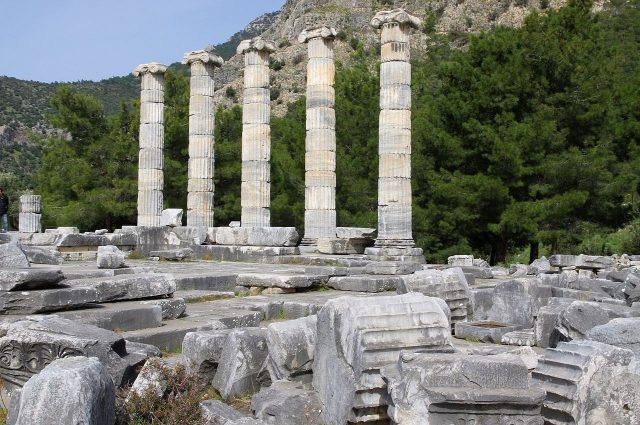
The ancient city of Priene, a significant site in Asia Minor, is situated on the mountainous Mykale peninsula in modern-day Turkey. Its ruins, near the town of Güllübahçe in Aydın province, show a systematically planned Hellenistic city that, despite its minor political importance, represents a masterpiece of Greek urban planning.
History+
The origins of Priene are not fully known, but according to Pausanias, the city was taken from the Carians by Ionian and Theban Greeks. It was a member of the Ionian League and was ravaged by Cimmerian incursions in the 7th century BC. After disputes with Samos, Priene fell under Lydian rule around 645 BC. In the 6th century BC, the sage Bias lived here. When the Persians attacked the Lydian Empire in 545 BC, Priene was possibly destroyed and its inhabitants enslaved, but it recovered. The city participated in the Ionian Revolt (494 BC) and was devastated again after the defeat. A new foundation of the city at a different location occurred in the mid-4th century BC, possibly under Maussollos or the Athenians. This new settlement, with a Hippodamian street grid and a Temple of Athena supported by Alexander the Great, flourished. Priene maintained its autonomy and a democratic constitution. After the rule of the Seleucids and Ptolemies, the city came under Roman influence in 190 BC. A fire disaster around 140/130 BC destroyed parts of the city. After the death of Attalus III in 129 BC, Priene became part of the Roman Empire. The Mithridatic Wars led to economic decline, but the city recovered in the early imperial period, evidenced by the completion of the Temple of Athena under Augustus. However, due to the progressive silting of its harbor, Priene lost importance. In the 5th century, the city became a bishopric, and in the 13th century, a castle was built on the agora, before settlement ended around 1300 with the Turkish conquest. In the 18th and 19th centuries, Priene became a destination for research expeditions, and systematic excavations began in 1895.
Take Mobile History with you
You are reading this text for free. Premium adds what matters on the road: descriptions read aloud, sites found through your camera, whole regions taken offline.
- Every description, including the ~17,700 Premium sites
- Audio guide: have descriptions read to you on location
- AR finder: see sites through your camera, with distance and bearing
- Unlimited saved sites
14 days free, then from €2.99 a month. Cancel anytime.
Source: Wikipedia · Licence: CC BY-SA 4.0 · Image: http://commons.wikimedia.org/wiki/File:Temple_of_Athena_at_Priene.jpg
This description draws on the facts documented in the linked Wikipedia article; Wikipedia content is licensed under CC BY-SA 4.0. Wording and editing: Mobile History.
Location: 37.6593, 27.2978