The remains of the ancient town can be visited
Ancient BuildingTivoli
Ancient City Tibur-Tempio della Tosse
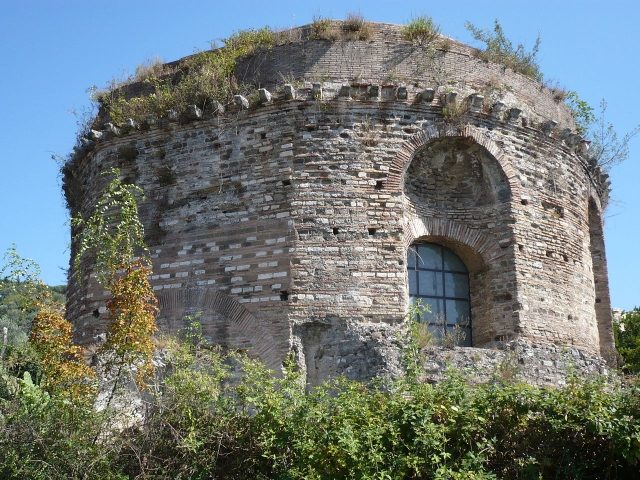
The Temple of Tosse is a former Christian church from the 10th century, founded by reusing a circular-plan building from the Roman era, located on the ancient Via Tiburtina in Tivoli. It is situated near the Aniene, close to the Sanctuary of Hercules Victor and the lower portion of Villa d'Este, outside the gate known as "del Colle". Nearby is also an abandoned paper mill, built on the structures of the Temple of Hercules.
History+
The original function of the building is not precisely known. From the discovery of a tombstone, it seems to have been built in the first half of the 4th century on the ruins of a Roman villa from the 1st century BC, during the principate of Constantine I, to commemorate works carried out on the Via Tiburtina. Several hypotheses have been put forward, including that it was a nymphaeum, an early Christian church, or a temple dedicated to Venus or the Sun, or a tomb of the gens Tuscia, from which the current name "Tosse" would then derive. The hypothesis, which emerged during the medieval period, that it was a temple dedicated to the personification of the goddess Tosse, or to the Madonna della Tosse, erected outside the walls to keep the disease away from the Tiburtine population, is entirely unfounded. Despite the various hypotheses presented, no archaeological finds have been made to confirm any supposition. The building was transformed into a church dedicated to the Virgin Mary in the 10th century and restored with material from the nearby Sanctuary of Hercules. Some frescoes contained in the apses inside, dating back to the early Middle Ages, depict Christ Pantocrator and the Ascension of Christ, who is carried to heaven on an almond by two angels. Christ is beardless and makes a gesture of blessing in Greek form (meeting of thumb and ring finger), indicating influences of early Christian and Byzantine style. There is memory of a third fresco, depicting the Madonna, now lost, which justified the dedication of the church. The remaining frescoes are partly damaged by time and at risk of collapse and vandalism. The building was probably abandoned between the 17th and 18th centuries. Currently, the temple is undergoing restoration work and is incorporated into a private property. For these reasons, it is not possible to visit its interior.
Source: Wikipedia · Licence: CC BY-SA 4.0 · Image: http://commons.wikimedia.org/wiki/File:Tempio_della_Tosse_6.JPG
This description draws on the facts documented in the linked Wikipedia article; Wikipedia content is licensed under CC BY-SA 4.0. Wording and editing: Mobile History.
Location: 41.9629, 12.7898