The church can be visited
MonasteryBirklingen
St. Marien Church
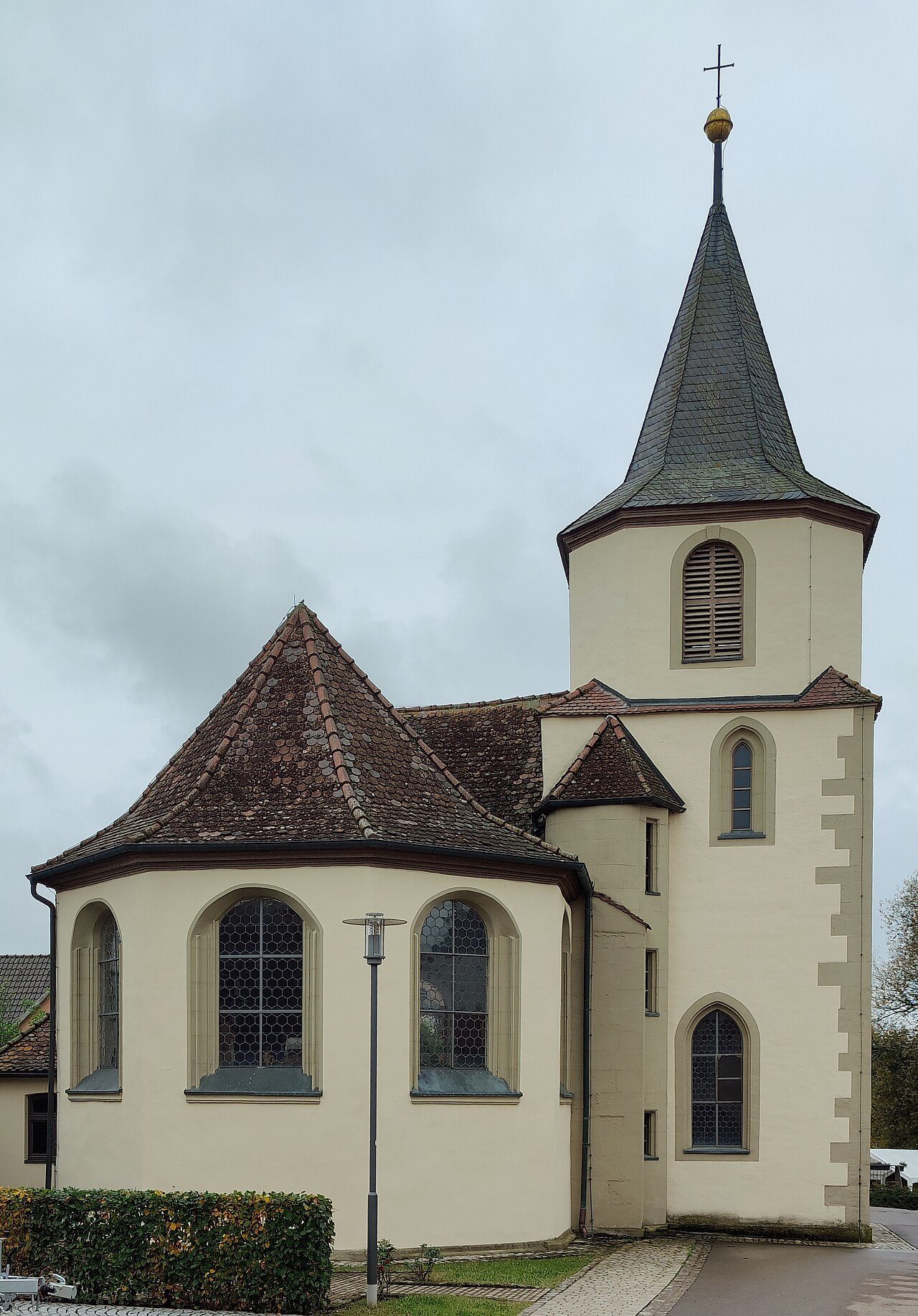
Birklingen Monastery is a former monastery of the Augustinian Canons in the Iphofen district of Birklingen in the Diocese of Bamberg.
History+
Foundation and Refoundation (until 1459)+
The prehistory of the monastery is first mentioned in the work of Abbot Johannes Trithemius. The cleric describes that an image of Mary was found in the forest on the Birklingen district. It was brought to the small chapel in the village and revered as an Acheiropoieton, a divinely created work. The monastery chronicle does not mention this event, but merely assumes a Pietà, a figure of the suffering Mary, which was placed in the chapel from about 1455 and soon performed miracles. The stream of pilgrims increased, and already in 1457, the Bishop of Würzburg, Johann III von Grumbach, granted an indulgence for visiting the chapel. The income was to be used for the expansion of the church. In the same year, Bishop Isidor of Sabina also promoted the pilgrimage with an indulgence. Already a year later, on May 24, 1458, the foundation stone for the new church could be laid with the benediction by Auxiliary Bishop Johannes Hutter. Bishop Johann von Grumbach planned to establish a monastery in the burgeoning pilgrimage site of Birklingen. For this purpose, he called some Augustinian Canons from the monasteries of Triefenstein near Marktheidenfeld and Heidenfeld near Schweinfurt. Balthasar Monachi, who was appointed as the first rector of the new foundation by Bishop Johann and his councillors on February 22, 1459, also came from the latter. The monastery chronicle, probably written by Balthasar, names the bull of Pope Pius II of April 16, 1459, as the actual founding date. However, the monastery soon reached its limits, because the small convent, which was equipped with only a few goods on the edge of the Steigerwald, lacked new recruits. No one from the surrounding canonries wanted to make their profession in Birklingen anymore. In 1461, Bishop Johann turned to the reformed canons of the Windesheim Congregation. Thereupon, the reformed monastery of Kirschgarten zu Worms sent three priests and a deacon to Franconia on April 16, 1459.
Establishment of the Canons (until 1463)+
Balthasar Monachi was deposed and the Franconian monks left Birklingen again. Monachi, however, remained and joined the Windesheim Congregation. However, another person became the new rector, whose name is not mentioned in the sources. The small monastery remained under the Prior of Kirschgarten; thus, Berthold Scharn von Kirschgarten separated Birklingen Monastery from the Iphofen Martinspfarrei in March 1462, as the Chapel of St. Mary was still considered its filial church. Meanwhile, the so-called Bavarian War between Margrave Albrecht Achilles and the Bavarian Duke Ludwig IX had also reached the Prince-Bishopric of Würzburg, where Birklingen was located. Although the Margrave had issued a letter of protection to the small convent, this did not prevent the Margravial Vogt Jörg von Gebsattel from Uffenheim from attacking and setting fire to the monastery on April 25, 1462. The monks fled to nearby Iphofen, while the most important monastery buildings were fortunately spared from the flames. It was not until August 1462 that the monks could return to the monastery and quickly began to repair the devastated complex. On September 29, 1462, the first, unnamed rector of the reformed canons died. The cleric Johann von Offenburg was appointed as his successor. During his tenure, the monastery acquired goods for the first time and consolidated its possessions and influence in the region. On April 24, 1463, the monastery received high visitors: The Priors Berthold von Kirschgarten, Heinrich von Höningen, and Johannes von Rebdorf confirmed the convent's independence within the Windesheim Congregation. From then on, the canons could elect their own prior. They confirmed Johannes von Offenburg, the old rector, in office. On July 7, 1463, he laid the foundation stone for a new dormitory on the monastery grounds, but resigned from office in September of the same year. The monks appointed Johannes von Sonsbeck from the mother monastery of Kirschgarten as his successor. The experienced theologian continued to promote construction in Birklingen and was able to announce the consecration of the choir of the monastery church on September 18, 1463. On December 24, 1463, the first service was celebrated in the new church building. The consolidation of the monastery also led to a rapid increase in pilgrimages, which brought pilgrims from all over Europe to the small village.
Heyday of Pilgrimage (until 1524)+
After the recall of Johannes von Sonsbeck to his home monastery, he became Prior in Kirschgarten in 1473, Petrus Megen from Ochsenfurt took over the monastery leadership. Megen soon resigned, on July 2, 1474, making way for Prior Meffried. Under his aegis, the monastery bought the village of Birklingen from the Iphofen hospital and acquired the parish of St. Martin in Iphofen on April 20, 1476. In 1480, Meffried began expanding the dormitory and in 1481 received the benefice of the Holy Sepulchre in Iphofen for his convent. The following years can be described as a brief heyday of the monastery's foundation. New altars were consecrated, which in turn attracted more pilgrims to Birklingen. In 1482, the expanded dormitory was completed, and a refectory was also established. The Counts of Castell also began to use the monastery church as a burial place for their family during this time. In 1479, the body of Wilhelm II was brought into the church. In 1500, the cloister of the monastery was completed, and in 1506, the roof vault was finished. Previously, in 1501, a second pilgrimage had been founded on the Birklingen district, which aimed at a Vesperbild on the Birklinger Steige. However, the Bishop of Würzburg, Lorenz von Bibra, soon dissolved this competition. The growing importance of Birklingen was also evident from Meffried's appointment as Visitator of Schamhaupten Monastery. He died on May 2, 1510. His successor Ditterich could not build the same influence as his predecessor and limited himself to maintaining the monastery's assets. From 1512, an altar of the holy martyrs is documented, which had found its place in the church. The Marienkirche now had several winged altars of the so-called Nuremberg School of Painting and was also known regionally for its many relics. Around 1520, the so-called Birklinger Hof was built in Dettelbach. The monks had previously been able to acquire some rights in the city.
Destruction and Dissolution (until 1546)+
The decline of the monastery began under Prior Michael Wisandt. On February 14, 1524, citizens of the city of Iphofen plundered the monastery's wine cellar in the city. A year later, in April 1525, the convent was again threatened: The German Peasants' War had broken out, and a Marktbibart banner demanded that the canons hand over the grain supplies of the rural population. On April 18, 1525, the monastery courtyard in Iphofen was occupied. The anger against the monks erupted on May 3, 1525, when Iphofen citizens burned down the monastery buildings with the Marienkirche. Previously, the rich furnishings of the church had been distributed among the rebels. Although the uprising could be ended in June 1525, the monastery was so destroyed that the monks, who had meanwhile found refuge in Iphofen, considered dissolving the monastery. On January 9, 1526, Prior Michael handed over all the goods of Birklingen to Bishop Konrad II von Thüngen and received a pension of 583 guilders annually for himself and his convent. A bull from Pope Clement VII dissolved the contract between the monastery and the bishop and demanded the establishment of a visitation for all Franconian monasteries. This began in 1527 and initially restored self-administration to the canons. Prior Michael was deposed by the visitors due to his advanced age, and Hieronymus Roeß was appointed as his successor. Roeß had to report annually to the Bishop of Würzburg. The visitors planned to resume pilgrimage services and therefore appealed to the escaped monks to return to the monastery. Soon, the monastic habit and enclosure were reintroduced. Despite this modest new beginning, Bishop Konrad confiscated the monastery's assets in 1542 and dissolved the household on February 22, 1546. This ended the history of Birklingen Abbey. Reasons for the failure of the new beginning were the extensive destruction of the monastery, the lack of personnel for reconstruction, and the thorough estrangement that the Peasants' War had caused between the monks and their peasant subjects.
Rectors and Priors+
Initially, Balthasar Monachi, a rector from the Augustinian Canonries of Heidenfeld, took over the newly founded monastery. From 1461, canons from Kirschgarten near Worms took over the leadership of the new establishment. It was not until 1463 that the monastery received the right to elect its own prior as head of the monastery. In total, Birklingen Monastery was led by seven priors during its short existence.
Burial Place of the Castell Princely Family+
In the 15th century, the church temporarily served as the burial place for the princely family of Castell. However, only six members of the family probably found their final resting place there. After the destruction of the monastery in 1525, Count Wolfgang I of Castell had the remains of his ancestors transferred to the Johanneskirche in Castell or to the monastery church in Ebrach (see also Burial Place of the Castell Princely Family in Castell, Burial Place of the Castell Princely Family in Rüdenhausen and Burial Place of the Castell Princely Family in Vogelsburg Monastery).
Take Mobile History with you
You are reading this text for free. Premium adds what matters on the road: descriptions read aloud, sites found through your camera, whole regions taken offline.
- Every description, including the ~17,700 Premium sites
- Audio guide: have descriptions read to you on location
- AR finder: see sites through your camera, with distance and bearing
- Unlimited saved sites
14 days free, then from €2.99 a month. Cancel anytime.
Source: Wikipedia · Licence: CC BY-SA 4.0 · Image: Subbass1 / CC BY-SA 4.0 via Wikimedia Commons
This description draws on the facts documented in the linked Wikipedia article; Wikipedia content is licensed under CC BY-SA 4.0. Wording and editing: Mobile History.
Location: 49.7104, 10.3450