The Abbey can be visited
MonasteryNeustadt am Main
Neustadt am Main Abbey
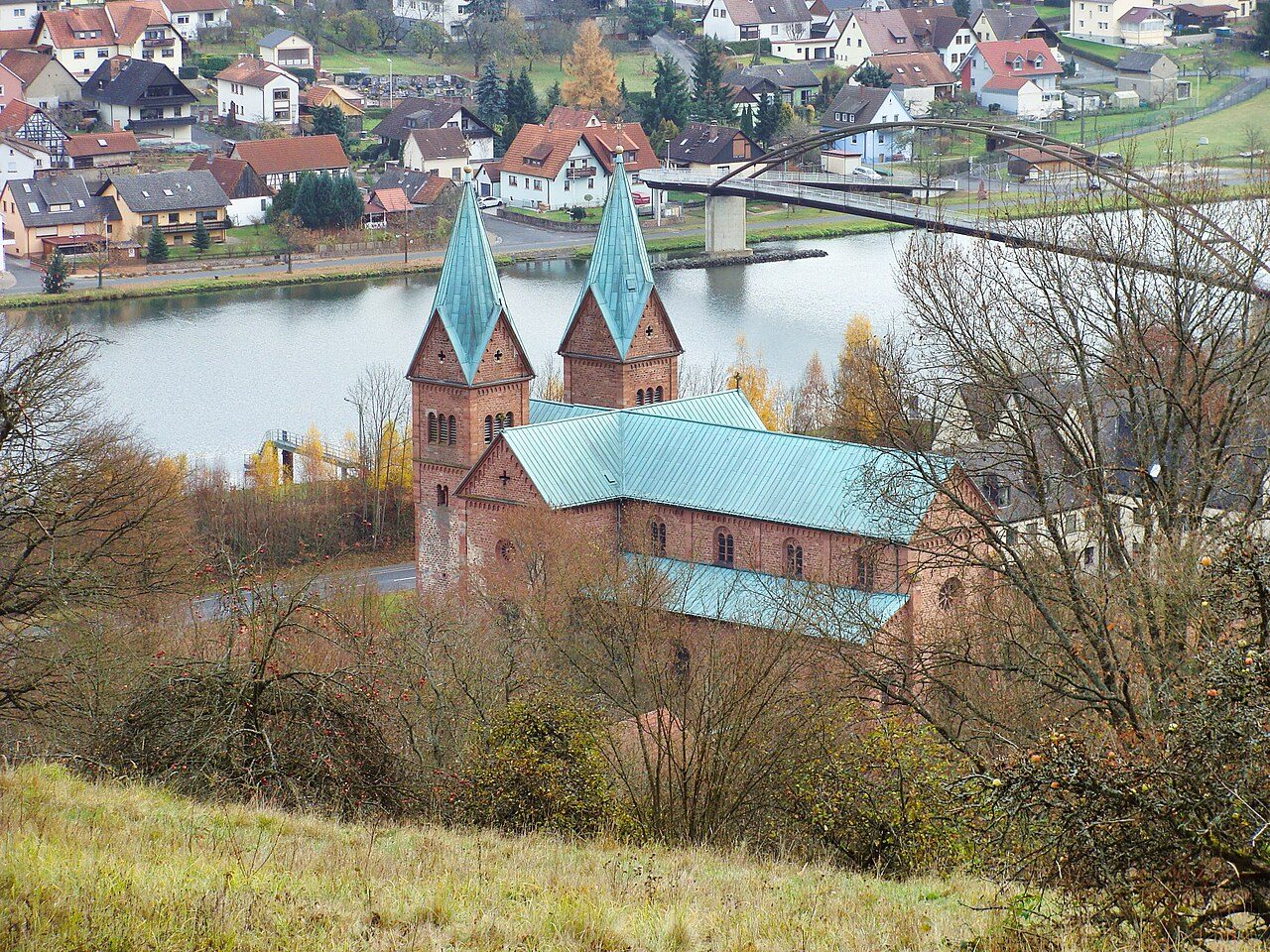
In Neustadt am Main, from the 8th century until the secularization in Bavaria, there was an abbey of the Benedictine Order, the Benedictine Abbey of Neustadt am Main, which successively had four different locations.
History+
Burkard and his companions stayed from 738 until the end of 741 / beginning of 742 in the Carolingian hunting and pleasure palace on the Michaelsberg, the Michilstat. He received the hunting and pleasure palace from Charles Martel, mentioned in the document DO III 354. Whether there was a first monastery in the true sense is not certain, as no traces that could originate from a monastic convent have been discovered during previous archaeological investigations on the Michaelsberg. However, during excavations carried out by the Bavarian State Office for Monument Preservation in 1974, the foundations of a hall church with a constricted apse, in South Anglo-Saxon style, were unearthed: The monastery church of Michilstat. The term apse comes from Greek and means "arch" or "vault". Neustadt was then called Rorinlacha, which according to Joseph Schnetz means "swamp overgrown with reeds". The swamp was in the valley, not on the Michaelsberg. Due to the topography, the convent building at Michilstat could only have been north of the hall church; south of Michilstat there was and is a steep ditch, but no excavation has been carried out north of the present cemetery church so far. From 738/739, the reed-overgrown swamp (Rorinlacha) in the valley was drained. Megingaud, the later second Bishop of Würzburg, had a first monastery consecrated around 741 in the Main valley near the mouth of the Silberlochbach. Why a Benedictine monastery was founded precisely here, in a very deserted place, in the early 8th century, is not clear. The convent of the monastery at the "Alte Statt", like at Michilstat on the mountain, was north of the hall church with a constricted apse. The monastery at the "Alte Statt" was excavated in 1981/82 and is now located under the rectory. He had, of course, previously received the land in the valley from Hatto, a related Matton. After he resigned his office as bishop in early 769 in favor of Berowelf and returned to Rorinlacha, he rebuilt the hall church of the "Alte Statt" after 772 with the transept church of the Neue Statt. The convent of the missionary monastery at the Neue Statt was now south of the associated church. The new monastery was initiated by King Charles I and consecrated in 781. More than 50 noble Benedictine brothers, who had previously remained in Würzburg, were forced by Berowelf to move into the monastery. Megingaud requested the protection of the monastery from Charlemagne, and the king promoted the monastery, for example, by granting it a large area in the Spessart with a core area of about 18 × 10 km. The king's protection was intended to secure Neustadt's independence, but the Bishop of Würzburg repeatedly tried to influence the monastery. He succeeded in 993 through a forged document, and Neustadt thus became a proprietary monastery of Würzburg. In the 12th century, the Bishop of Würzburg allowed the monastery's Vogt Markwart II von Grumbach to build Rothenfels Castle on monastery land, which then dominated not only the Main valley but also the monastery. The harassment continued, so that in 1282 Neustadt felt compelled to ask King Rudolf of Habsburg for help. A forged founding privilege of Charlemagne dated to 794 was indeed recognized by Bishop Berthold of Würzburg in 1279, confirmed by Emperor Charles IV in 1366, and not doubted thereafter until the 16th century, yet it changed nothing in the situation. However, Heinrich Wagner dated the document to the beginning of the 11th century in 2000. The date 794 in document DKar I 252 is indeed forged, but the content is only partially forged. The course of the Neustadt monastery mark from 772 is, among other things, genuine in the document. Neustadt also tried to prove the foundation of the monastery by Gertrud, an alleged sister of Emperor Charlemagne, through a forged document. This approach did not lead to success, but it resulted in a centuries-long veneration of Gertrud. Annually, pilgrims from Würzburg embarked on the "Gertraudreise" on Whit Monday, the supplicatory pilgrimage to Neustadt Abbey. In the 11th century, the monastery was under the influence of the Gorze monastic reform; at the beginning of the 12th century, the monastery adopted the Hirsau reform. These spiritual reform efforts repeatedly prompted the Bishop of Würzburg to intervene.
On August 3, 1095, a Gerhard, who was probably the Burgrave of Mainz, privately, together with his wife Bertha, for the salvation of both their souls and that of his brother Gebeno, as well as his parents Radebodo and Dude/Jutta, and for Faliger, Bernold, Erembert, and Gerold, donated to the Neustadt monastery, for the consecration of the Romanesque basilica at the altar of the Mother of God Mary, Gerhard's property and rights in the villages of Bütthard and Dachesi (deserted south of Bütthard) in the Ochsenfurter Gau. Among the witnesses are: Abbot Adelgero of Neustadt, Advocatus Marquard (Vogt of Neustadt Monastery), Diemar of Röttingen, Ebo of Mergentheim, his son Goswin of Mergentheim, and Engelhard comes de Lubenhusen. Gerhard, officially as comes Gerhardus de Moguncia (without his family), Ebo of Mergentheim, his son Goswin of Mergentheim, and Engelhard comes de Lubenhusen, are also mentioned as witnesses on January 18, 1103, in the donation from Diemar v. Röttingen to Hirsau Monastery. All these five persons are also mentioned in the document of 1095 for Neustadt a. Main Monastery. After the Vogt family Grumbach remained without male descendants in 1243, but the only daughter married into the Rieneck family, in 1317 Count Ludwig von Rieneck († 1333) received the Vogtship over the monastery from Bishop Gottfried III von Hohenlohe and became partial Vogt over its possessions. Depending on the interests and power relations of the emperor and bishop, Neustadt sometimes managed to detach itself from Würzburg, or the monastery had to submit to the bishop again. During the Thirty Years' War, Neustadt was plundered three times and temporarily came under Swedish rule. Only during the time of Abbot Benedikt Lurz, who presided over the monastery from 1764 to 1788, was it possible to clarify the centuries-old disputes with Würzburg. The lawsuit finally ended on November 21, 1794, with a settlement. In the course of secularization, the monastery was dissolved in 1803 and, with its extensive library, came into the possession of the Catholic Prince Dominik Konstantin zu Löwenstein-Wertheim-Rosenberg. About 1400 volumes of the Neustadt monastery library are now in Maria Laach Abbey. On November 4, 1985, auction of 796 lots at Sotheby's in Munich from the secularization holdings of the monastery libraries of Bronnbach and Neustadt am Main.
Influence of the Abbots and the Monastery+
Neustadt Monastery and Amorbach and the Saxon Mission+
In the early medieval church province of Franconia, the Abbot of Neustadt was considered the second most important man after the Bishop of Würzburg. Neustadt was closely connected with Amorbach Monastery from 810 to 829; only three abbots led both monasteries. The abbots of Amorbach and Neustadt were sent as bishops to Saxony, which had only been subdued in 804 and forcibly Christianized. Among others, between 810 and 829, three Neustadt abbots were the first bishops in Verden an der Aller.
Possessions+
The most important possession was the Neustadt monastery mark. According to Heinrich Wagner, it dates from 772. The Benedictine monastery of Neustadt had many possessions. In 1264, the monastery founded a provostry in Einsiedel on its own property. Since about 1200, the monastery claimed the tithe from the parish of Steinfeld; in 1336, the parishes of Steinfeld and Karbach, as well as the provostry of Retzbach, were incorporated into the monastery, so that Neustadt received all income, but had to pay the parish priests and maintain the churches and rectories. The monastery also owned, among other things, Hausen, Kützberg, Kronungen, Roden in Lower Franconia with the localities of Ansbach and Roden, and, at the time of secularization, over 4000 ha of forest in today's Princely Löwenstein Park, including the localities of Lindenfurterhof and Einsiedel. The monastery also held the patronage over the parish church of Mariä Himmelfahrt in Altenmünster.
Inhabitants of Neustadt+
For centuries, the inhabitants of Neustadt lived with and from the monastery, because on the one hand the place was on monastic land, and on the other hand there were hardly any other employment opportunities than working for the monastery. The time when the place originated is not known. In the late Middle Ages, however, a certain sovereignty developed as the village began to understand itself as an independent force. Many documents from the period between 1000 and 1500 have been preserved, in which the village association, a precursor of today's municipality, appears as a contracting party. These so-called "Weistümer" stipulated how the monastery had to consider the needs and wishes of the community. With the secularization, little changed for the inhabitants of the village, except that now the respective Prince Löwenstein-Wertheim-Rosenberg held the rule. The men mostly worked as day laborers or forest workers for the princely house.
Monks in the Monastery+
The number of monks in the monastery fluctuated greatly over the centuries. While there were over 50 monks at the end of the 8th century, in 1348 a document limited the number to 12 priests, 2 deacons, 2 subdeacons, and 4 students, as economic conditions did not allow for a larger number. From 1460, monks who did not belong to the nobility were also admitted. Heinrich Schultheiß was the first non-noble abbot. During his tenure, the cloister and the adjacent chapels were consecrated in 1464. In 1525, the peasants from the Amt Rothenfels attacked the monastery and plundered it. The monks fled to Rothenfels. Only in 1534 could the church be consecrated again. In 1554, Abbot Johann Fries professed Lutheranism and was therefore deposed. The subsequent election of a new abbot, required in August 1555, could not be carried out because there were only two conventuals. Slowly the monastery recovered. In 1559 there were 4 monks; thereafter the monastery recovered again. From 1650 until secularization, the number of monks decreased to 12 to 15 fathers. On January 22, 1803, the abbot, 18 monks, and two novices had to leave the monastery.
Monastery School+
Already three years after the founding of the monastery, Charlemagne ordered that a school for boys – "not merely children of servile origin, but also sons of freemen" – be established. Noble families whose sons wished to dedicate themselves to monastic life usually handed over parts of their property to the monastery. However, it was not a condition for admission to the monastery school that the students decided on a subsequent life as priests. A document from 1095 proves that the monks actually maintained a monastery school. In the hierarchy of the monastery, the schoolmaster held the third position. Usually between 7 and 10 boys lived in the monastery and were taught there. For the numerous musical performances in the monastery, at least 4 choirboys were required to sing soprano and alto.
Heraldry+
Various coats of arms in the Main-Spessart district still show the influence of the Benedictine Abbey of Neustadt (Neustadt am Main Monastery) with their heraldic figures. The symbol in the shield is a black uncial capital letter N surmounted by a small black cross.
Buildings+
First Monastery on the Michaelsberg+
Boniface went with Burkard to Rorinlacha in 738 to drain the former sacred Celtic lake. Burkard received the complex on the mountain in Rorinlacha as a gift from Charles Martel. There, Boniface and Burkard immediately built the first monastic cell in Rorinlacha. The monastery church, a hall church with an apse, was excavated by the BLfD in 1974. The hall church with an apse was of South Anglo-Saxon construction. The monastery church on the mountain had an orientation of 13.5°. The first monastery church in the valley, the "Alte Statt", also had 13.5°. Thus, both hall churches with apses had the patron saints: Martin, Mary, Peter and Paul. The monastery dimensions of the monastery at Michilstat, on the mountain, and the "Alte Statt", in the valley, were approximately the same: approx. 20 m in north-south direction and 18 m in west-east direction.
First Monastery in the Valley+
The monastery church in the valley was a copy of the monastery church on the mountain. The convent of the monastery in the valley was also north of the monastery church, just like on the mountain. Although there was space for a southern convent in the valley. The first monastery in the valley, the "Alte Statt" from before 742, was located under the present rectory or parish hall. A small, single-nave hall church with an apse, 46 m² inside. The first monastery church in Fulda, built by Boniface, also had this South Anglo-Saxon construction. The walls, which are located under the present rectory and parish hall, originate from this church and the associated convent. The dimensions of the monastery were approx. 20 m from north-south and 18 m from west-east. The church had an orientation of 13.5°. The patron saints were Martin, Mary, and Peter & Paul. However, before the monastery in the valley was built, the reed-overgrown swamp (Rorinlacha) in the valley first had to be drained. Megingaud received the land around 738 from Hatto, a related Matton.
Second Monastery in the Valley+
The church of the second monastery in the valley was a significantly larger three-nave Carolingian transept church. The complete associated convent has not yet been found. However, research suspects the remains of the convent, of the church building erected after 772, rather at the site of the Romanesque basilica. The church was rebuilt by Abbot Dietho (term of office 908–932). The cruciform church, a Carolingian transept church, had a basilical nave with a polygonal choir. The cloister was located on the south side of the nave. Monastery buildings adjoined the south side of the choir. Entrances to the church were on the south side of the transept and in the western bay of the northern side aisle, but not on the west side. The dimensions of the church were approx. 18 m from north-south, and 24 m from west-east, with a 17 m high tower. The church had an orientation of 10.5°. The patron saints were Martin, Dionysius, Salvator and Holy Cross. The Marian patronage was located at the separate Marian chapel.
Third Monastery in the Valley+
The Romanesque monastery complex dates from around 1100. Existing buildings and remains of buildings partly date from the 12th century, but predominantly represent the state of construction after the fire of 1857. During the time of Prince-Bishop Julius Echter von Mespelbrunn (1545 – 1617), the church and towers were then raised by about 3 m, the choir between the two towers was rebuilt in an enlarged form, new windows were installed, new vaults were built in the crossing and transepts inside, and the monastery was also completely rebuilt. For the construction costs that Bishop Echter imposed on the monastery, the monastery took out a loan of 17,000 fl, and in the subsequent period, goods had to be sold several times to pay for the maintenance of the church, the monastery buildings, the monastery farms, and other building burdens. The wall around the southern part of the complex was built in 1719 under Abbot Bernhard Krieg. He also succeeded in paying off the debts and was even able to improve the church's furnishings and purchase agricultural businesses.
Secularization+
After the secularization, Prince Karl von Löwenstein had the monastery church converted into a parish church in 1836. He also had the Carolingian transept church of the Neue Statt from 781 demolished before 743, only half of the transept tower remained. The convent building is on the south side of the church; in the west and southwest are agricultural buildings from the 17th and 18th centuries, further south is the garden with the abbot's summer house from 1734. After the secularization, the monastery buildings were converted into apartments for officials and employees of the princely administration. In 1857, the monastery buildings and church largely burned down. The farm buildings survived the fire and continued to serve the princely agricultural enterprise. The church was rebuilt in Romanesque style or restored using old building parts until 1879. Remains of the convent buildings were completely demolished in July 1960, without an excavation by the BLfD, and are now located under Pfalzbrunnenstraße in the Neustadt settlement. Preserved from the convent building are the chapter house in the east wing, which now serves as the so-called "weekday church", a portal, and otherwise only spolia. The parish church of St. Michael and St. Gertraudis, as the former monastery church of St. Maria and St. Martin, is a protected monument, as are the former chapel of St. Peter and Paul with the arcaded walkway, the former administrative building of the monastery (Klosterhof 5), the former summer house of the abbot (Klosterhof 7), and the monastery wall including the gate entrance and gate.
Archaeological Investigations+
First archaeological investigations began at the beginning of the 20th century, after the Bavarian Office for Monument Preservation was founded in 1908. In 1946/47, the art historian Walter Boeckelmann carried out building history investigations in the vicinity of the transept church at the Neue Statt. Thereafter, no systematic excavations took place, but rather these were mostly reactions to impending construction measures. Examples include excavations in 1969 and 1991 at the entrance of the church, and in 1981/82 at the site of the first monastery in the valley, directly under the rectory.
Take Mobile History with you
You are reading this text for free. Premium adds what matters on the road: descriptions read aloud, sites found through your camera, whole regions taken offline.
- Every description, including the ~17,700 Premium sites
- Audio guide: have descriptions read to you on location
- AR finder: see sites through your camera, with distance and bearing
- Unlimited saved sites
14 days free, then from €2.99 a month. Cancel anytime.
Source: Wikipedia · Licence: CC BY-SA 4.0 · Image: Steffen 962 / CC0 via Wikimedia Commons
This description is a machine translation of an excerpt from the linked Wikipedia article. The source text was written by its authors, the translation is by Mobile History; like the original it is licensed under CC BY-SA 4.0.
Location: 49.9301, 9.5703