Hotel
CastleRyn (Rhein)
Ryn Castle
More pictures
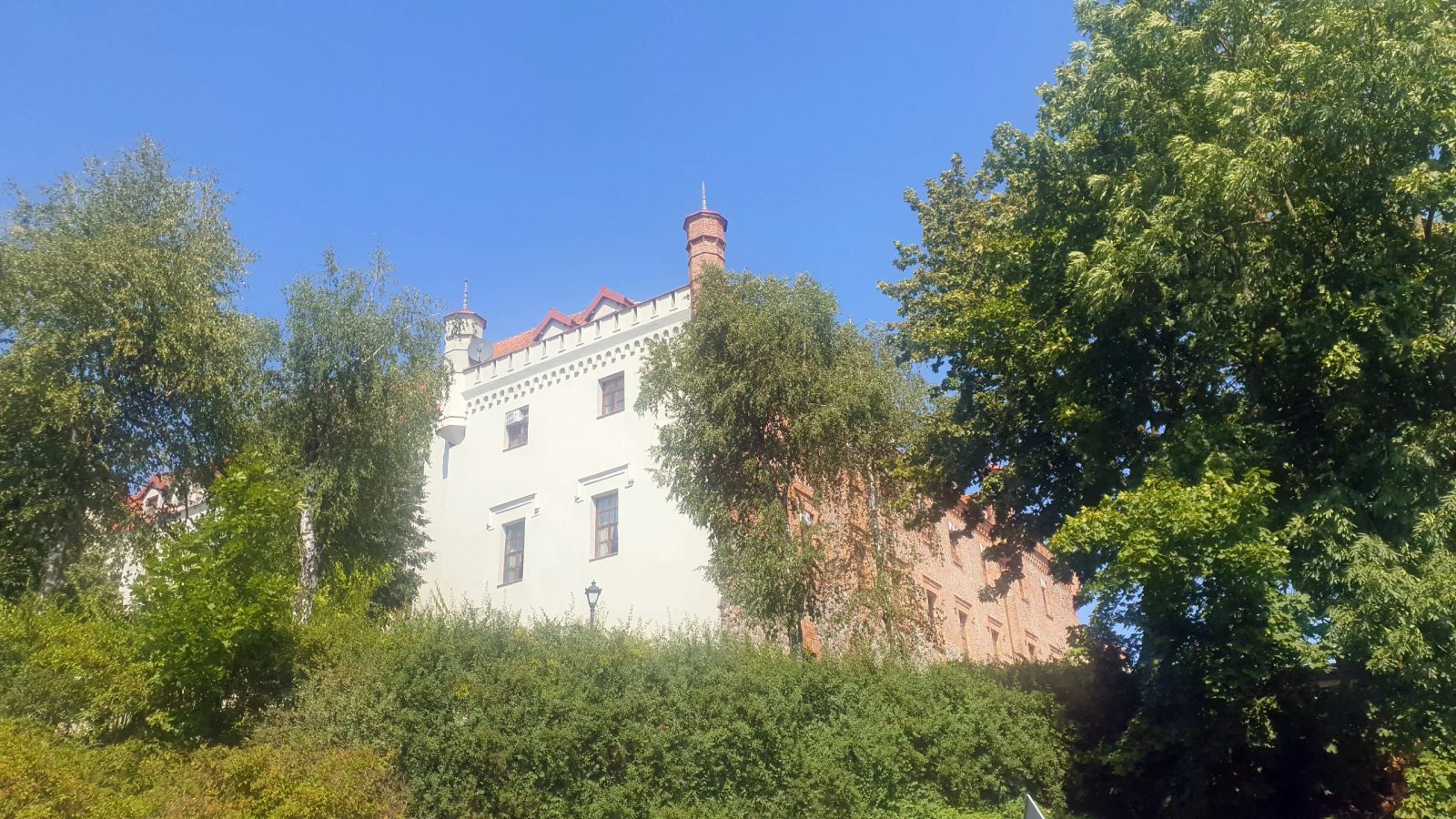
Rhein Castle is a Teutonic Order castle in Ryn, Warmian-Masurian Voivodeship (Poland). It was alternately the seat of a commander of the Teutonic Order Commandry Rhein or a bailiff of the Teutonic Order Commandry Balga. After the secularization of the Monastic State in 1525, the castle became the seat of the Rhein office.
History+
In 1377, the Grand Master of the Teutonic Order, Winrich von Kniprode, had a castle built on a hill at a narrow point between the two lakes Ollofsee and Rheinersee. The castle zur Ryne (1339 Renus from Baltic renis – water channel) was built on the site of an earlier Prussian rampart. The region originally belonged to the tribal region of the Galindians, and after their subjugation by the Order, to the Teutonic Order Commandry Balga. Presumably, a settlement also emerged together with the Order castle, but it is only mentioned in documents in 1405. However, no traces of a Prussian castle or settlement were discovered during excavations in the castle area. In contrast, foundations of a small, brick-built, German predecessor castle were found, which was positioned diagonally to the current building. According to Herrmann, Rhein Castle was originally conceived as a rectangular castellan castle with side lengths of 52 × 44.5 m. It has a high fieldstone foundation, reaching approximately 1.3 meters above ground level, whose gaps are filled with mortar, brick rubble, and smaller stones. The walls consist of bricks measuring 29 × 14 × 8–9 cm. Relative to the north, the castle stands diagonally. Jackiewicz-Garniec and Garniec, however, suggest the possibility that the castle was originally conceived as a bailiff's castle, and only later was the building plan changed. However, the castle was not completed as a castellan castle during the Order period. The enclosing walls and the southeastern commander's wing (approx. 44.5 × 17 m) were realized. This shows projecting reinforcements at the corners due to several brick layers. The areas in between are decorated with diamond patterns; the diamond pattern is formed by black-fired bricks. The two-part commander's wing was three stories high in the shorter, southeastern part, and four stories high in the longer southern part (today's exposed brick part with the diamond patterns). Two square defensive towers with side lengths of approx. 13 m at the north and west corners of the rectangle were laid in the foundations, but presumably never executed, positioned diagonally to the course of the wall. Originally, there was an outer bailey to the northeast of the castle, which is no longer preserved today but has been proven by excavations. In the 17th century, the northeast wing and a stair tower were finally erected. Brick material was taken from the southwestern and northeastern enclosing walls; the walls were accordingly significantly lowered. In 1657, the castle was besieged by Tatars and suffered fire damage. In 1798, the salt warehouse was finally built on the foundations of the northwest wing. In 1853, the entire complex was converted into a prison. The exterior of the complex received a neo-Gothic style and was plastered overall. The narrow ornamental turrets at the corners date from this period. In 1881, the northwest wing and the western part of the southwest wing burned down to the enclosing walls. They were subsequently rebuilt. In 1945, the town of Ryn used the building. It housed a local history museum, an art gallery, a library, and various offices. In 2001, the castle was sold and converted into a hotel and conference center. Particular emphasis was placed on the preservation and uncovering of old building fabric. For example, the swimming pool was installed in cellar rooms with groin vaults. The castle was the seat of the newly founded Teutonic Order Commandry Rhein from 1393 to 1397, but was then downgraded again to the bailiwick of the Balga commandry. In 1418, Rhein again became a commander's seat, and in 1422, it again sank to the rank of a bailiwick. In 1464, it was temporarily again the seat of a commander, and in 1477, Rhein Castle became a commander's seat for a somewhat longer period and remained so until the secularization of the Monastic State (and conversion into the secular Duchy of Prussia) in 1525. Thereafter, the commandry was converted into a ducal office, the Rhein office. Rhein Castle remained the official seat until 1752.
Take Mobile History with you
You are reading this text for free. Premium adds what matters on the road: descriptions read aloud, sites found through your camera, whole regions taken offline.
- Every description, including the ~17,700 Premium sites
- Audio guide: have descriptions read to you on location
- AR finder: see sites through your camera, with distance and bearing
- Unlimited saved sites
14 days free, then from €2.99 a month. Cancel anytime.
Source: Wikipedia · Licence: CC BY-SA 4.0 · Image: Foto: Jörg Heldt (Community)
This description is a machine translation of an excerpt from the linked Wikipedia article. The source text was written by its authors, the translation is by Mobile History; like the original it is licensed under CC BY-SA 4.0.
Location: 53.9384, 21.5459