The remains of the Castle can be visited
CastlePerštejn
Šumburk Castle
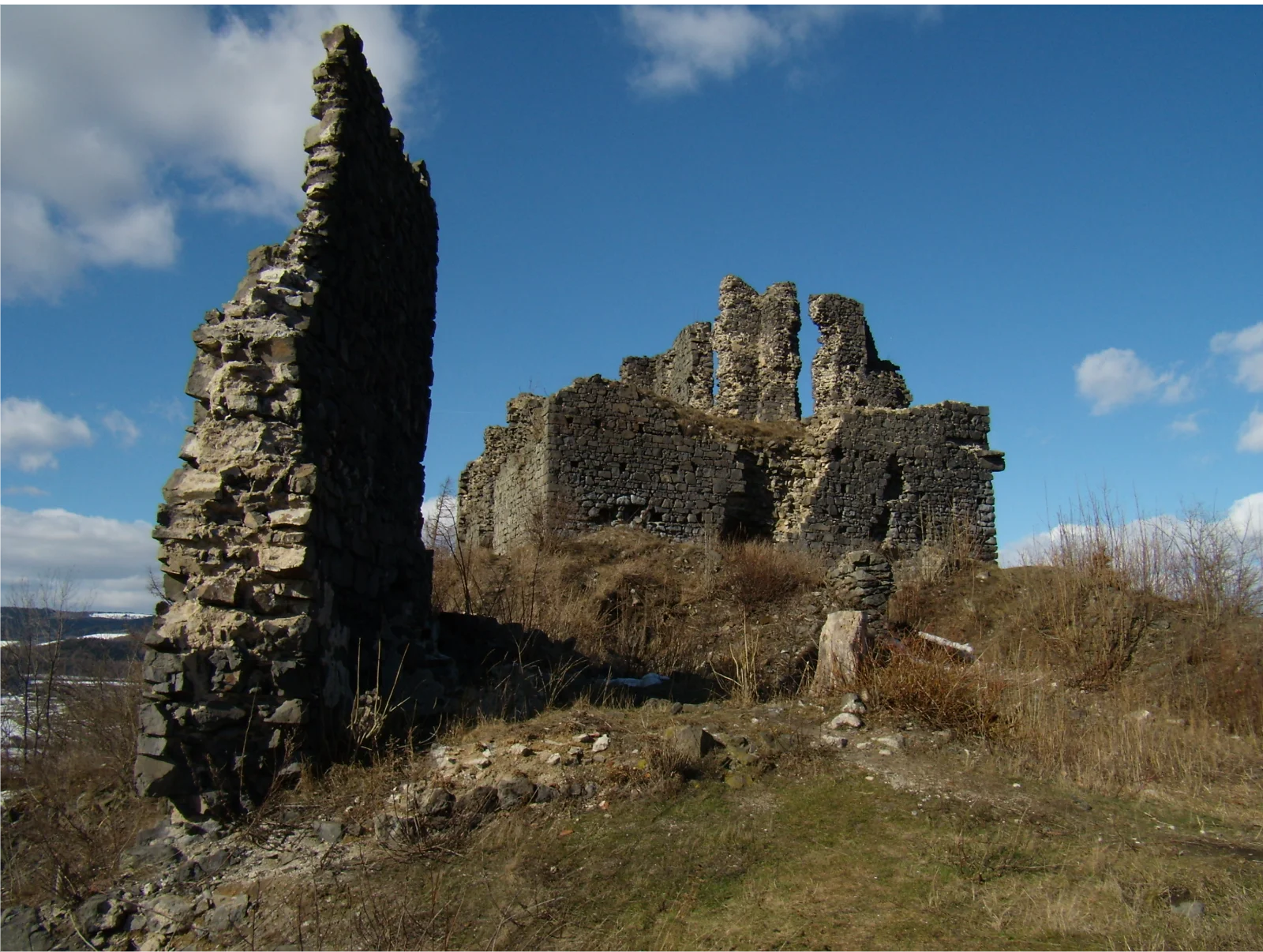
The ruin near Klösterle, usually known today as Šumburk/Schönburg Castle, is actually called Neuschönburg. Since 1950, it has mostly been simplified to Šumná. It is located on the summit of the eponymous conical mountain Šumná in the Egergraben near Perštejn (Pürstein) in the Czech Republic. Even today, larger parts of the outer walls, the palace, and the large residential tower of the stately castle are still preserved. At the ascent to the castle, there is a baroque manor house (ruin).
Forms of Name+
This castle (and the completely vanished older castle "Schönburg") has been referred to by two alternatively used names in various documents, literature, and maps since the Middle Ages:
Schönburg (Czech: Šumburk) or Neuschönburg (Czech: Nový Šumburk). Both names are historically documented. The castle hill is usually called Šumná, which is also said to mean Schönburg. Gerhard Mercator's map of Saxony (Amsterdam 1585) labels the mountain and castle as "Neu Schonberg". The map of Bohemia by G. Mercator and J. Hondius (Amsterdam 1623) labels the mountain/castle as "N. Schuburg". On the "Müller Map" (Johann Christoph Müller) from 1720, the castle and mountain are marked as "Schonberg". Franz Jacob Heinrich Kreibich's map of the Saaz district from 1828 labels the place, mountain, and castle as "Schönburg".
History+
In 1435, Šumburk was first mentioned as Nový Šumburk (Neuschönburg). The castle was probably founded by the Lords of Schönburg, who owned the Pürstein dominion at that time. Presumably, the castle was built in connection with the inheritance division between Alesch (Aleš) and Wilhelm (Vilém) von Schönburg. The latter called himself "zcu Nuenschonenburg" in 1435 and was among the supporters of George of Podiebrad. In 1442, the dominion and Hoyerswerda Castle came into the possession of Wilhelm I von Schönburg zu Neuschönburg. In 1449, he sold Šumburk to Wilhelm d. Ä. von Ileburg due to numerous feuds and property conflicts. The latter kept Schönburg for only a very short time and sold it on to Apel Vitzthum the Elder zu Roßla. Vitzthum had the castle enlarged after he was expelled from the Wettin lands (Electoral Saxony and Duchy of Thuringia) after the end of the Saxon Fratricidal War in 1452 and found a new position in Bohemia in 1453 as a councilor to the king there. There he had acquired the lordships of Klösterle and Neuschönburg. The Vitzthums' expulsion from Saxony had occurred because they had served as advisors on both sides during the Saxon Fratricidal War and had demonstrably misadvised the elector in their own favor. In 1512, the Knights of Vitzthum achieved the conversion of their fiefs into allodial estates by King Vladislaus II. At the beginning of the 16th century, they had the castle considerably expanded again. Extensive additions were made to the residential tower, a new palace, and other farm buildings. Apel IV von Vitzthum operated a counterfeiting workshop at the castle. This was discovered by imperial officials in 1530, and Vitzthum, who was at a wedding in Vlašim at the time, fled to Electoral Saxony. He was punished in 1531 with the loss of his estates and expelled from Bohemia by Ferdinand I. In 1542, the Lords of Schönburg reacquired the castle they had built. At the end of the 16th century, Šumburk burned down and was not rebuilt. At this time, the manor farm below the castle was renovated. In 1623, the Schönburgs ceded the ruinous complex to the owner of Klösterle Castle and dominion, Christoph Simon Freiherr von Thun, who had the manor farm below the castle ruin, acquired at the same time, rebuilt in the Baroque style. In the 17th century, the castle is mentioned as desolate. The manor farm below the castle is mentioned for the first time in 1512, in connection with the release of the castle from its feudal ties. The baroque four-sided manor farm below the castle also fell into ruin after 1946. It is titled "Alt-Schönburg" on a German-language hiking map from 1939. In the vicinity of the manor farm, there was a village called Schönburg (Czech Šumná; also: Šumburk, Dvůr Šumná, Hof Schönburt, Schemrich, Šenburk) until after 1945. Since the Battle of White Mountain and the subsequent expulsion of the Vitzthums, the castle (ruin) and the manor farm belonged to the Thun und Hohenstein family, based at Klösterle Castle, until 1945.
From 1990 to 1991, the Hinterglauchau Castle Museum presented a special exhibition "The Schönburgs, Economy, Politics, Culture". An eponymous brochure was published, created by several experts from various fields. Several museum staff visited the former Schönburg castles in the Czech Republic in preparation for the exhibition. In the chapter "Overview of Schönburg Possessions", the following quote appears on page 15: "The Bohemian possessions of the House of Schönburg were concentrated on a series of castles and lordships in the upper Eger valley, in the closer and wider surroundings of Klösterle (today Klášterec). This included Schönburg, a complex from the early 14th century, which was soon preferred to the somewhat younger, northern Neuschönburg". This apparently means that another - older - Schönburg existed in a different place and that the castle commonly referred to as "Schönburg" today is in fact the younger "Neuschönburg". So, on the mountain Šumná is the "Neuschönburg" and at the foot of this mountain is the ruinous manor farm. According to the description, the original Schönburg must therefore lie south of Mount Sumna with the Neuschönburg. This would also explain the two different names in historical documents. It is remarkable that the amateur historian Viktor Karell, in his 1936 book "Castles and Palaces of the Ore Mountains and Eger Valley", in the article "Neu-Schönburg" (pp. 35–40), discusses the Neuschönburg with the manor farm, but does not mention a single word that there had been a predecessor castle "Schönburg" in another place. It can probably be assumed that nothing remains of the older "Schönburg" today, meaning this castle is a desolate castle site (Burgstall)/vanished castle. Since the existence of the older Schönburg was probably forgotten by the population, the name Schönburg was ultimately transferred to the Neuschönburg, which still exists today as a large ruin. According to the Chomutov District Museum, there is no literature on the older Schönburg. Matthias Donath briefly mentions the Bohemian castles Schönburg and Neuschönburg (quote): "In the early 14th century, they (the Schönburgs) were able to acquire land in northern Bohemia, where they founded the castles Schönburg and Neuschönburg".
Take Mobile History with you
You are reading this text for free. Premium adds what matters on the road: descriptions read aloud, sites found through your camera, whole regions taken offline.
- Every description, including the ~17,700 Premium sites
- Audio guide: have descriptions read to you on location
- AR finder: see sites through your camera, with distance and bearing
- Unlimited saved sites
14 days free, then from €2.99 a month. Cancel anytime.
Source: Wikipedia · Licence: CC BY-SA 4.0 · Image: Von Krabat77 - Eigenes Werk, CC BY-SA 3.0, https://commons.wikimedia.org/w/index.php?curid=31215262
This description is a machine translation of an excerpt from the linked Wikipedia article. The source text was written by its authors, the translation is by Mobile History; like the original it is licensed under CC BY-SA 4.0.
Location: 50.3720, 13.1455