The remains of the Castle can be visited
CastleToruń (Thorn)
Dybów Castle
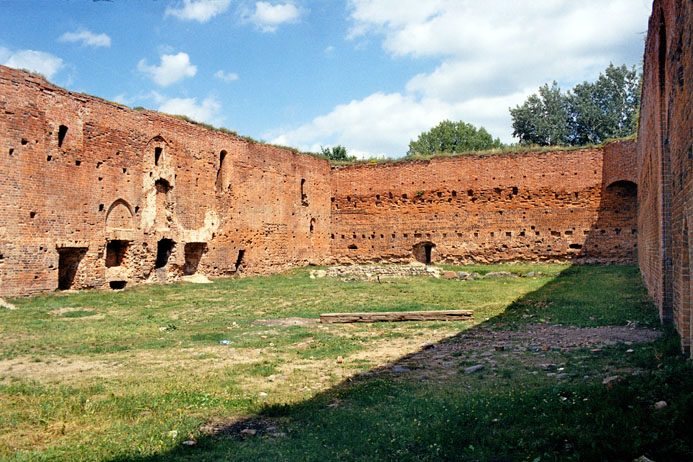
Dybów Castle (Polish: Zamek Dybów, German: Burg Dybow or Ruine Dybow, renamed Ruine Dibau only in World War II) is located in the Polish city of Toruń (Thorn) on the left bank of the Vistula, diagonally opposite the Old Town.
Border Castle+
It was founded in 1423 by the Lithuanian Grand Duke and Polish King Władysław II Jagiełło on the territory of the Duchy of Kuyavia as a border post against Chełmno Land, the southernmost part of the Teutonic Order State. Less than ten years later, however, the Teutonic Order itself came into possession of the castle, from 1431 to 1435. After its recapture, it was further expanded by the Polish side and now had four floors. As the Prussian cities allied themselves with Poland against the Order State from 1456, and the latter had to cede Chełmno Land, Pomerelia and central parts of Prussia to the Polish Crown in the Second Peace of Thorn in 1466, Dybów Castle lost its border location and thus its importance. Still during the Thirteen Years' War, the market settlement of Nieszawa, which had developed near the castle, was demolished in 1460 under pressure from the citizens of Thorn and resettled 30 km away as Nowa Nieszawa. In 1512, the castle came into the possession of the city of Thorn as collateral.
Invaders and Besiegers+
During the "Swedish Deluge", the castle was burned down by Swedish troops in 1656. Nevertheless, in 1703 it was again used as a guard post by Swedish troops when they besieged the city. In the 18th century, the castle came into the possession of the Dębski family. During the French retreat in 1813, a French garrison of 40 soldiers withstood a three-month siege by the Russian army until they capitulated together with the French and Saxons in the city.
Present and Surroundings+
In 1848, the castle was again razed and has been a ruin ever since. As such, however, it was restored in the years 1998–2000. Since the late 18th century, the Bydgoszcz suburb, today Bydgoskie Przedmieście, developed near the castle, where in 1862 the city's first railway station was built with the Bydgoszcz (Bydgoszcz)–Warsaw line, from which today's main station Toruń Główny has developed.
Take Mobile History with you
You are reading this text for free. Premium adds what matters on the road: descriptions read aloud, sites found through your camera, whole regions taken offline.
- Every description, including the ~17,700 Premium sites
- Audio guide: have descriptions read to you on location
- AR finder: see sites through your camera, with distance and bearing
- Unlimited saved sites
14 days free, then from €2.99 a month. Cancel anytime.
Source: Wikipedia · Licence: CC BY-SA 4.0 · Image: Pko · Wikimedia Commons · CC BY-SA 3.0
This description is a machine translation of an excerpt from the linked Wikipedia article. The source text was written by its authors, the translation is by Mobile History; like the original it is licensed under CC BY-SA 4.0.
Location: 53.0011, 18.6000