The remains of the Castle can be visited
CastleSchwedt - Vierraden
Vierraden Castle
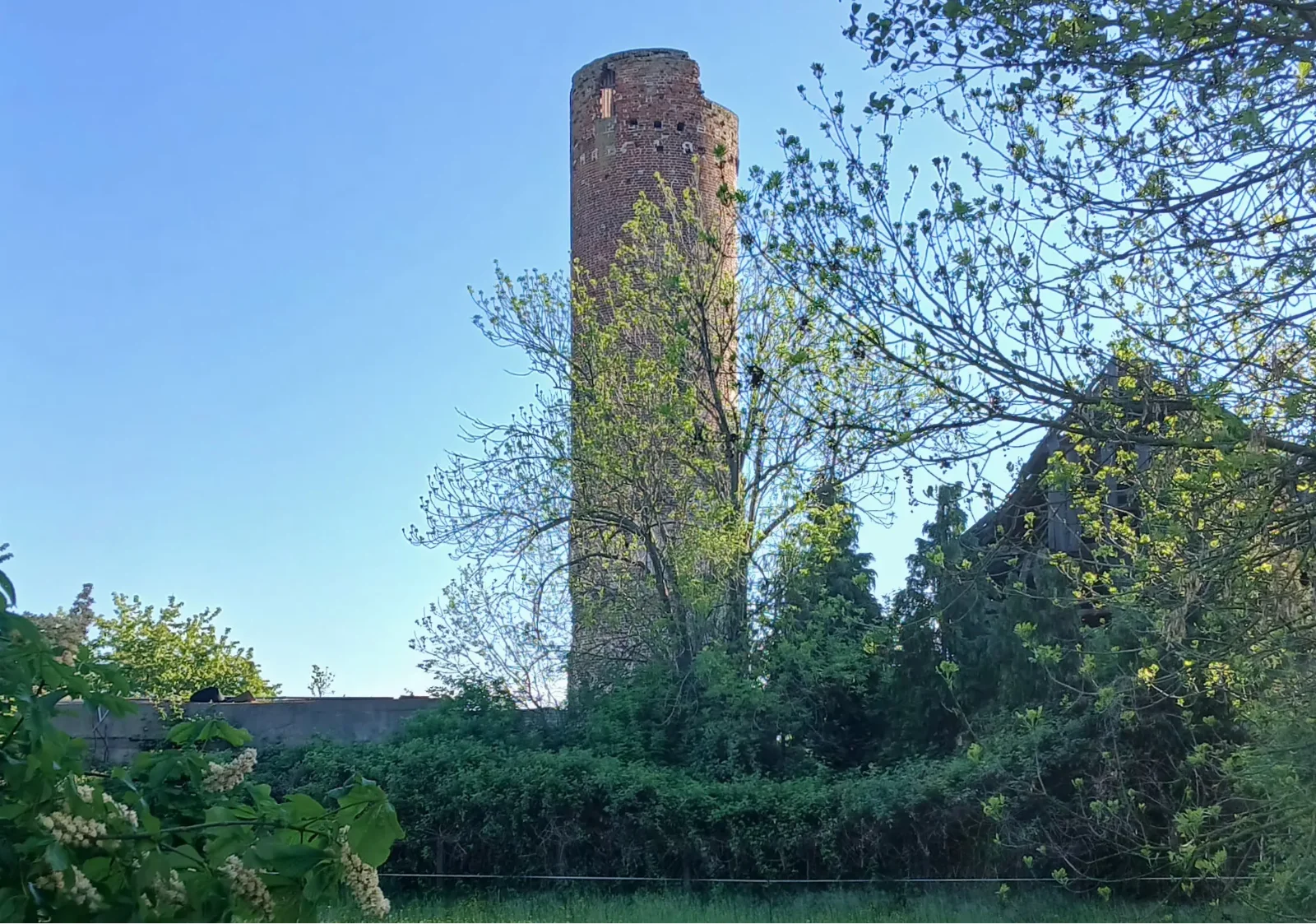
The castle ruin Vierraden is located in the district Vierraden of the city Schwedt/Oder on the lower Welse. Since the Ascanians had conquered the southern Uckermark in 1230 and the Treaty of Landin of 1250 fixed the border, this river formed part of the dividing line between Pomerania and Brandenburg. A battle between Stendell and Vierraden is recorded for the year 1303, but the castle itself is only mentioned in documents in 1321, after Heinrich von Mecklenburg had conquered it the year before. The construction must therefore have taken place between 1303 and 1320. A Pomeranian duke had the complex built as a border fortress at the intersection of the Via Regia with the Welse, thereby also protecting the important mill at this location.
In the following century and a half, ownership frequently changed between Pomerania and Brandenburg. Elector Frederick II, called the Iron, won the castle in 1468 after two attacks and successively appointed Claus von Arnim, Hans von Buch and Kurt von Schlabrendorff as bailiffs. In 1477, the Pomeranian captain Lindstedt from Ueckermünde stormed the castle and took it, until Elector Albrecht recaptured it in 1478. The Treaty of Prenzlau of the same year confirms the Brandenburg conquest and contains the first illustration of the place. Vierraden Castle appears there as a tower in the water, fed by the Welse, surrounded by a ring wall and accompanied by a building that served as kitchen, bakehouse and brewery. In 1473, there were ten cannons, thirteen arquebuses, half and a quarter barrel of powder, and a mortar in the castle; in 1479, the garrison still numbered one hundred men. From 1479 to 1518, the castle was the actual administrative seat of the entire area and thus also for Schwedt. In 1478, Albrecht gave it to Count Johann von Hohenstein I, bailiff of Angermünde, as a hereditary fief, reputedly because he was the first to scale the wall during the storm. Two years later, the Count also acquired Schwedt and united both places into one dominion. In 1518, the Counts moved their residence to Schwedt, because the damp Welse lowlands were unsuitable for expansion into a Renaissance residential castle. Only a count's bailiff and the so-called Rote Vorwerk remained in Vierraden as an agricultural enterprise.
During the Thirty Years' War, the castle and town were severely destroyed. According to tradition, Gustav Adolf of Sweden spent the night in the castle in 1631, when his troops set up a large camp nearby. In 1637, passing Swedes caused particularly great damage to the complex, presumably in revenge for the Elector having turned to the Imperial forces after the king's death. In 1681, the cellars were still usable, and the brewery, granary and gatehouse were still standing. In the same year, the electoral order was issued to use the brick material of the castle for the reconstruction of Schwedt Castle, which had been severely damaged by fire, whereby the complex was almost completely ruined. Securing work is only attested in 1842; a brick with the inscription 1841 in a niche of the uppermost tower section suggests that the work began the year before. The collapsed tower dome was restored. In 1843, the city of Vierraden received permission to break an opening into an existing ground-level niche at its own expense, so that the tower could be climbed with ladders. In 1877, the royal court chamber offered the city the ruin with tower and castle square for sale and linked to it the obligation of maintenance; the city declined due to lack of money. In 1878, the farmer Julius Kummrow acquired the ruin of the castle and the castle square, but not the tower, and used the masonry for a barn for drying tobacco. At the end of the Second World War, the tower served the Wehrmacht as an observation post and therefore became a target for the Red Army. In 1945, the top of the tower was shot off to the southeast, and the two soldiers who had taken up positions died. Their remains could only be recovered in August 1946 and buried in the Vierraden cemetery. From 1994 to 1996, emergency securing work was carried out on the tower.
In addition to the tower, the castle consisted of a square courtyard and a rectangular house. The space enclosed by the wall measured approximately twenty-nine meters by twenty-six meters. The tower is now 27.20 meters high, its wall thickness is about two meters, the outer diameter about six meters. From the foundation, the core is round; the angular brick cladding was only built around it later. The entrance was at a height of sixteen to eighteen meters and led from the battlement of the ring wall into the tower, which emphasizes the defensive character of the complex. The narrowness inside made the tower hardly suitable as a keep. The top was formed by a projecting cornice, on which a slender, dome-shaped closed superstructure once sat. Only remnants of the ring wall and the other buildings are preserved, some of which have been incorporated into newer buildings. The owner of the complex is the city of Schwedt/Oder.
Take Mobile History with you
You are reading this text for free. Premium adds what matters on the road: descriptions read aloud, sites found through your camera, whole regions taken offline.
- Every description, including the ~17,700 Premium sites
- Audio guide: have descriptions read to you on location
- AR finder: see sites through your camera, with distance and bearing
- Unlimited saved sites
14 days free, then from €2.99 a month. Cancel anytime.
Source: schwedt.eu · Image: Foto: Jörg Heldt (Community)
Text and/or image for this object come from the linked site and are used with the permission of its operators; the linked page remains the copyright of its authors. The legacy catalogue kept text source and image source in a single field, so which part came from there can no longer be told apart entry by entry.
Location: 53.0991, 14.2992