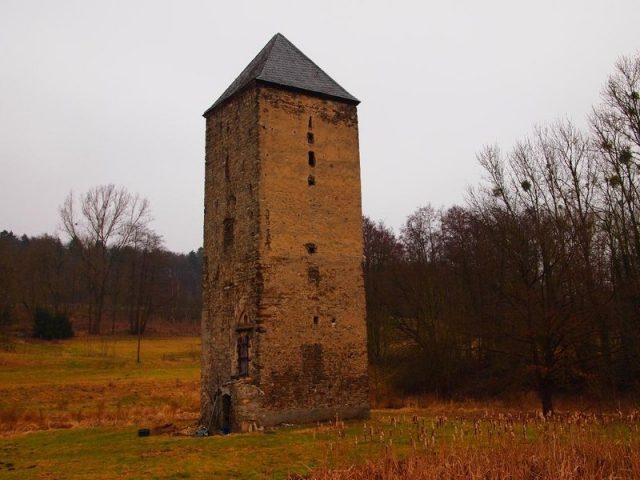
The remains of the Castle can be visited
Mühlenbach Castle

Mühlenbach Castle is a vanished lowland castle in Koblenz. Of the castle, built around 1300 in what is now the Arenberg district and destroyed in the 17th century, only the main tower remains.
Mühlenbach Castle was built around 1300 by Hermann II von Helfenstein as a moated castle in the headwaters of the Mühlenbach stream. In addition to their ancestral castle (Helfenstein Castle), which was located below the Electoral Trier Ehrenbreitstein Castle, the Helfenstein family also owned Sporkenburg Castle near Eitelborn. They gave their name to the imperial lordship, which included the villages of Arenberg and Immendorf, as well as several mills on the Mühlenbach.
In the 14th century, Mühlenbach Castle became a Ganerbenburg (jointly inherited castle), belonging to the Helfenstein and Brandenburg families. The Brandenburgers sold their share in 1445 for 2000 guilders to Johann von Helfenstein. After the Helfenstein family died out, the castle passed to the von Rolshausen family in 1580. In 1626, it finally came into the possession of the von Wrede and von Stein-Kallenfels families.
During the Thirty Years' War, Mühlenbach Castle was destroyed, but then rebuilt. The final destruction of the castle complex occurred in 1692 by the French during the War of the Palatine Succession. Only the main tower remained, which was used as a granary in the early 20th century.
Construction+
The preserved five-story main tower is 23.5 m high and consists of greywacke rubble stone. It was built on a square floor plan and has a tent roof. Some slit windows, the staircase on the south side leading to a door on the first floor with a pointed arch blind niche, and part of the medieval plaster are preserved. Remains of fireplace systems and window niches suggest that it must have been a residential tower. Nothing of the rest of the castle complex has survived above ground. The main tower was probably in the middle of a rectangular curtain wall, which was provided with four small round towers at the corners. The complex was surrounded by a moat, which was probably filled with water, as several streams met in the valley basin.
Take Mobile History with you
You are reading this text for free. Premium adds what matters on the road: descriptions read aloud, sites found through your camera, whole regions taken offline.
- Every description, including the ~17,700 Premium sites
- Audio guide: have descriptions read to you on location
- AR finder: see sites through your camera, with distance and bearing
- Unlimited saved sites
14 days free, then from €2.99 a month. Cancel anytime.
Source: Wikipedia · Licence: CC BY-SA 4.0 · Image: http://www.wehrbauten.de/thread.php?threadid=614
This description draws on the facts documented in the linked Wikipedia article; Wikipedia content is licensed under CC BY-SA 4.0. Wording and editing: Mobile History.
Location: 50.3532, 7.6710