The remains of the Castle can be visited
CastleNeuendorf
Schönrain Castle
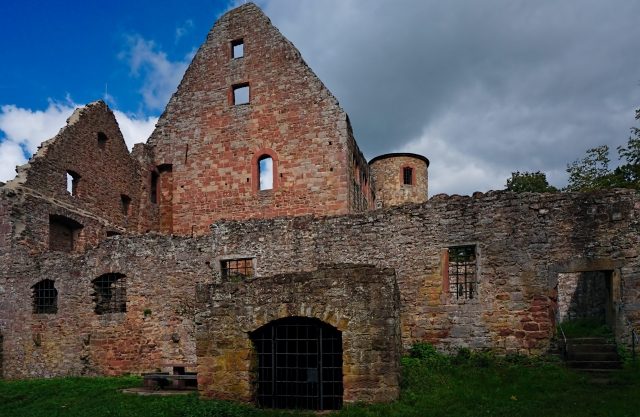
Schönrain am Main was founded around 1080 as a Benedictine monastery, partially destroyed in the German Peasants' War in 1525, and rebuilt as a residential castle by the Counts of Rieneck. After the death of the last Countess (1574), Schönrain served as an escheated fief to the Diocese of Würzburg until the beginning of the 19th century as accommodation for the appointed forest administrators. After Napoleon's victory over Austria, the end of the Holy Roman Empire of the German Nation, and the associated annexation of the Franconian territories to the newly created Kingdom of Bavaria (1806), Schönrain was not spared from secularization. The ruin is traversed by the Schönrain Tunnel, lies above the Main, and opposite Neuendorf on the southwesternmost end of the municipal area of the city of Gemünden am Main, in the Lower Franconian district of Main-Spessart in Bavaria. The Franconian Marienweg runs directly past the ruin.
The History of the Former Hirsau Priory+
The Donation of Schönrain+
Only after the turn of the millennium does the darkness surrounding the history of Schönrain lift. Amidst the Investiture Controversy between Emperor Henry IV and Pope Gregory VII (Walk to Canossa), the Ludowingian Counts Ludwig the Springer and Berengar of Sangerhausen donated Schönrain with two mills including accessories, as well as their estate in Wiesenfeld, to Abbot Wilhelm of Hirsau (Abbot from 1071 to July 5, 1091, died in Hirsau). The conditions that led to the foundation of Schönrain Monastery made it possible to recognize in the comital brothers Ludwig and Berengar the first representatives of the East Saxon-Thuringian nobility, whose connection to Wilhelm of Hirsau became discernible through source statements. The relations were so good that the two counts entrusted the Hirsau abbot with the establishment of a monastery, funded by their Main-Franconian possessions, for the salvation of their ancestors. Soon thereafter, Ludwig's relationship with the Hirsau reform was to become even closer, for a little later, around 1085, the count founded Reinhardsbrunn Monastery near Friedrichroda, which became the actual house monastery of his lineage.
Schönrain Monastery, Outpost of the Cluniac Reform Movement+
Abbot Wilhelm, the initiator of the Hirsau Reform, clearly took a stand in the Investiture Controversy in favor of the Pope – as did Count Ludwig the Springer, a member of the general Saxon-Thuringian princely opposition. In the 11th century, under Abbot Wilhelm, Hirsau Monastery had joined the reform movement emanating from the Burgundian Benedictine monastery of Cluny and became one of the most important German monasteries in the High Middle Ages. The monastic reform triggered a small mass movement. Finally, the reform movement resulted in numerous new foundations and acquisitions of other monasteries:
Klosterreichenbach in the Murgtal 1082, St. Georgen in the Black Forest 1084, Zwiefalten on the Swabian Alb 1089, Fischbachau am Schliersee 1090, St. Paul in the Carinthian Lavanttal 1091, St. Peter in Rosazzo in Friuli, Alpirsbach in the Black Forest 1095, Kloster Berge near Magdeburg 1099 and others. Thus, towards the end of the eleventh century, another outpost of the Cluniac reform movement, Schönrain Monastery, also emerged in the midst of imperial-loyal Franconia, whose function may have served particularly to connect the South German with the North German Gregorians.
Church and Monastic Buildings of the Hirsau Priory+
The completion of the monastic buildings took at least ten to fifteen years. Practically, apart from a remnant of a crossing pier (base) uncovered and photographed at the time by the Lohr Historical Society and the column including capitals and chessboard frieze, there are no clues whatsoever. One is therefore dependent on stylistic comparisons and calculations based on the column height. It was probably a flat-roofed, three-aisled column basilica.
The Mystery of the Schönrain Monastery Church+
The typical ground plan of the Hirsau church complexes, the three-aisled basilica with an eastern transept, was sometimes modified in various ways with skillful adaptation to local conditions. Especially in Bavaria, the usual building scheme was often deviated from by omitting the transept, following the example of Reichenbach. In both the Hirsau priories of Reichenbach and Mönchsrot, the church seems to have been limited to a single nave. Given the modest endowment of the Hirsau Cella Schönrain with goods and revenues, which moreover largely consisted of remote scattered possessions, it is plausible to assume that the church was also executed with only one nave and the transept was omitted. However, there are strong indications from the sources that contradict this assumption and suggest a three-aisled ground plan with a three-apsed choir. Even a transept must be considered. The solution to this mystery is of supra-regional importance for art historical research. Two arguments from tradition make the above view appear justified: The unusually long construction period of the monastery, which stretched from 1085 (at the latest) to 1139, i.e., over half a century, speaks mainly for this. The report of the highly learned Abbot Johannes Trithemius (1462–1516), preserved in the Hirsau Annals, who served as abbot of the Würzburg Scottish Monastery in the last decade of his life, deserves full credibility. The personally colored description of Schönrain's location suggests that Trithemius knew the priory and its archive from his own observation; he was probably personally acquainted with three Schönrain priors. The first Schönrain prior was named Adelhelm, as his note from 1085 records. A large part of the church was already completed under Wilhelm's successor, Gebhard (1091–1105), at his special instigation, probably according to Wilhelm's plans. During his lifetime, the forces of the mother monastery were occupied with the completion of St. Peter and Paul (1091); only from 1091 could the Hirsau building lodge be reinforced by sending a larger number of conversi to Schönrain.
Three Altars – Three Naves?+
The second clue for the assumption of a three-aisled church complex is the tradition from documents, rent registers, and the necrologies of the Austrian monastery of Admont (from 1477 and 1495), which was united with Schönrain and a large number of other monasteries in the Bursfelde Congregation since 1458. Due to disputes with the Prince-Bishopric of Würzburg, the Bursfelde Congregation gained no influence over the Benedictine Abbey of Neustadt am Main. This implies that the Schönrain monastery church had three altars: In honor of the local patrons St. John the Evangelist and the Mother of God Mary, St. Lawrence, to whom the main altar was probably dedicated as church patron, and St. Nicholas. The local patrons, incidentally, emphasized a close relationship with Cluny, whose monastery church also had an altar for these two saints. In 1139, Bishop Embricho of Würzburg issued a charter of protection for Schönrain Monastery on the Main, in which the following event related to the founding of the monastery was recorded: In the time of Henry IV and Bishop Adalbero of Würzburg, Count Ludwig and his brother Berengar transferred the place Schönrain with two mills and other appurtenances and the praedium they owned in Wiesenfeld to Abbot Wilhelm of Hirsau on the condition of establishing a monastic institution there. Wilhelm undertook this project, which was completed by his successors.
Source: Wikipedia · Licence: CC BY-SA 4.0 · Image: Reinhold Schulz
This description is a machine translation of an excerpt from the linked Wikipedia article. The source text was written by its authors, the translation is by Mobile History; like the original it is licensed under CC BY-SA 4.0.
Location: 50.0306, 9.6565