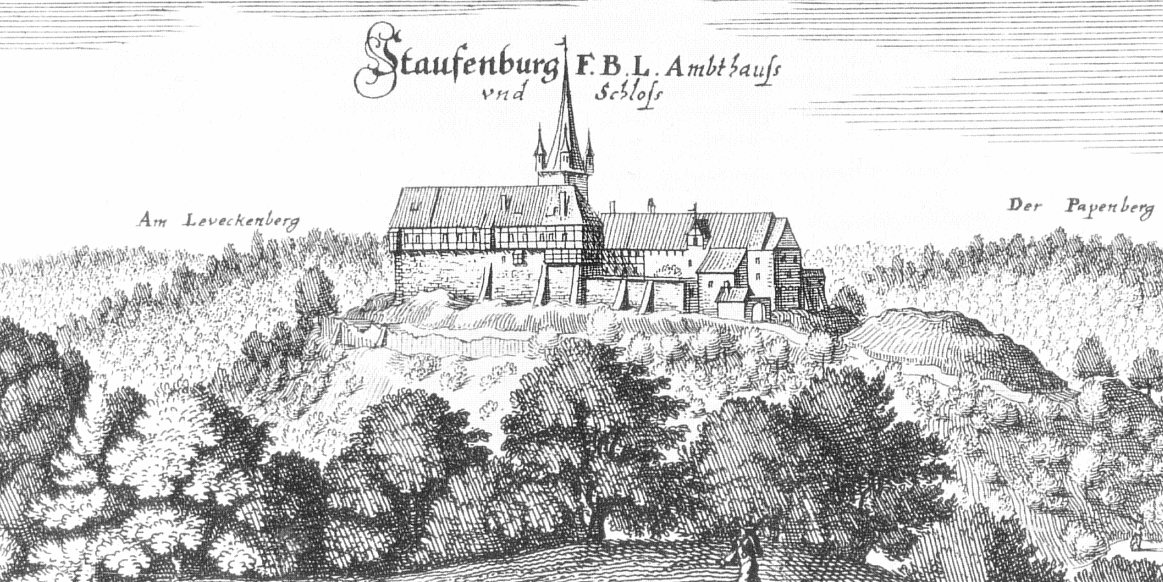
The remains of the Castle can be visited
Staufenburg Castle

The Stauffenburg, also called Staufenburg, is the ruin of a former hilltop castle near Seesen-Münchehof in the Lower Saxon district of Goslar.
Its structural beginnings are presumed to be in the 11th century. Today, the never-besieged fortification is a castle ruin with restored wall remains. Its stones have been removed since the 18th century for the construction of other buildings in the area.
The Stauffenburg castle ruin is located about 3 km south-southwest of the village of Münchehof, a district of the town of Seesen (district of Goslar) and about 2.8 km north-northwest of Gittelde (district of Osterode am Harz). It is situated on the wooded Burgberg (346 m above sea level), a conical hill in the Westerhöfer Bergland. About 1.6 km east of the ruin, beyond the Stauffenburg domain in the Markau valley between Münchehof and Gittelde, runs the B 243. East of it begins the Harz mountains.
Architectural Description+
The old access road to the castle is in places a sunken road and in the upper part is flanked by elevations that may have already been a kind of preliminary fortification. The once walled castle complex has dimensions of about 85 x 30 m. In the entrance area, there are restored walls of two semicircular towers, which contain embrasures for former cannons. The partially restored lower wall remains of the gate zwinger, measuring about 20 x 3 m, are preserved. Of the core castle, mainly only knee- to hip-high wall remains of 1 m thickness are still present, which were formerly much higher and served as an outer defensive wall. They likely represented the lower floors of individual castle buildings, whose upper floors had half-timbered superstructures. This can be clearly seen in Merian's engraving of the castle from 1654. The square keep with 2 m thick walls has a base area of 7 x 7 m. During a restoration, it was rebuilt to a height of about 3 m. A cellar floor is visible within it, which presumably served as a dungeon. In some places, small areas of the old stone paving of the castle courtyard are still present.
Origins in the Middle Ages
The first buildings of the castle were probably erected in the 11th century by the Counts of Katlenburg. Over the centuries, it was constantly expanded and rebuilt. The function of the Stauffenburg was to protect the Harz mining in nearby Gittelde and to secure the Thuringian military road, which ran below the castle from Seesen southeast along the Harz to Nordhausen. The first documentary mention of the name Stauffenburg in the region dates back to 1154. It is the name of a ministerial family mentioned in a document by Henry the Lion. This indirectly suggests the existence of the castle. Henry the Lion pledged the castle to noble pawnbrokers, and at times it is said to have been the seat of robber knights. After his fall in 1180, the castle, like the other Welf possessions in the area, fell to Emperor Frederick Barbarossa. In 1193, it came to the Archbishopric of Magdeburg. At the beginning of the 13th century, the Imperial Seneschal Gunzelin von Wolfenbüttel resided in the castle. When his son was lord of the castle, he called himself "Guncelinus de Stoyphonborg" (Stauffenburg) in 1254. From the 14th century onwards, the castle served as the administrative center of the ducal office for mining and metallurgy in Gittelde. Between 1495 and 1522, the castle became the dower house of Duchess Elisabeth zu Stolberg, the wife of Duke Henry the Elder of Braunschweig-Wolfenbüttel. She brought miners and blacksmiths from Stolberg and Ellrich to Gittelde, thus promoting mining with its extraction and processing of silver, copper, and iron ore. From the proceeds of the Harz mining, she expanded the castle.
Love Nest in Modern Times
Duke Henry the Younger of Braunschweig-Wolfenbüttel, also mockingly called "the wild Heinz of Wolfenbüttel," hid his mistress Eva von Trott in the castle for nine years. With her, he had a total of ten children, most of whom were born during their secret stay at Stauffenburg from 1532–1541. Previously, she had been a lady-in-waiting to the Duchess. When the affair with the Duke became known in 1532, the Westphalian noblewoman was sent home from the ducal seat in Wolfenbüttel, where she never arrived. On the way, she declared in the ducal castle of Gandersheim that she was afflicted with the plague and faked her death. Her alleged coffin was solemnly buried in the Gandersheim Abbey, while the lady-in-waiting went to the secluded Stauffenburg. The affair could not be kept secret indefinitely and became publicly known. Martin Luther accused the Duke of fornication and, because of the sham burial, of blasphemy.
After Eva von Trott, an ancient lime tree next to the castle was named Eva-Linde. It is located to the side in front of the castle gate on a small hill (to the right of the castle in Merian's copperplate engraving), on which stands the stump of an ancient lime tree about 2 m in diameter.
Widow's Residence, Prison, and Decay
From 1569, the castle became the dower house for Margarete, the sister of Duke Henry the Younger of Braunschweig-Wolfenbüttel. She had been married to the Silesian Duke Johann of Münsterberg and Oels. She converted the castle into an infirmary and helped needy people until her death in 1580.
In the 16th century, the Protestant abbess of Gandersheim Abbey, Margarethe von Warberg, served a life sentence in the castle. She was imprisoned from 1588 until her death in 1597 for murder, as she was said to have killed her illegitimate child.
From about 1600 to 1713, the castle served as an administrative office, which was then moved to one of the outworks below the castle. Until 1778, the castle was used as a prison. After that, the decay of the complex began. The stones were used, among other things, for the construction of a domain located below the castle.
Take Mobile History with you
You are reading this text for free. Premium adds what matters on the road: descriptions read aloud, sites found through your camera, whole regions taken offline.
- Every description, including the ~17,700 Premium sites
- Audio guide: have descriptions read to you on location
- AR finder: see sites through your camera, with distance and bearing
- Unlimited saved sites
14 days free, then from €2.99 a month. Cancel anytime.
Location: 51.8207, 10.1666