The castle ruins can be visited
CastleVolkach - Obervolkach
Stettenburg Castle
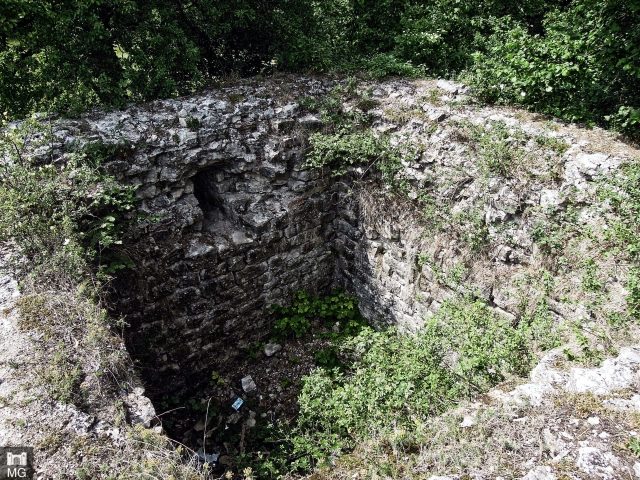
The Burgstall Stettenburg refers to a vanished spur castle in Obervolkach. Today, the castle ruin belongs to the town of Volkach in the Bavarian district of Kitzingen.
The Burgstall Stettenburg is located approximately 1000 meters northwest of the Catholic parish church of Sankt Nikolaus in Obervolkach on a spur of the 273.7 m above sea level Stettenberg, oriented to the west-northwest, in the local area of Dornstück. The mountain, wooded in its northern part and used as a vineyard in the south, is encircled on its west and southwest sides by the Volkach river, and to the east and southeast it is bordered by the valley of the Weidachbach stream. The castle site lies about 30 meters in elevation west below the summit of the mountain and is protected on three sides by moderately steep slopes and the Volkach river. Several paths lead from Obervolkach to the former castle.
History+
The exact founding date of the castle is not known; when Volkach was first mentioned in 906, neither a village Obervolkach nor a Stettenburg was mentioned. The period of its creation is assumed to be the first half of the 13th century due to the bossed ashlar with a continuous marginal draft. However, at its first mention in 1225, only ditches of a castle (Latin: "iuxta fossatum castri Stettenberg") still existed. It was originally the ancestral seat of the Lords of Stettenberg, feudal tenants of the Prince-Bishopric of Würzburg, among whom the most famous, Eberhard von Stettenberg († 1443), was elected Bishop of Worms in 1426. They are mentioned in a document by Count Rupert zu Castell, who at that time owned vineyards next to Stettenburg. In the 13th century, a mill existed there, the "molendium sub castro" (mill under the castle). In 1339, Friedrich von Castell received permission from Emperor Ludwig the Bavarian to rebuild the castle (purkstal zu Stetenberg). However, the reconstruction never happened because the Prince-Bishop of Würzburg refused his consent. Later, two more castle lords were named, appointed by Bishop Otto von Wolfskeel. Today, the ruin is in private ownership. The Bavarian State Office for Monument Protection lists the ruin as an architectural monument under number D-6-75-174-289, and the ditches and ramparts are registered as an archaeological monument D-6-6127-0106.
Source: Wikipedia · Licence: CC BY-SA 4.0 · Image: Mobile Geschichte
This description draws on the facts documented in the linked Wikipedia article; Wikipedia content is licensed under CC BY-SA 4.0. Wording and editing: Mobile History.
Location: 49.8816, 10.2525