Private school
CastleLa Bruffière
Château de l'Échasserie
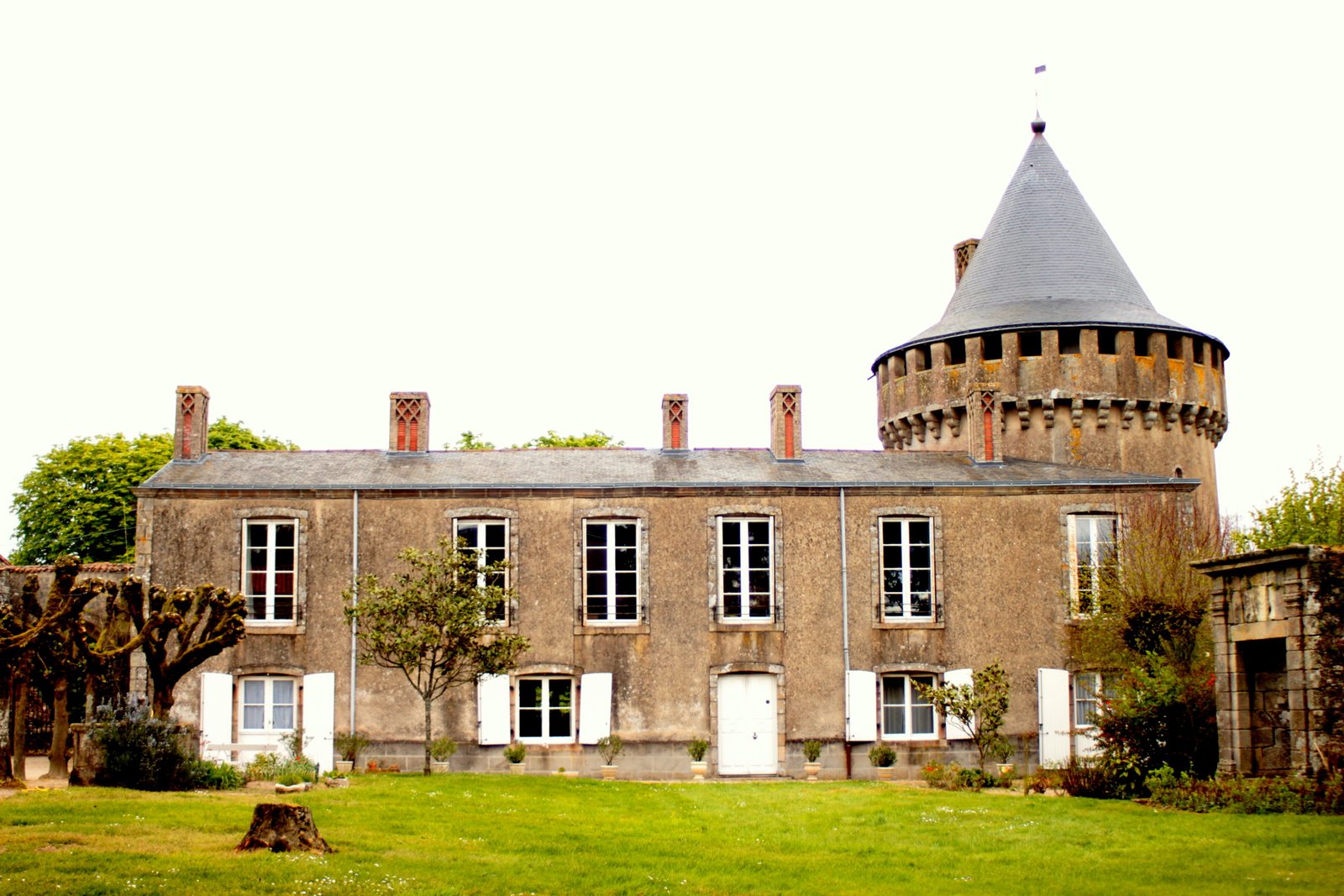
The Château de l’Échasserie is a former fortified castle located in La Bruffière, in the Vendée department of the Pays de la Loire region in western France. Its name derives from a Gallo-Roman term meaning “the roadway” (la chaussée), referring to its position along the ancient Roman road linking Tiffauges to Saint-Georges-de-Montaigu.
The site originated in the 11th–12th centuries as a defensive outpost on the borders of the Marches of Brittany, Anjou and Poitou, protecting the approaches to Tiffauges. It began as a wooden keep surrounded by a ditch and palisade against Norman invasions and was later rebuilt in stone. The castle forms an irregular pentagon entirely surrounded by water-filled moats (10 to 20 metres wide). Originally it had five corner towers (two square and three round); four survive today in varying states of preservation.
Notable remaining towers include:
the Tour au Chandelier (northeast), with its distinctive “chandelier” roof (restored in the early 1980s) crowned by fleurs-de-lys and a weathervane;
the Grosse Tour Ronde or Tour du Guet (southeast), the only tower to survive the 1793 fire intact, featuring crenellations, machicolations and an unusual conical spiral staircase that narrows as it rises;
the 14th-century Tour Carrée (southwest).
The original seigneurial logis was destroyed; a new residence was built in the early 19th century using its stones. A chapel, stables and curtain wall were also added or rebuilt in the 19th century.
Ownership passed through the Sauvage de Cugand and Charbonneau families (the latter from 1250 to 1738), then to the Servanteau de La Brunière / de l’Échasserie family (shipowners from Les Sables-d’Olonne). During the French Revolution the owner Charles André Augustin Marie Servanteau was killed in March 1793; in October of the same year General Kléber burned the château during a punitive expedition. In 1806 the estate was acquired by Louis Richard de La Vergne; it later passed through the female line (Couespel du Mesnil, de Quatrebarbes) to the present du Rosel de Saint-Germain family.
The façades and roofs of the square tower, the watch tower and the chandelier tower have been listed as a Monument historique since 20 October 1971. The château remains a private inhabited property; the exterior may be visited by appointment (and during the European Heritage Days).
Take Mobile History with you
You are reading this text for free. Premium adds what matters on the road: descriptions read aloud, sites found through your camera, whole regions taken offline.
- Every description, including the ~17,700 Premium sites
- Audio guide: have descriptions read to you on location
- AR finder: see sites through your camera, with distance and bearing
- Unlimited saved sites
14 days free, then from €2.99 a month. Cancel anytime.
Source: Wikipedia · Licence: CC BY-SA 4.0 · Image: Llann Wé² · Wikimedia Commons · CC BY-SA 3.0
This description is an excerpt from the linked Wikipedia article and was written by its authors. Like the original it is licensed under CC BY-SA 4.0 and may be reused under the same terms.
Location: 46.9895, -1.1485