To be privately owned
CastleSaint-Martin-des-Noyers
Château de la Grève
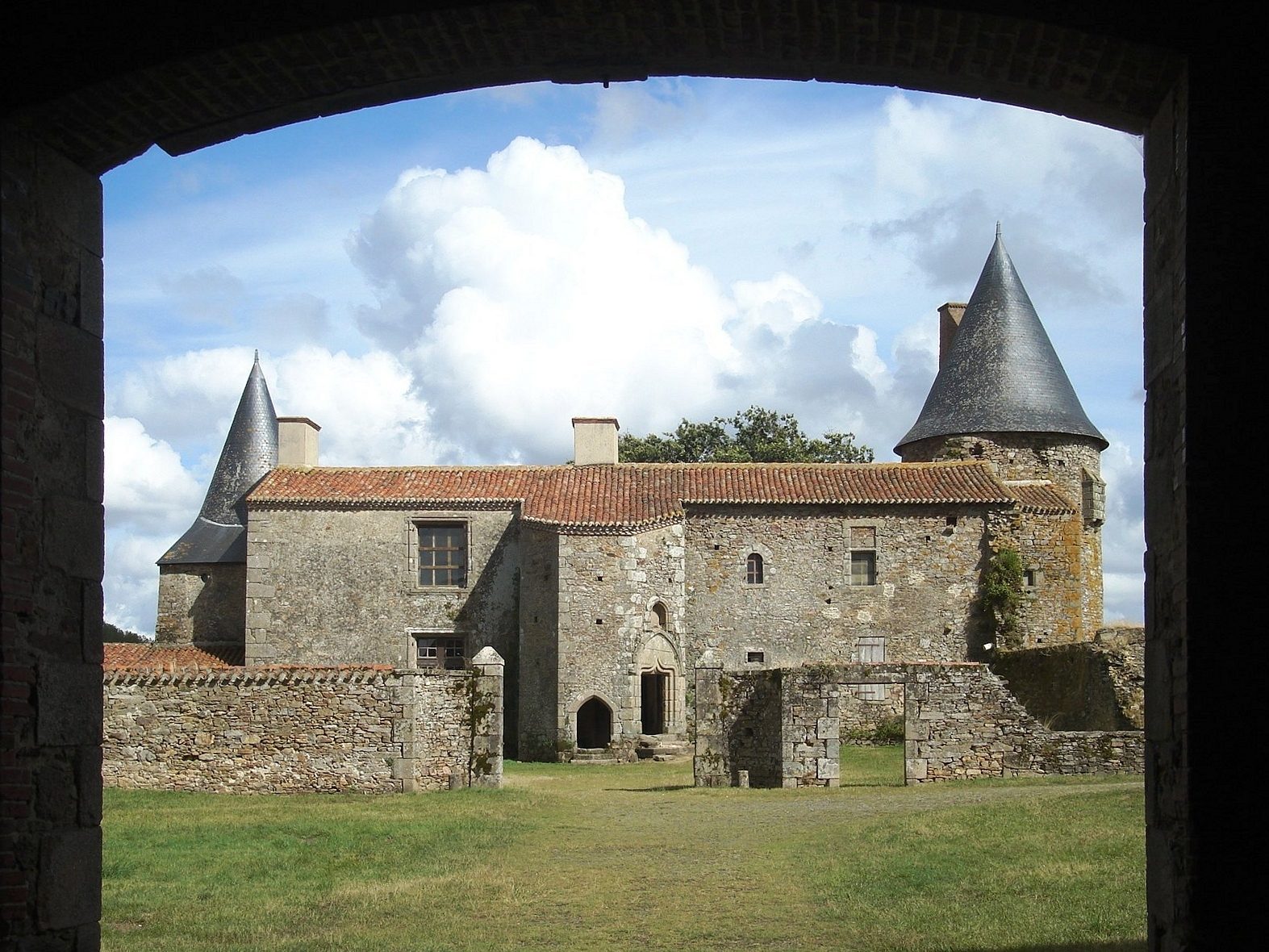
The Château de la Grève (also known as the château of Saint-Martin-des-Noyers) is a medieval fortified residence located in Saint-Martin-des-Noyers, in the Vendée department of the Pays de la Loire region in western France. It stands in the centre of the department near the Forêt domaniale du Détroit, between La Ferrière and Saint-Martin-des-Noyers, about 20 km north-east of La Roche-sur-Yon. It is one of the rare medieval fortified castles still standing in the Vendée.
The toponym derives from a Gaulish word (graua) meaning “sandy shore”. The site is mentioned from the late 11th century, when Agnès, Dame de Rocheservière and de la Grève, married Sébrand I Chabot. It became the first fief of the powerful Chabot family and remained in their hands for more than three hundred years. As one of about twenty baronies holding faith and homage to the Duchy of Thouars, its lord exercised high justice. During the Hundred Years’ War Thibault X de Chabot, loyal to Charles VII, was killed at the Battle of Patay on 18 February 1429.
In 1446 the estate passed to the de Chastillon family. The present château was rebuilt in the 15th century in a pre-Renaissance style on older foundations (contrary to some tourist literature, the standing building does not date from the 12th century). It was heavily fortified during the Hundred Years’ War and later adapted during the Wars of Religion, when it served as a Protestant stronghold and changed hands between Catholics and Protestants. In 1599 it was sold to Pierre Durcot, a Protestant seigneur close to Henri IV, who remodelled it. From the 17th and 18th centuries it gradually lost its military and residential role and was converted to agricultural use. Period inventories describe a fortified complex with terraces, keep, crenellated walls, machicolations, towers, drawbridge and underground rooms, surrounded by water and deep ditches.
Acquired by the Batiot family in 1802, the château received partial conservation work in the 1970s (including the restoration of the pond to its 17th-century form). It was inscribed as a Monument historique on 8 October 1984 and awarded a regional Vieilles Maisons Françaises prize in 2000. It welcomed several thousand visitors a year until safety concerns led to closure around 2019. Sold in 2020–2021 to Boris Racaud, a heritage enthusiast, the site is undergoing progressive security, consolidation and restoration work, supported by the Fondation du patrimoine and the Mission Patrimoine, together with historical, archaeological and 3D surveys.
The complex remains one of the most complete medieval fortified ensembles in the Vendée, retaining a 15th-century main building, gatehouse, outbuildings, high and low courts, moats and pond, thick walls, multiple fireplaces, cross-windows with window-seats and other medieval features. Access is currently limited while restoration continues.
Take Mobile History with you
You are reading this text for free. Premium adds what matters on the road: descriptions read aloud, sites found through your camera, whole regions taken offline.
- Every description, including the ~17,700 Premium sites
- Audio guide: have descriptions read to you on location
- AR finder: see sites through your camera, with distance and bearing
- Unlimited saved sites
14 days free, then from €2.99 a month. Cancel anytime.
Source: Wikipedia · Licence: CC BY-SA 4.0 · Image: Spouik · Wikimedia Commons · CC BY-SA 3.0
This description draws on the facts documented in the linked Wikipedia article; Wikipedia content is licensed under CC BY-SA 4.0. Wording and editing: Mobile History.
Location: 46.7158, -1.2106