To be privately owned
CastlePalluau
Château de Palluau
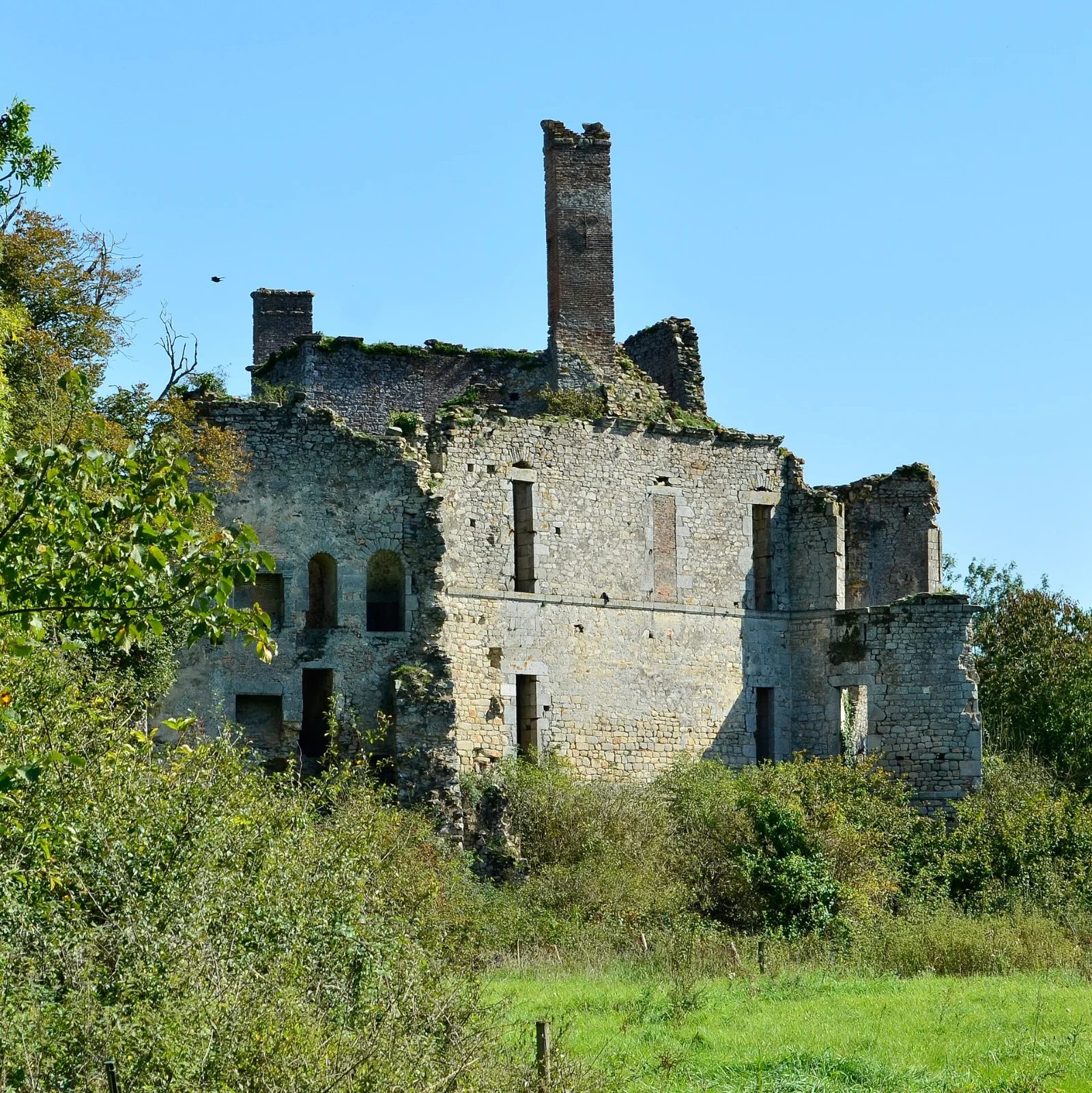
The Château de Palluau is a ruined historic fortress located in the centre of the commune of Palluau, in the Vendée department of the Pays de la Loire region in western France. The name derives from the Latin palus or paludellus (“little marsh”).
According to castellologists the original fortress dates from the mid-13th century. It was a powerful stronghold flanked by six towers and surrounded by wide moats and ditches, enclosing a medieval settlement (vicus) and parish church (both now vanished). Strategically placed as a “lock” between Brittany and Poitou in the disputed marches, it resisted an English siege in 1371 during the Hundred Years’ War. Accounts kept by the castellan Guillaume Ouvrart in 1369–1371 show that the permanent garrison was armed with crossbows and, unusually early for the period, with cannons and gunpowder—making it one of the first fortresses in the region to possess firearms.
In the early 14th century Létice de Parthenay (wife of Maurice de Belleville), known as “Dame de Paluya”, held a “Court of Love” there—a cultural and intellectual centre that attracted artists, poets and musicians. The seigneury was a vassal of the powerful Vicomtes de Thouars.
In the 17th century the estate passed to the Clérambault family. Philippe de Clérambault, promoted Marshal of France on 18 February 1653 by the young Louis XIV in person, undertook a major reconstruction. He transformed the old fortress into a modern Louis XIV-style residence while retaining the six medieval towers and inserting between them a new building covered with a Mansart-style roof, crowned by a dome and lantern. The work was completed in 1661. The royal engineer-geographer Claude Masse described it as “the most regular and accomplished château in the whole of Bas-Poitou”. The Marshal died in Paris in 1665 after a long illness. In the 18th century the Comte de Pontchartrain made further modifications.
The château was set on fire in 1793 (or January 1794) during the Revolution and the Wars of the Vendée and has remained in ruins ever since. The site also witnessed fighting involving Charette’s forces.
The ensemble of pre-Revolutionary structures—the old vicus, the enclosure, the Marshal’s château, the transversal moat and the surrounding ditches—was inscribed as a Monument historique on 20 May 1998 (excluding two 19th-century outbuildings and a modern house). The ruins, combining medieval and 17th-century elements, stand in the heart of the village. Access is limited to the exteriors; occasional guided visits are organised that evoke figures such as Jeanne de Belleville, the Marshal de Clérambault and Julien Poydras de la Lande.
Take Mobile History with you
You are reading this text for free. Premium adds what matters on the road: descriptions read aloud, sites found through your camera, whole regions taken offline.
- Every description, including the ~17,700 Premium sites
- Audio guide: have descriptions read to you on location
- AR finder: see sites through your camera, with distance and bearing
- Unlimited saved sites
14 days free, then from €2.99 a month. Cancel anytime.
Source: Wikipedia · Licence: CC BY-SA 4.0 · Image: https://de.wikipedia.org/wiki/Palluau#/media/Datei:Chateau_de_Palluau_(Vend%C3%A9e).jpg
This description draws on the facts documented in the linked Wikipedia article; Wikipedia content is licensed under CC BY-SA 4.0. Wording and editing: Mobile History.
Location: 46.8021, -1.6204