To be privately owned
CastleSaint-Menoux
Château de Souys
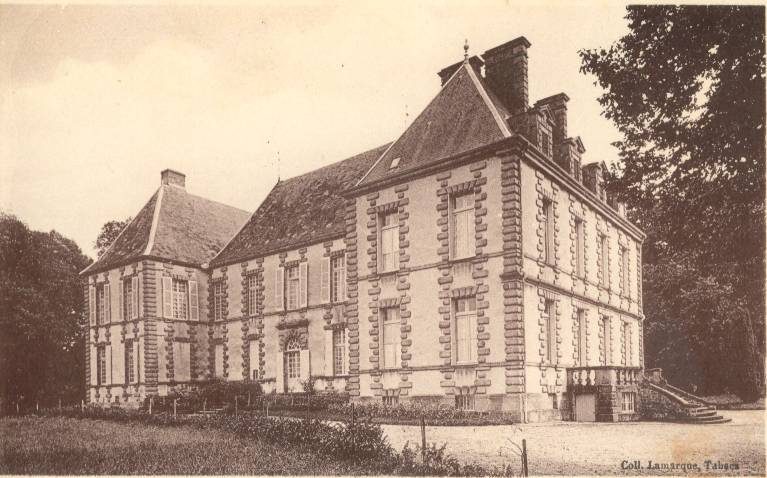
The Château de Souys is a castle located in Saint-Menoux, France, built according to Mansart's plans in the mid-17th century. A residence for gentlemen under the Ancien Régime, a probable place of stay for Mme de Montespan, it became the property of notables from 1849 before being acquired, around the mid-20th century, by a commune in the department of Seine-Saint-Denis to be a children's holiday resort.
Location+
The castle is located in the commune of Saint-Menoux, in the Allier department, in the Auvergne-Rhône-Alpes region, about 2 km northeast of the village.
Description+
The castle is a 17th-century building, situated at the back of a main courtyard. Its plan is very symmetrical, composed of a main building flanked by two wings forming avant-corps on each facade. Each building body is covered with an independent pavilion-style slate roof. The facades are adorned with corner chains treated in large, high-relief bossages. Its elevation is bayed, with a ground floor, a first floor, and an attic floor. Access to the main courtyard (to the west) is through a semicircular portal (softened bossages, Ionic capitals). On each side of this entrance stands a pavilion in the style of the castle: the one on the left is the caretaker's lodge; the one on the right houses a chapel built on a rotunda plan, covered with a dome resting on a classical order, with black and white paving, a painted and gilded altar with Ionic columns, tabernacle, and steps. To the right of the chapel, to the east, extend the outbuildings. Access to the enclosed farmyard is through a carriage gate. It includes two barn-stables, a bread oven, a water feature, the farmers' dwelling (with a preserved fireplace), and a corner cabinet. On the south barn-stable, the roof is broken. All roofs are slate except for those of the agricultural buildings. The dwelling was remarkable for its immense salon extending, on the first floor, between the two pavilions: it contained a series of five silver-woven tapestries from the Royal Beauvais Manufactory, signed Behaeghe. They depicted, against a backdrop of landscapes with dwellings, waterways, animals, birds, etc., the Rest of Diana and her companions, the Abduction of Europa, the Sleep of Endymion, Diana and one of her attendants, and the Meeting of two mythological figures. The borders featured vases and floral scrolls. This dwelling was modified to the west in 1872 by Jean-Bélisaire Moreau (1828-1899), a Moulins architect often working in concert with Viollet-le-Duc and renowned in the Allier where he restored numerous other castles (Avrilly, Busset, Lapalisse) and where he was appointed inspector of diocesan works in Moulins. The edifice is partially listed (facades, roof, and main portal) as a historical monument in 1952.
History+
A land in the hands of the Gaudon family for nearly two centuries+
As early as 1375, there is mention of the "grange de Soye," a property jointly owned by Hugues Regnier and his wife Jacquette. The name later became "Souye": this is how the property of Jean Gaudon, described in 1493 and 1518 as "seigneur de Souye," was named. A century later, in 1604, the property was still in the hands of a descendant of Jean Gaudon, Nicolas Gaudon, son of a Jean Gaudon, lieutenant general in the Bourbonnais domain, seigneur de Souye, Foullet, and Arvilly. Nicolas Gaudon was lieutenant general in Orléans then treasurer of France in Moulins, and sieur de Souys and de Foullet. The building he occupied in Souys was not the current castle but what would later become the "vieux Souys" or "Grand domaine de Souys." His third child, Pierre Gaudon, born in 1613, squire, ordinary gentleman of the king's chamber, inherited the lands of Souys while those of Foullet went with others to the eldest. Pierre acquired new land properties, becoming owner of La Grange as early as 1644. After about ten years, he abandoned the old Souys or "Grand domaine" to tenant farmers for the current castle which he had built in 1655 and 1656. From Pierre's hands, the domain seems to have passed to his third child, Marc Antoine Gaudon, squire, captain in the Condé regiment, seigneur de Souys, but in 1692, Marc-Antoine sold it to Jacques Faverot.
A castle designed by Mansart for Madame de Montespan?+
The castle – because it was built according to the plans of Mansart, superintendent of the king's buildings – is the subject of quasi-legendary tales, transmitted by the different families who lived there. They all concern the figure of Mme de Montespan, royal favorite, mother of eight children she had with King Louis XIV. The castle is said to have been built on the order of Louis XIV for Mme de Montespan. This fact proves to be inaccurate. Madame de Montespan only stayed at Souys: it is certain that she was received there by Jacques Faverot at least in May 1700 when she was going to the waters of Bourbon-l'Archambault; her passage in Saint-Menoux is reported on May 17. Perhaps she stopped there at other times between 1692 and 1707, the date of her death in Bourbon-l'Archambault. Tradition even refers to a stay in 1668 when the castle was still the property of Marc Antoine Gaudon: then 28 years old, Mme de Montespan is said to have given birth to a child there. This fact is not historically verified. The first-floor bedroom, next to the Grand Salon or Gallery, was long called "Madame de Montespan's room" or "the red room." It is therefore not impossible that two of the owners of the Château de Souys, Marc Antoine Gaudon, in 1668, and then Jacques Faverot, in 1700, received Madame de Montespan there when she was going to Bourbon-l'Archambault.
A succession of changes in the 18th century+
Jacques Faverot de Neuville, seigneur de Saint-Aubin, squire and captain in the Auvergne regiment, became owner of the castle in 1692. Jacques Faverot acquired the neighboring land of Cluzor at the same time as Souys. He kept Souys until 1720, when he sold it to Nicolas-Pierre Amyot de Montérigny. Souys remained with the Amyot family for two generations, who later also reunited the lands of Cluzor and Souys. There is indeed a record of a sale, on February 6, 1745, by Gilles Brunet d’Évry, of his "fiefs, lands and lordships of Cluzor and Lépaud" to Pierre Jacques Renaud de Boisrenaud, captain in the Rohan cavalry regiment, who himself, very shortly after, resold a part of Cluzor to an Amyot, Claude Parfait, subsequently described as "seigneur de Souys and de Cluzor." The two reunited fiefs formed a significant estate, with an area of 600 to 700 hectares. During their sale by Claude Parfait Amyot in 1775, the total price was 244,600 livres, of which 15,600 was for Souys. The buyer was Madame de Serre de Saint-Roman, née Françoise de Murard, wife of a counselor to the Parliament of Paris. With her purchase in 1775, she owned two castles, Souys and Cluzor, a "reserve" (perhaps the Domaine de la Cour in Souys), seven large farms, a tile factory, a mill, and a tenant farm.
Source: Wikipedia · Licence: CC BY-SA 4.0 · Image: Unknown authorUnknown author / Public domain via Wikimedia Commons
This description draws on the facts documented in the linked Wikipedia article; Wikipedia content is licensed under CC BY-SA 4.0. Wording and editing: Mobile History.
Location: 46.5891, 3.1785