The remains of the Abbey can be visited
MonasteryBallyvaughan
Corcomroe Abbey
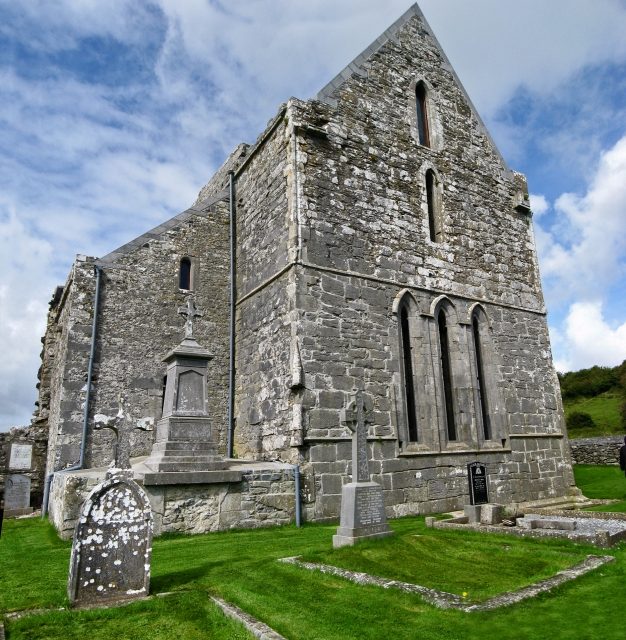
Corcomroe Abbey, also known as “Sancta Maria de Petra Fertili” (Saint Mary of the Fertile Rocks), is a Cistercian abbey and a historical site in the Burren in Ireland.
History+
The founding of Corcomroe Abbey, located near the present-day Bellharbour in northern County Clare, occurred around 1195. It marked the conclusion of five decades of Cistercian activity in Ireland during the 12th century. It is believed that a King of Thomond, either Donal Mór O'Brien or his son Donat, endowed the abbey, with monks from Inislounaght Abbey in County Tipperary serving as the builders. Although Cistercian abbey lands were typically very fertile, Corcomroe was only productive in contrast to the barrenness of the southern Burren. Its strategic location on the northern border of Thomond likely served to secure the “Corker Pass” and to maintain an O'Brien garrison, rather than solely for the religious provision of the northern Burren. In 1198, the daughter foundation Kilshane Abbey was established. In the 13th century, Corcomroe became embroiled in conflicts between Irish and Anglo-Norman Cistercian abbeys. In 1228, it was placed under the “Rule of Furness,” but three years later, it was re-affiliated with Mellifont Abbey. The abbey was the site of two battles: in 1267, King Conor na Siudaine O’Brien fell here and was buried in the abbey; in 1317, another battle took place at Abbey Hill. Following the dissolution of the monasteries in 1540, the abbey was maintained by various members of the O'Brien family.
Location+
Corcomroe Abbey is situated in Ballyvaughan, County Clare (An Clár), in the Munster (An Mhumhain) region of Ireland. It lies at an elevation of approximately 24 meters above sea level.
On site+
The ruins of Corcomroe Abbey are open to visitors today. Although few remains of the monastic complex survive, the church has a square choir, flanked by chapels in the transepts. Particularly noteworthy are the choir with its Gothic chancel arch and the royal tomb featuring a recumbent statue of a crowned king from the 14th century, which remains the only surviving royal Irish tomb effigy.
Take Mobile History with you
You are reading this text for free. Premium adds what matters on the road: descriptions read aloud, sites found through your camera, whole regions taken offline.
- Every description, including the ~17,700 Premium sites
- Audio guide: have descriptions read to you on location
- AR finder: see sites through your camera, with distance and bearing
- Unlimited saved sites
14 days free, then from €2.99 a month. Cancel anytime.
Source: Wikipedia · Licence: CC BY-SA 4.0
This description draws on the facts documented in the linked Wikipedia article; Wikipedia content is licensed under CC BY-SA 4.0. Wording and editing: Mobile History.
Location: 53.1267, -9.0540