Evangelical-Lutheran parish church
ChurchRothenburg ob der Tauber
Franciscan Church
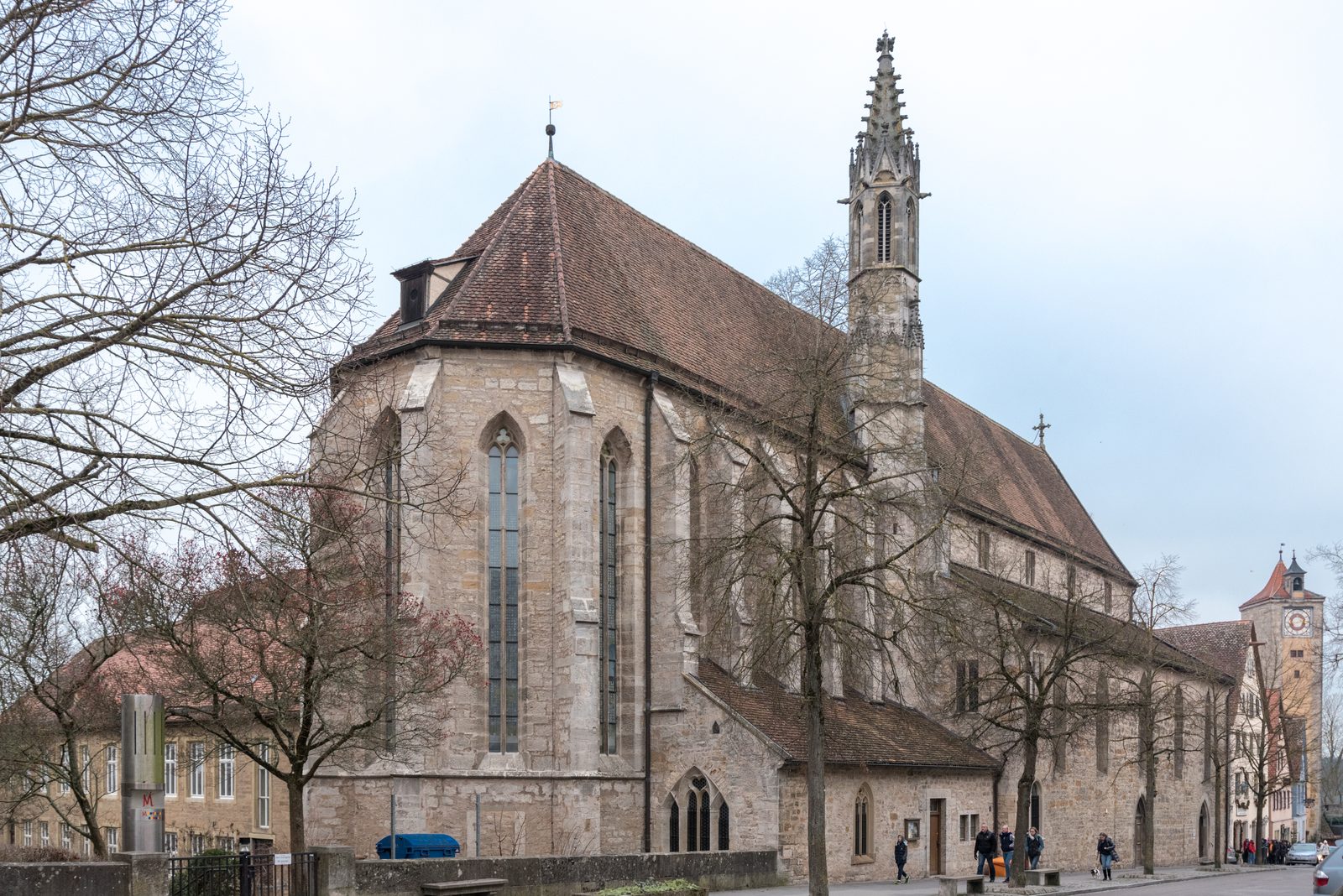
The Franciscan Church in Rothenburg ob der Tauber is the monastery church of the former Franciscan monastery in Rothenburg ob der Tauber in Bavaria (Diocese of Bamberg). The church is now an Evangelical Lutheran parish church.
History of the Franciscan Monastery+
The monastery was founded in 1281 by Hermann von Hornburg, Schultheiß, among others. It bore the patronage of the Virgin Mary and belonged to the Upper German (Strasbourg) Order Province of Argentina of the Franciscan Order, founded in 1210. In 1282, the monastery church, which still stands today, was built. When the Franciscan Order split in 1517, the monastery joined the Franciscan Conventuals (Minorites), who practiced a less strict form of the vow of poverty. Around 1400, a community of Franciscan Tertiaries also lived in the monastery for a time, until they received their own friary; however, the Tertiary monastery continued to be pastorally cared for and supplied by the Franciscan monastery. The Minorite monastery died out in 1548 in the course of the Reformation. The buildings of the voluntarily abandoned monastery first housed a Latin school, later an apartment for pastors' widows. After 1805, the buildings served, among other things, as a salt warehouse. Parts of the complex (cloisters, refectory, etc.) were demolished, and much of the inventory was destroyed or sold.
Architecture of the Church+
The Franciscan Church of Our Lady (Latin: Beatae Mariae Virginis) is an important example of a mendicant order church with a rood screen and significant art treasures. It is considered "the best preserved and probably also the most important" mendicant order church in Franconia. Construction began in 1282. The choir was consecrated in 1309 (second consecration 1333). A three-aisled, basilical nave with a flat ceiling is adjoined by a high, elongated choir with a ribbed vault.
Furnishings+
Rood Screen+
A five-bay wide rood screen separates the three-aisled nave from the choir, the church space of the laity from that of the monks. However, it extends laterally beyond the width of the choir and spans the entire width of the nave. It is divided into (rood screen) chapels by solid partition walls; in each of the four side chapels stands an altar (at least an altar table); a door in the central bay allows access to the choir. After the Reformation, the rood screen was not removed but used as a gallery. This preserved the spatial image of the 14th century, which is rarely found today. A small organ still stands on it today. In the medieval church, the rood screen was a place of proclamation. It served for readings and sermons as well as a singers' pulpit. In the Rothenburg church, the wooden rood screen parapet was designed in this sense as a picture bible: Around 1370/1390, it was painted with a Passion cycle; in 1494, the pictures of the "Rothenburg Passion" were placed above it (today in the Imperial City Museum). After the Reformation, this tradition was continued with a Last Supper painting (early 17th century).
Altars+
Of the eight altars attested from the Middle Ages, five were still preserved in the 18th century: the high altar (Mary altar) and four altars in the rood screen chapels, dedicated to Saints Louis, Francis, John, and Catherine. Fragments of the Louis and John altars later came to St. James's Church. The others were lost. In the late 19th century, the choir was equipped with a new Trinity altar as the high altar, into which a late Gothic Trinity group (around 1500) and two reliefs (around 1560) were inserted. This now stands under the rood screen arcades (on the second altar from the left). The Francis altar (around 1480/1490) is considered the most important work of art in the current church furnishings. Its origin is unknown; it can hardly be identical with the Francis altar of the rood screen chapel, as the latter was already mentioned in 1366. It may have stood in a Francis chapel at the cloister of the monastery. In the 20th century, it was placed in the nave, in front of the middle of the rood screen. Since it was replaced by a simple altar table at this spot and moved to the place of the high altar, church visitors can again look from the nave through the rood screen door into the choir. The predella, probably connected to the altar at the beginning of the 1870s, comes from the aforementioned John altar and is attributed to Jakob Mülholzer. It shows the adoration of the Christ Child by the Holy Family and the founding family (von Eyb) of that altar. Above it is a retable with a carved relief in the central part and painted wings. If the altar had a finial, it is lost. The relief shows the stigmatization of St. Francis of Assisi: on the left kneels the saint, on the right sits Brother Leo, who eavesdropped on him, in the background is the mountain landscape of Alverna or La Verna. The figure of the angel, to whom the saint looks up and from whom he receives the stigmata, is missing. Either this seraph was part of the finial and was lost with it, or the seraphic crucifix was placed in the middle of the relief, or a crucifix hung near the altar and the saint looked up at it. The attribution of the relief is disputed; most art historians seek the artist in the circle of Tilman Riemenschneider or attribute it to him as an early work. The polychromy of the relief and the painting of the altar wings are attributed to Brother Martinus Schwarz, who himself belonged to the monastery. The wings are mounted upside down. The inner sides (actually outer sides) show in a continuous image, which should not actually be separated by the relief, the beheading of the first martyrs of the Franciscan Order by the Sultan of Morocco. They are of poorer quality, but at least preserved in full height. In contrast, only the lower half of the depictions of the outer sides (actually inner sides) are preserved, but in better condition: the confirmation of the order rule by Pope Honorius III and the sermon to the animals or birds by St. Francis.
Organ+
The organ of the Franciscan Church comes from the workshop of the Nuremberg organ builder Johannes Strebel. The instrument, built in 1889 as Opus 12 with 14 stops on two manuals and pedal, was restored in 1992 by the company Orgelbau Sandtner. It is considered "one of the most important monument organs in Bavaria."
Couplers: II/I, I/P Other playing aids: Kalkantenzug, Fixed combinations (mezzoforte, fortissimo) as pedals
Cycle Path Church+
The Franciscan Church of the monastery is designated as a cycle path church due to its location on the Taubertal Cycle Path.
Take Mobile History with you
You are reading this text for free. Premium adds what matters on the road: descriptions read aloud, sites found through your camera, whole regions taken offline.
- Every description, including the ~17,700 Premium sites
- Audio guide: have descriptions read to you on location
- AR finder: see sites through your camera, with distance and bearing
- Unlimited saved sites
14 days free, then from €2.99 a month. Cancel anytime.
Source: Wikipedia · Licence: CC BY-SA 4.0 · Image: Tilman2007 · Wikimedia Commons · CC BY-SA 3.0
This description is a machine translation of an excerpt from the linked Wikipedia article. The source text was written by its authors, the translation is by Mobile History; like the original it is licensed under CC BY-SA 4.0.
Location: 49.3767, 10.1764