Pilgrimage church
MonasteryDettelbach
Franciscan Monastery (Franziskanerkloster)
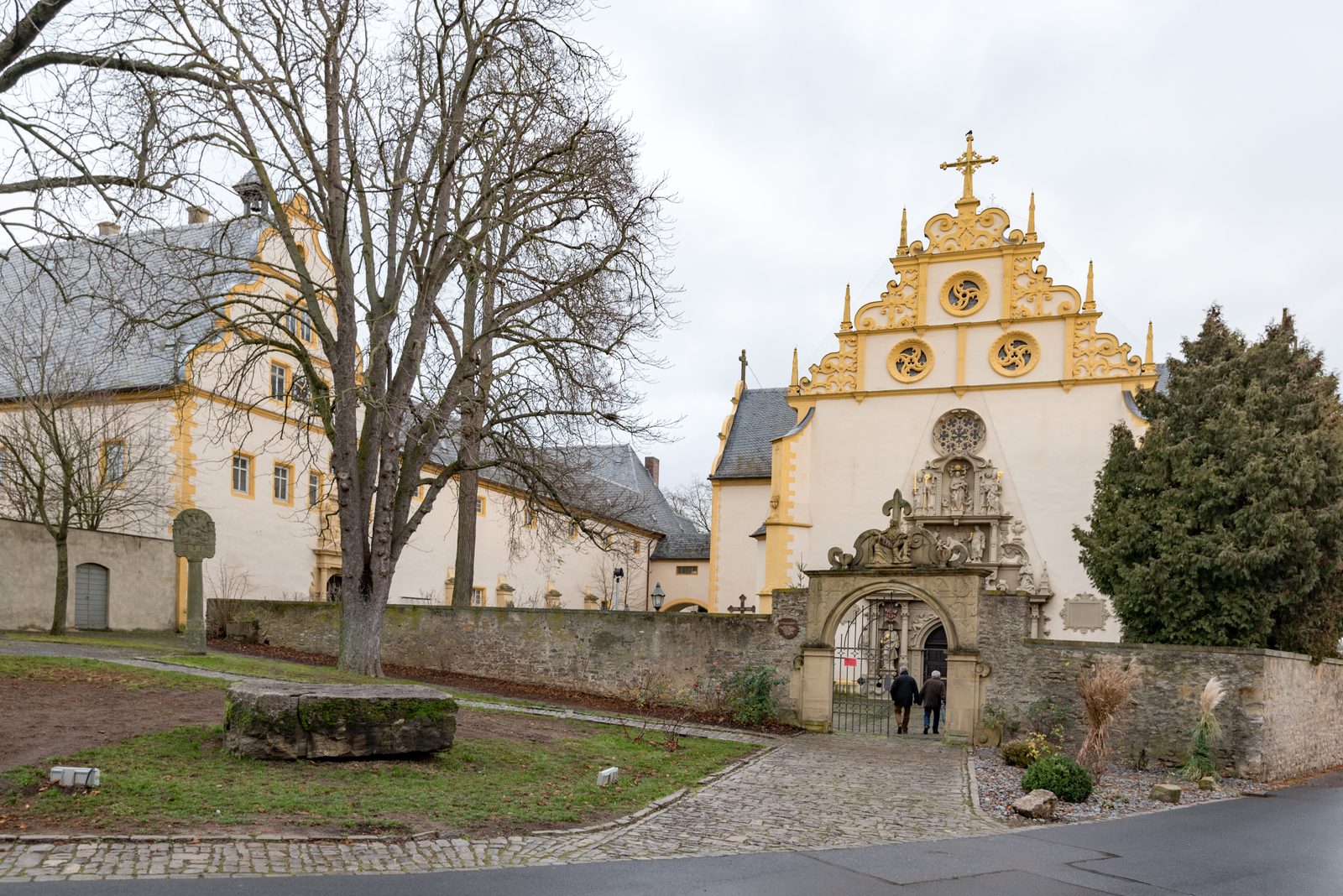
The Franciscan Monastery Dettelbach is a former monastery of the Franciscan Observants in Dettelbach, Bavaria, in the Diocese of Würzburg. The founding and establishment of the settlement is closely linked to the pilgrimage to the Church of Maria im Sand. In 2017, the monastery was dissolved.
History+
Until the Thirty Years' War+
After a miraculous healing was first associated with a wayside shrine near the town in 1504, a pilgrimage movement to Dettelbach quickly began. However, the Reformation from 1517 interrupted the upward development of the pilgrimage. Fewer and fewer pilgrims visited the sanctuary. Only the accession of the Würzburg Prince-Bishop Julius Echter von Mespelbrunn stopped the decline. He first had to lead the inhabitants of Dettelbach back to the old faith. Once he succeeded, he made Dettelbach a center of Catholic reform in his diocese. The most striking sign was the construction of the large pilgrimage church in Renaissance style, which still dominates the monastery grounds today. The large church was completed by 1613. To provide pastoral care for the pilgrims to the Marian shrine, Franciscans were to occupy a monastery next to the church. For this purpose, the Prince-Bishop contacted the Strasbourg Franciscan Province Argentina in 1616. Initially, the Franciscans lived in the prince-bishop's official residence on Dettelbach's Kirchplatz; after the completion of the first buildings in 1617, they were able to move into the monastery intended for them. The buildings were initially planned for 24 convent members and servants. But already under Echter's successor Johann Gottfried von Aschhausen, the buildings were expanded to accommodate 36 brothers. Soon, young order members were also trained in Dettelbach. The establishment of a monastery in Dettelbach was supported by the monasteries of Münsterschwarzach (Benedictines), Heidenfeld (Augustinians), and Theres (Benedictines). In the following decades, the pilgrimage initially continued to grow. A threat to the existence of the convent was then the outbreak of the Thirty Years' War. Repeatedly, passing and overwintering troops plagued the monastery. Especially the Protestant Swedes brought the monastery to the brink of dissolution. A memorial plaque in the present monastery church refers to a Swedish church thief who stole the chalice in 1631.
Until the Dissolution+
The Franciscans from Dettelbach left the monastery during this time of hardship. Some, however, were captured and killed by the Swedes, others were tortured. Although the convent remained almost continuously in existence during the war years, the Franciscan theological studies in the premises were abandoned. Only in 1634 did students return. In the decades after the Thirty Years' War, the convent grew again. In 1644, the Franciscans even succeeded in founding the Kreuzberg monastery. For a short time in 1665, the monastery passed from the Strasbourg to the Thuringian Franciscan Province (Thuringia), but had to be returned to the Strasbourg Province in 1676. Supported by the Würzburg bishops, the pilgrimage to Dettelbach also recovered in the 18th century. In 1770, the fathers heard the confessions of 80,000 people. In 1747, a small settlement (hospice) with two fathers and a lay brother was founded from Dettelbach near the Magdalenenkapelle in Oberschwarzach, which, however, existed only for a short time. The monastery was plundered in 1762 during the Seven Years' War. In Dettelbach, displaced French Franciscans, who had been expelled during the Revolution, soon found shelter. During the Napoleonic Wars, Dettelbach, with its nearby Main crossing at Schwarzenau, became an important transit area. In 1796, the Dettelbach brothers cared for 250 wounded from the conflicts with the French revolutionary troops after the Battle of Würzburg.
Despite these burdens, the Franciscans succeeded in expanding the order's studies in Dettelbach. Previously, the order's novices had only been trained in theology there; from 1789, the young brothers of the order province were also taught church history. From the late 17th century, the Dettelbach monastery took over parish pastoral care in many surrounding towns. In 1773, Brück also became part of the Franciscan pastoral district, and in 1774, Effeldorf was also taken over. During the secularization at the beginning of the 19th century, the monastery, unlike many others, was not dissolved. During the period of the Grand Duchy of Würzburg under the rule of Grand Duke Ferdinand III from 1806 to 1814, it even experienced a flourishing period. In 1816, Dettelbach – now Bavarian – became a "dying monastery," where residents of other dissolved monasteries were accommodated; however, it was no longer allowed to accept new novices. In 1826, King Ludwig I officially permitted the continued existence of the monastery. Subsequently, responsibility changed: From 1828 to 1836, the Dettelbach monastery belonged to the short-lived Franconian Franciscan Province, then it came to the Bavarian Franciscan Province Bavaria. In 1850, the religious succeeded for a short time in housing a brewery in the buildings. It existed until 1885. In the second half of the 19th century, members of the Bavarian royal family repeatedly made pilgrimages to Dettelbach. After the unification of the empire, the pilgrimage was expanded into a national sanctuary, so that more and more procession groups visited Dettelbach. During National Socialism, the pilgrimage movement to Dettelbach was suppressed. However, many people now went to the Church of Maria im Sand as private individuals. From the 1960s onwards, the Franciscans took on more and more pastoral duties. In 2005, however, only four fathers and two brothers lived in the monastery. Due to a shortage of personnel, the monastery was dissolved on January 22, 2017, by the German Franciscan Province, into which Bavaria had merged in 2010. The Dettelbach parish office is now housed in the premises.
Architecture+
The still preserved buildings of the Franciscan monastery consist of a four-wing complex from around 1617 and the pilgrimage and monastery church Maria im Sand. The compact monastery complex is supplemented to the east, which was originally occupied by the monastery's agricultural areas, by the present cemetery of the city of Dettelbach. Several wayside shrines from the 17th century are located on the property. Underground remains of the predecessor churches are classified as archaeological monuments by the Bavarian State Office for Monument Protection.
Monastery Church+
The present monastery church was built on the site of the miraculous wayside shrine. A provisional church was built in the 16th century. Later, a chapel was built nearby. It was probably completed around 1511. The present church goes back to the Counter-Reformation efforts of Julius Echter von Mespelbrunn. He was able to commission the Italian master builder Lazaro Agostino. During the work in 1612, parts of the vault collapsed. Nevertheless, the church was soon completed in its present form. The church today presents itself as a cruciform building with a crossing and transept. The oldest part of the building is the choir, taken over from the predecessor church. Inside, Gothic rib vaults characterize the nave, and the windows are crafted with richly decorated tracery. The church has a small bell tower, which was added to the north of the choir. In addition, a small roof turret crowns the crossing of the complex. The main portal on the west side is of particular importance. It was created by Michael Kern in 1612/1613. It is crowned by the Mother of God. Inside, the furnishings from the construction period predominate today. Only the Altar of Grace in the center of the crossing dates from the 1790s. The pulpit, also created by Michael Kern, is dated 1626. It shows the "Tree of Jesse" and was surrounded by a Renaissance grille. In 1659, a prayer choir for the brothers was built behind the organ on a gallery. Here ends the connecting passage between the monastery and the church. The church interior is permeated by several miracle paintings that commemorate the miraculous healings at this place. → see also: Jesse Tree Pulpit (Dettelbach)
Convent and other Monastery Buildings+
The monastery buildings still present themselves in the forms of the early 17th century. The four-wing complex around an inner courtyard includes three residential wings and a blind wing on the south side towards the church, which was only placed on the cloister on the ground floor. These buildings were constructed around 1617, when Lazaro Augostino is verifiable as a master mason. Already in 1617, the library cabinets were installed in the monastery library, so it can be assumed that the complex was largely completed by this time. A corridor connects the south wing with the transept of the church. The main portal of the monastery is also on the south side. It was added to the west wing, which ends with a curved Renaissance gable. The portal's structure is based on the west portal of the church and was probably also created by Michael Kern. It shows the foundation of the monastery: the kneeling Prince-Bishop Julius Echter presents the monastery to the Franciscan Provincial Marquard Leo. The two are framed by Saints Kilian (left) and Francis of Assisi (right). Originally, the so-called sacristan's house was located between the monastery and church portals. It was demolished in the 19th century, perhaps in 1886/1888. A sales stand for pilgrimage devotional items was housed at the house. The monastery grounds are still surrounded by an enclosing wall, which also includes the municipal cemetery. The complex is entered through a portal in the west. It is much simpler than the two counterparts at the monastery and church and ends with a stone Pietà. Two volutes flank the sandstone frame of the portal.
Wayside Shrines and Small Monuments+
Several wayside shrines have been preserved around the monastery complex, erected for silent devotion and mostly dating from the early 17th century. Significantly younger are the Stations of the Cross on the so-called pilgrimage path, which today runs right through the Dettelbach settlement. It was erected in 1894 and consists of several natural stone grottoes with relief panels. The oldest wayside shrine, however, dates from 1603 and shows the crucifixion of Christ in its finial. In 1606, another shrine was created, which depicts the deposition of Christ from the cross and also adorns the pilgrimage path. It is attributed to the Dettelbach wayside shrine master. Two years later, in 1608, the wayside shrine depicting the Way to Golgotha was erected. Finally, in 1617, through a donation from the Dettelbach hospital master Johann Wirtzberger, the wayside shrine in front of the monastery wall was created. It shows the Resurrection of Christ on its front and the Pietà on its back. All wayside shrines can be assigned to the Renaissance. Also from the 17th century is the processional altar with scenes from the life of Jesus, which has been preserved directly next to the main portal of the monastery, but originally also adorned the pilgrimage path. Perhaps this small monument was created by the same workshop as a similar wayside shrine that has been preserved in Rödelsee. Further monuments were inserted into the wall of the monastery church. A memorial stone to the Swedish period during the Thirty Years' War has also been preserved there.
Monastery Library+
The Franciscan monastery possessed a significant library, which was established already at the founding of the monastery in 1617. In 1991, the library comprised a collection of approximately 32,000 volumes. Collection focuses were theological and philosophical works as well as fiction. Of particular importance within the collection were the 181 incunabula from the early days of printing. In addition, eight medieval manuscripts were found in the holdings. A total of 35 journals, especially of theological content, were collected. The library survived the Thirty Years' War completely intact and was not accessible to the public in the 20th century. It was a member of the Working Group of Catholic Theological Libraries. After the dissolution of the monastery, the library was broken up. The Franciscana were transferred to the library of St. Anna Monastery in Munich. Most of the holdings were sold to a company from Leipzig, which was to ensure the return of the works to the reading cycle. In 2021, many historical prints were auctioned at the Pforzheim auction house Kiefer, including the biography of Joachim and Anna by Jacobus Polius. For the incunabula, storage in a library was envisioned in 2020.
Guardians of the Monastery (Selection)+
Bartholomäus Sutor (1613–) Valentin Bambach (mentioned 1819) Archangelus Staiber (mentioned 1925) Agathangelus Hauptmann (1964–1970) Richard Heßdörfer (2002–2017)
Take Mobile History with you
You are reading this text for free. Premium adds what matters on the road: descriptions read aloud, sites found through your camera, whole regions taken offline.
- Every description, including the ~17,700 Premium sites
- Audio guide: have descriptions read to you on location
- AR finder: see sites through your camera, with distance and bearing
- Unlimited saved sites
14 days free, then from €2.99 a month. Cancel anytime.
Source: Wikipedia · Licence: CC BY-SA 4.0 · Image: Tilman2007 · Wikimedia Commons · CC BY-SA 4.0
This description draws on the facts documented in the linked Wikipedia article; Wikipedia content is licensed under CC BY-SA 4.0. Wording and editing: Mobile History.
Location: 49.8053, 10.1700