Restaurant Winery Events
CastleVolkach
Hallburg Castle
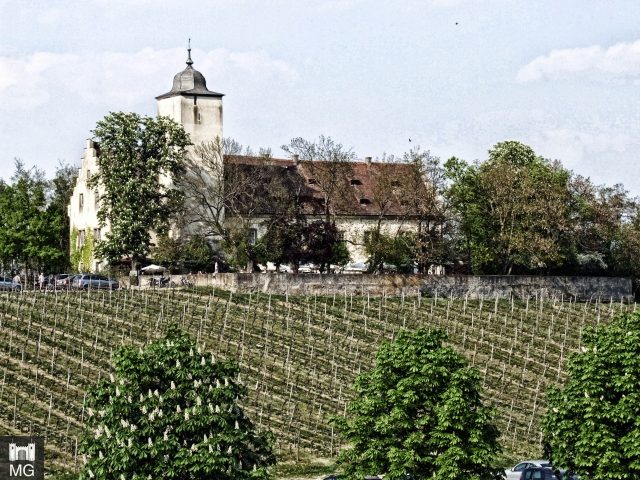
Hallburg Castle, also known as Hallburg Palace, is a hilltop castle on the 230 m above sea level Hallburger Schlossberg above the Volkach Main loop, in the district of Hallburg, a part of Volkach, in the Lower Franconian district of Kitzingen in Bavaria.
The castle, whose history is partly obscure, was owned by the Counts of Castell until 1230, who held the Vogt rights in Volkach in the 11th century. They presumably received the castle as an imperial fief and operated it as a toll castle on the Main. In 1194, an Iringo de Heliburch is mentioned in a document, who was already named in 1177 together with his father, the Schultheiss Heinrich, and his brother, the later Imperial Kitchen Master Heinrich I von Rothenburg. In 1182, he is documented as Iring von Kürnach and is assigned to the Würzburg ministerial noble family of Püssensheim. In the reconciliation treaty of January 18, 1230, Count Rupert zu Castell had to cede the castle to the Diocese of Würzburg as compensation and received it back as a collegiate fief. The brothers Berthold (1241, 1254), his brother Friedrich (1244), and an Albert (1248) are named as Castellian vassals at the castle. In 1314, the castle came into the possession of Heinrich von Hohenlohe, and the first Main toll was levied under his rule. The Fuchsen von Schwanberg received parts of Hallburg, which they sold in 1334. In 1365, the castle was transferred to Stephan Zollner zu Hallburg. The Zollners owned the castle until the 17th century. In the 15th century, feuds and storms destroyed Hallburg. In 1525, during the German Peasants' War, Volkach and Fahrer peasants plundered the Zollburg. In 1631, the Swedes occupied the castle and held Protestant services in the chapel. Above all, however, the mismanagement of the owners damaged the building, so that in 1634 the estate was no longer leased to the Zollners. In the 17th century, the complex came into the possession of the Counts of Stadion. In 1634, the administration was left to a Vogt, as the Counts hardly inhabited the castle. In 1639, the castle grounds passed to the Schenken von Stauffenberg, who remained owners of the castle until the Reichsdeputationshauptschluss. After the secularization in 1806, Hallburg came to Franz Erwein von Schönborn. In the 1840s, the use of Hallburg changed again: the secundogeniture of the Counts of Schönborn had its seat there. This was followed by frequent rentals of the castle complex; in 1866, English military moved in, and in 1869, the Russian Baron von Grothues. On September 20, 1955, the district with the castle and manor was incorporated into the city of Volkach. With the completion of the Main Canal in 1957 as a breakthrough between Volkach and Gerlachshausen, the Hallburger Schlossberg is located on the resulting wine island. Today, the castle area houses the agricultural manor and the Graf von Schönborn winery with the Schlossberg vineyard, managed by the Schönborn domain administration Wiesentheid. In addition, an inn was located in the castle until a fire in the kitchen area on May 16, 2016. The Bavarian State Office for Monument Preservation lists the remains of Hallburg under monument number D-6-75-174-269.
Architectural Description+
After several destructions and subsequent reconstruction phases, the built-up area of the castle decreased in size. It was probably twice as large as it is today. Remains of a round tower from the 13th century are preserved. A bridge construction on the castle complex is documented for the year 1454. An inventory listing was made in 1490, after which the castle was only equipped with the bare essentials, and mainly armor and crossbows were stored there. In 1492, an expansion took place. Walls, a moat, and an outer bailey were built for the first time. In the next centuries, the complex fell into disrepair after wars and uprisings. The Counts of Stadion expanded the building again. Now a spiral tower was erected next to the keep. In addition, the characteristic tower was provided with a roof truss. At that time, people spoke of an upper and a lower castle. The castle complex today has an oval ring wall. The walls are partly still preserved. The long living area from the 16th century, slightly kinked in its floor plan, is provided with stepped gables. The gable roof is interrupted by two rows of dormer windows. The natural stone window frames are partly fluted. The portals in the south of the complex have interrupted gable coverings. The four-story keep cuts in approximately the middle of the long side. The tower dates from the 13th century and is covered with a Renaissance dome. Remains of the originally existing outer bailey are located in the west of the complex. The castle chapel, which is under the patronage of Saint Pancras, is located on the ground floor of the keep. It features ribbed cross vaults and has been documented since about 1400.
Origin of the Name+
The name Hallburg (also Halburg in older works) is derived from Old High German. It is composed of the words Halle and Burg. Halle, stemming from the Old High German halla, means to hide, to conceal. Burg originated from the word Berg (mountain). Hallburg therefore means "hiding place on the mountain."
Legends+
The Zollners on Crusade+
During one of the Crusades, two brothers from the Zollner family resided at Hallburg. One was already married, the other was still single. Both joined the Crusader armies in the Holy Land and fought against the pagan Turks there. However, a great battle was lost by the Christians, and the two brothers fell into enemy captivity. After having been imprisoned for a long time but not having renounced their faith, they were sentenced to death. When the daughter of the Turkish jailer heard this, she wept because she was also inclined towards the Christian faith. Thereupon, she asked the two prisoners to include her in their last prayers. On the day of the execution, the two Zollner brothers prayed to Mary in the Vineyard, to whom they had often made pilgrimages, and also included the young Turkish woman. In a dream, Mary from Volkacher Kirchberg appeared to them and waved to them. At Hallburg, the abandoned wife of one of the Zollners also dreamed of Mary on the same night. So the next morning, the wife made a pilgrimage to Kirchberg. There she discovered two men in slave clothing and a young girl in Turkish attire. She recognized her husband among them, and all prayed. The Turkish woman became the wife of the young Zollner and was baptized at Kirchberg.
Source: Wikipedia · Licence: CC BY-SA 4.0 · Image: Mobile Geschichte
This description is a machine translation of an excerpt from the linked Wikipedia article. The source text was written by its authors, the translation is by Mobile History; like the original it is licensed under CC BY-SA 4.0.
Location: 49.8507, 10.2128