Parish office
MonasteryWürzburg
Kapuzinerkloster Würzburg
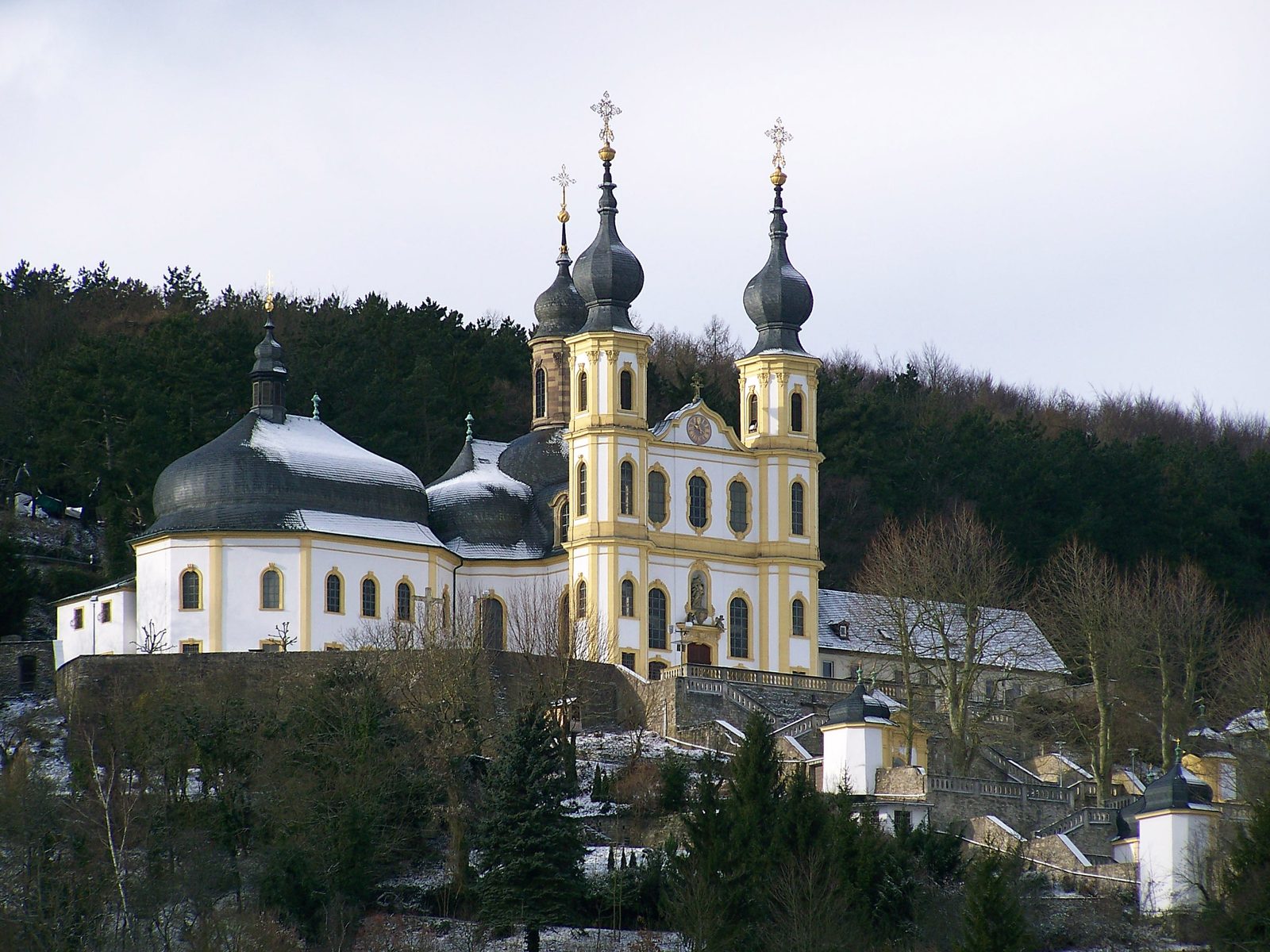
The Capuchin Monastery Würzburg consisted of two locations: the convent of St. Kilian and St. Francis, founded in the city center in 1615, and the pilgrimage settlement at Käppele, erected on Nikolausberg in 1749. Both served as pastoral and pilgrimage centers. While the inner-city complex was secularized in 1803 and destroyed in 1945, the Capuchin Monastery at Käppele existed until the departure of the last friars in 2014, marking the end of the Capuchin presence in the city.
The Capuchin Order in Franconia+
The Capuchins had separated from the Franciscans in 1528 through the bull Religionis zelus. Initially, members of the order were only allowed lay activities such as manual labor, nursing the sick, or lay exhortations, and a ban on studies was in place. Only later was the constitution revised and preaching emphasized, for which theological study was deemed necessary to fulfill their role as a pastoral order. A pastoral focus of the order lay in a very popular apostolate, which manifested itself, among other things, in penitential sermons. The Capuchins owed their popularity among Catholics primarily to their commitment to the poor, the needy, the homeless, and the sick. The habit includes a chestnut-brown habit with a pointed hood – from which the order's name is derived – a white rope belt with a rosary, a short round cloak, and sandals. Wearing a beard is also obligatory. After Pope Gregory XIII allowed the Capuchin Order to spread across the Alps in 1574, the friars quickly came to Bavaria. In 1668, the Bavarian province of the order was founded from the Tyrolean province. In 1711, the Franconian province of the Capuchins was separated from the Bavarian province due to its size. Alongside the Jesuits and Franciscans, the Capuchins were considered the strongest pillars of the Counter-Reformation in Franconia. In the present-day Diocese of Würzburg, they founded five other monasteries in the 17th and 18th centuries, in addition to the Würzburg city center monastery. Prince-Bishops Julius Echter von Mespelbrunn and Johann Philipp von Schönborn promoted settlements from 1615 onwards in Würzburg, Ochsenfurt, and Lohr, among other places.
The City Center Monastery of St. Kilian and St. Francis+
Founding and Consecration+
The Capuchin Monastery of St. Kilian and St. Francis was the first Capuchin community on Lower Franconian soil. The Capuchins came to Würzburg in 1615 after being called by Prince-Bishop Julius Echter von Mespelbrunn. Julius Echter von Mespelbrunn (1545–1617), Prince-Bishop of Würzburg and Duke of Franconia since 1573, took the lead in the Counter-Reformation in Franconia from at least 1585 and vigorously promoted the founding of new monasteries when he deemed it helpful for the goal of re-Catholicizing the diocese. In 1616, Echter von Mespelbrunn had a monastery built for the Capuchins in the so-called Neudorf (Rulandeswarte) on land he had acquired. Under Echter von Mespelbrunn's successor, Johann Gottfried von Aschhausen, the monastery and church were consecrated on October 8, 1618, by the papal nuncio Antonio Albergati, who was then in Würzburg, in honor of the Franconian missionary Kilian and the patriarch of the order, Saint Francis of Assisi. Johann Gottfried von Aschhausen (1575–1622) had governed the Prince-Bishoprics of Würzburg and Bamberg in personal union since October 1617.
Location and Work+
The monastery was located in the front part of today's Kapuzinerstraße in Würzburg's old town. This section of the street was formerly called Kapuzinergasse and before that Karthäusergasse, the latter in memory of the Carthusian monastery Engelgarten, which had settled in this area since 1348. In contrast to their brethren in the Capuchin monastery on the Käppele, who were entrusted with pilgrimage pastoral care, the Capuchins in the city center limited their activities to their origins as a Franciscan mendicant order.
Secularization and Dissolution 1803+
In anticipation of the Reichsdeputationshauptschluss, which was passed on February 25, 1803, Bavaria already occupied, among other things, the immediate Prince-Bishopric of Würzburg in the autumn of 1802. The secularization of 1802/03 brought one of the harshest cuts in the history of the Diocese of Würzburg. On April 1, 1803, the common monastic economic management was abolished throughout Bavaria. The Capuchin Monastery of St. Kilian and St. Francis was dissolved in the course of the secularization in 1803. The monastery area was fragmented into six parts and sold to private individuals.
Destruction in World War II+
During the heaviest air raid on Würzburg on March 16, 1945, approximately 82 percent of the city's building fabric was destroyed, and about 90 percent of the historic city center, including the most important architectural monuments, was severely damaged or annihilated. Around 5,000 people lost their lives. After World War II, the ruins of the monastery church of the former Capuchin monastery were still clearly recognizable.
The Capuchin Monastery on Nikolausberg (at Käppele)+
Prehistory and Origin of the Marian Pilgrimage+
The history of the Capuchin monastery on Nikolausberg is closely linked to the Marian pilgrimage to Käppele. In the midst of the Thirty Years' War, probably in 1640 or 1642, the son of a fisherman placed a wooden Pietà – a statue of Mary with the dead Jesus on her lap, which he had found on the banks of the Main – as a wayside shrine in the vineyards on Nikolausberg west of the Main. The people, ravaged by the war, sought refuge with the Mother of Sorrows. Subsequently, reports of light phenomena and healings at the site emerged. In 1653, a first wooden chapel of grace was built there, which was expanded in 1683/84 at the instigation of Bishop Konrad Wilhelm von Wernau. From then on, it had a tower. A large-scale expansion was initially not possible because the chapel was within the firing range of Marienberg Fortress. When seven nocturnal light phenomena were observed between 1685 and 1693, this was interpreted as a sign of Mary's presence at her miraculous image, and the number of pilgrims increased considerably. In 1730, the first documented mention as "Capele Käppele" occurred.
Calling of the Capuchins and Monastery Foundation+
In 1748, Oswald Loschert, the abbot of the Premonstratensian monastery Oberzell, laid the foundation stone for a new church. Capuchins were called to Nikolausberg for the permanent care of the pilgrimage site, and a simple hospice was built. Since 1749, the Capuchins have inhabited this enclosed Baroque ensemble and cared for the pilgrimage to the Mother of Sorrows. The monastery is listed in the database of the House of Bavarian History under the patronage of St. Kilian and St. Francis with the founding year 1749.
The Pilgrimage Church of the Visitation of Mary+
The pilgrimage church, consecrated in 1750, was built according to plans by Balthasar Neumann, the court architect of the Würzburg Prince-Bishops, approved by Prince-Bishop Anselm Franz von Ingelheim. Neumann's plans date back to 1736 and originally envisioned the construction of the pilgrimage church immediately adjacent to the small chapel of grace, which was actually intended to remain unchanged. In 1748, the foundation stone was laid, and a year later, the shell with the dome stood. Neumann designed a central building with two octagonal facade towers and a dome. The white-yellow church with its elegant roofscape and many domes and onion towers blends harmoniously into the landscape. The interior received magnificent furnishings in the Rococo and early Classicism styles. The frescoes by Matthäus Günther from Augsburg were completed in 1752. The organ by Christian Köhler from Frankfurt, which was reconstructed to its original state in 1991, dates from the same year. The stucco in the interior was contributed by the Wessobrunn master Feichtmayer, who later worked in Vierzehnheiligen. Only after Neumann's death, from 1778 onwards, Dominikus Ickelsheimer adjusted the height of the old chapel to match the new building. The tower was replaced by an oval dome roof with a bell turret.
Pilgrimage Piety+
After Neumann's death, Dominikus Ickelsheimer connected the chapel to the city via a monumental staircase with five terraces from 1761 to 1769. Käppele can be reached via 255 steps. In 1764, the station chapels were built on the terraces. The Würzburg sculptors Johann Peter and Simon Wagner created the 77 life-size figures of the 14 Stations of the Cross between 1767 and 1778. The sorrowful Mother with the body of her divine Son on her lap stands in a Neoclassical baldachin altar in the heart of the Chapel of Grace and probably dates from around 1640. In addition to this Pietà, there are two other miraculous images: Since 1797, a late Gothic Madonna (around 1460), originally housed by the Carmelites on Vogelsburg, has stood on the right side wall of the Chapel of Grace. In the miracle corridor behind the Chapel of Grace, there is also a so-called Black Madonna, a copy of the Mother of God of Altötting. Countless votive offerings are also displayed there.
Brotherhood of Our Lady of Sorrows+
Since 1754, the Brotherhood of Our Lady of Sorrows has celebrated its monthly service at Käppele. Bishop Franz Jung of Würzburg emphasized in 2024, on the occasion of the church's 200th consecration anniversary, that the fact that the pilgrimage to Käppele did not cease and the consecration of the church – delayed by war and secularization until 1824 by Bishop Adam Friedrich Groß zu Trockau – was certainly due to the Brotherhood of Our Lady of Sorrows, which has supported the pilgrimage since its founding in 1754. As of September 2024, the brotherhood still has around 950 members.
Exemption from Secularization 1803+
Unlike the city center monastery of St. Kilian and St. Francis, the Capuchin monastery on the Käppele was spared from secularization. The consecration of the pilgrimage church, delayed by war and secularization, only took place in 1824 by Bishop Adam Friedrich Groß zu Trockau.
World War II and the Rescue of Käppele+
During the bombing raid on Würzburg on March 16, 1945, Käppele was largely spared from bombs, presumably due to its secluded location in the vineyard. Although half a dozen phosphorus incendiary bombs fell on the pilgrimage church, the fire was extinguished in time. The only visible sign was a hole in the church roof above the organ. On April 4, 1945, members of the Waffen-SS wanted to destroy the church, as US artillery observers were suspected in the towers. The anti-aircraft gun commander Ludwig Herrmann (1910–1979) from Geldersheim saved the pilgrimage church on Nikolausberg from destruction through skillful disobedience, by not aiming his anti-aircraft gun, repurposed for ground combat, from its position at the Sieboldshöhe water tower at the opposite Käppele as ordered, but by explaining that he had orders to hold back the advancing US Army in Heidingsfeld and had only little ammunition left. That same evening, he was severely wounded in both legs by shrapnel. The interior of the church was thus preserved for posterity, and Käppele is one of the very few churches in Würzburg that were spared during the destruction of the city in 1945. Only in 1970 was Herrmann's rescue act published in the monastery chronicle by Guardian Pater Rainer Seidl OFMCap. The Capuchins invited Herrmann as a guest of honor to Käppele to thank him 25 years after the event for preserving Käppele. The market town of Zell am Main posthumously named a street after Ludwig Herrmann.
Restorations in the 20th and 21st Centuries+
A major interior restoration of Käppele took place from 1973 to 1976. From 1994 to 1997, an exterior restoration and renovation of the dome roofs and tower spires took place. The Stations of the Cross with station chapels were extensively renovated from 2002 to 2006 for 4.4 million Euros. In the winter of 2010/11, damage was found on the small domes at the transition to the Chapel of Grace. A renovation costing 40,100 Euros was carried out in 2011 by the Episcopal Building Authority and the State Office for Monument Preservation.
Departure of the Capuchins 2014+
In March 2014, the German Capuchin Province and the Diocese of Würzburg jointly announced that the Capuchins would leave Käppele in October of the same year. Father Marinus Parzinger, Provincial Minister of the German Capuchin Province, wrote to Würzburg's Bishop Friedhelm Hofmann: "This marks the end of a long tradition at this sanctuary, so significant for Franconia. We regret this step, but the personnel situation forces us to reduce and concentrate." The order lacked new recruits, and with the departure, the last Capuchin community disappeared from the Diocese of Würzburg. The three remaining fathers – Father Siegbert Mayer (then 72 years old), Father Matthias Doll (71), and Father Joachim Wrede (59) – bid farewell to Käppele on October 19, 2014, with a festive service. Bishop Hofmann from Würzburg and Provincial Father Marinus Parzinger from Munich also attended the farewell mass. After more than 260 years, the Capuchin presence at Käppele thus ended. The pilgrimage church is administered by the Käppele Church Foundation. The monastery and garden were the property of the Capuchin Province, which intended to sell the building and property to the Diocese of Würzburg.
Subsequent Pastoral Care+
From November 1, 2014, diocesan priest Josef Treutlein took over as the new rector and diocesan pilgrimage chaplain at Käppele. He also assumed the office of president of the Brotherhood of Our Lady of Sorrows. In 2024, the pilgrimage pastoral care passed into new hands. As of January 1, 2024, the two Franciscan Minorites, Brother Franz-Maria Endres and Brother Josef Fischer, each took over half of the pastoral care at Würzburg's Käppele. On Sunday, September 15, 2024, they celebrated the 200th consecration anniversary of the pilgrimage church. Bishop Franz Jung of Würzburg presided over the festive service.
Take Mobile History with you
You are reading this text for free. Premium adds what matters on the road: descriptions read aloud, sites found through your camera, whole regions taken offline.
- Every description, including the ~17,700 Premium sites
- Audio guide: have descriptions read to you on location
- AR finder: see sites through your camera, with distance and bearing
- Unlimited saved sites
14 days free, then from €2.99 a month. Cancel anytime.
Source: Wikipedia · Licence: CC BY-SA 4.0 · Image: Tors · Wikimedia Commons · Public domain
This description is a machine translation of an excerpt from the linked Wikipedia article. The source text was written by its authors, the translation is by Mobile History; like the original it is licensed under CC BY-SA 4.0.
Location: 49.7843, 9.9218