The church can be visited
ChurchKleinlangheim
Kirchenburg Kleinlangheim (Church Castle)
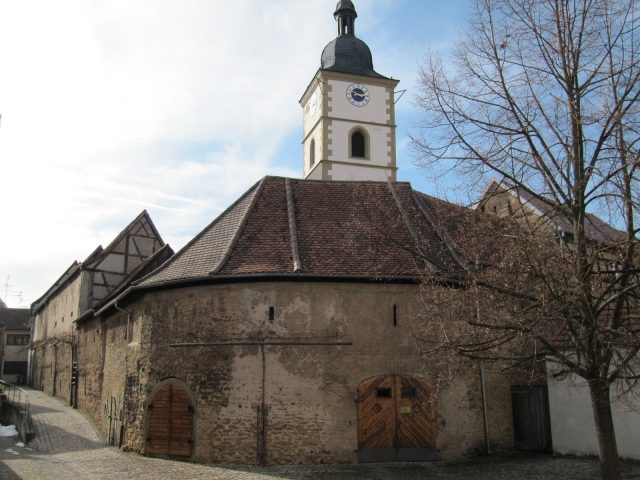
The fortified church of Kleinlangheim is a fortified church from the 12th century in the old village center of the municipality of Kleinlangheim in the Lower Franconian district of Kitzingen.
History+
Predecessor Churches+
Traces of the first churches in Kleinlangheim before the mid-7th century were found during an excavation in 1972–1973 for the installation of heating. In the nave of St. Georg and Maria, experts found Romanesque remains as well as an older stone base and evidence of wooden predecessor buildings. Furthermore, a note in the parish records indicated that there was a chapel in the tower. This was confirmed during excavation work under the floor by the discovery of an altar foundation in the middle of the rectangular apse under the tower. The vitrified sandstones and post holes told of a destructive fire of the probably wooden predecessor church. Striking fragments also allowed for the reconstruction of a stepping stone made of yellowish boundary dolomite and parts of a sigma-shaped altar plate. From the discovered consecration cross, the original size of the table can be estimated at 0.78 meters in length and 0.40 meters in width. Next to the consecration cross, there was also a sealed cuboid recess. This could have contained relics. Consecrated remains from the fire-destroyed predecessor churches built in half-timbered style were left in the altar area of the subsequent building. Around the 10th century, the half-timbered buildings of the first churches were replaced by a stone church and supplemented with a choir tower. This is still preserved today.
Fortification+
Since Carolingian times, fortified churches have been found in Franconia. They served as refuges for the protection of farmers. The rural population suffered particularly from the power struggles of the feudal lords. They were also threatened by wandering soldiers and riff-raff. The church was usually built of stone and covered with tiles. This offered protection from fire and was most suitable for defense. Furthermore, it was a sacred place that offered asylum. Even enemies respected the consecrated area of the church building and the churchyard. The house of God was originally surrounded by the cemetery. In the 12th century, the church and cemetery were fortified with strong, high walls made of hard boundary dolomite from the surrounding area. The masonry was laid in herringbone or ear-of-corn bond ("opus spicatum"). Finally, the surrounding wall was expanded into a refuge. Battlements were built and gaden (small houses) were added inwards against the churchyard wall. These consisted of storage cellars and small houses. In them, the village families could store important belongings and provisions for emergencies. On the outside, they consisted of the solid defensive wall without windows but with loopholes. The respective owners had to ensure their upkeep. Due to lack of space, the inhabitants also built the charnel house. As further security, stakes were erected before the excavation of the artificial moat. Its traces can be discovered in the vicinity of the town hall. The only access was protected by a drawbridge and a gatehouse. The latter was probably built in 1487 and used as the first town hall. The mentioned year is above the round arch. Even today, visitors can enter the churchyard through this access and appreciate the strength of the ring wall. The fortified church of Kleinlangheim was first mentioned in 1416, when it served as a base for the Burgrave of Nuremberg in the First Margrave War. Bishop Johann was able to plunder "much property, wine and grain that the farmers had fled into it". Further destructions took place in 1554 and during the Thirty Years' War. In 1648, the sources describe the destructions as follows: "So the stakes in front of and around the churchyard were burned, the churchyard gates, church and church house doors, as well as the roofs were smashed...".
Dismantling+
After the Margrave Wars and the Thirty Years' War, the fortified churches lost their importance for defense in times of war. Much of what was destroyed fell into disrepair. Only individual gaden underwent numerous alterations and major demolitions for agricultural purposes by their owners. From 1700, the inhabitants of Kleinlangheim leveled the moat and created space for buildings or gardens. Today, fortified churches, beyond their historical function of defensiveness and protection, have symbolic character for individuals and for the community. They represent a symbol for God. The gate is open to the village as a sign that the church turns to the people. It invites to silence and strengthening or to events of the local community. For more than 20 years, the municipality of Kleinlangheim and the Förderverein Kirchenburg Kleinlangheim e. V. (Association for the Promotion of the Fortified Church of Kleinlangheim) have been striving to renovate and preserve the remains of the fortified church. Thus, they have a suitable setting for events.
Source: Wikipedia · Licence: CC BY-SA 4.0 · Image: https://commons.wikimedia.org/wiki/File:KibuKl.JPG
This description is a machine translation of an excerpt from the linked Wikipedia article. The source text was written by its authors, the translation is by Mobile History; like the original it is licensed under CC BY-SA 4.0.
Location: 49.7709, 10.2858