The church can be visited
MonasteryStuhr - Heiligenrode
Heiligenrode Abbey
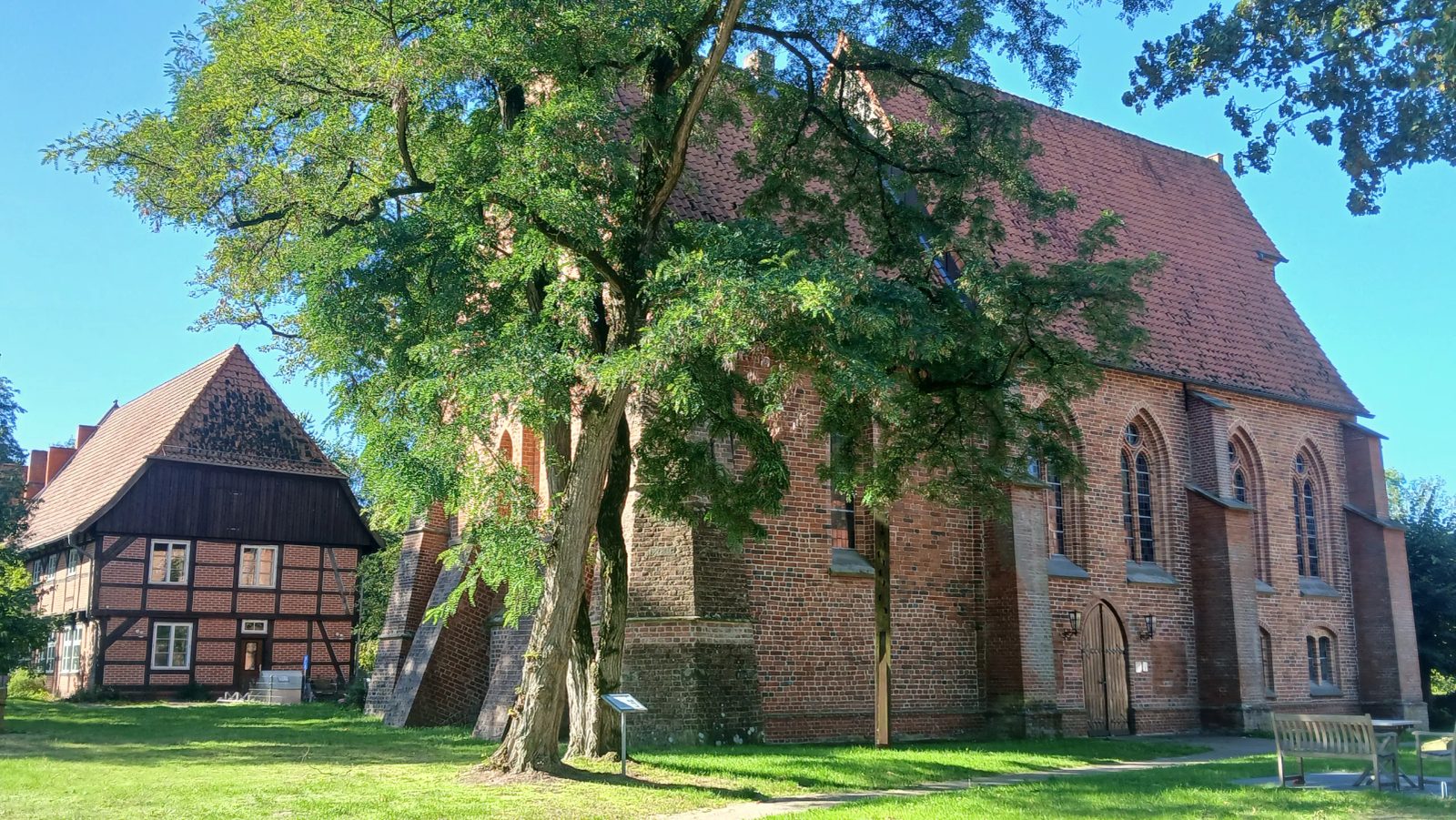
Heiligenrode Abbey was a Benedictine nunnery in Heiligenrode, today a district of the municipality of Stuhr in the district of Diepholz, Lower Saxony, located in the County of Hoya at the time of its foundation. The abbey was initially mentioned in a single document as a double monastery, but in all later mentions it is a pure nunn monastery. The abbey church of St. Marien (Heiligenrode) still exists today as an Evangelical parish church.
Foundation and History+
The abbey was founded around 1181 to 1183 by Friedrich von Mackenstedt, a ministerialis of the Archbishops of Bremen, on lands in Bremen's possession, near his own seat, which was probably located in today's Groß Mackenstedt. Friedrich von Mackenstedt was at that time active as a locator, settling settlers in the region, i.e., cultivating the swampy and sparsely populated landscape. The region of the abbey was called "Neubruch," so it was probably a Bruch, i.e., swamp or moorland. For his measures, including the foundation of the abbey, he obtained the permission of Bishop Balduin I of Bremen and Duke Henry the Lion. According to a (lost) document of Bishop Siegfried, issued between 1181 and 1183, Friedrich possessed the hereditary Vogtship over the abbey. The first (not preserved) abbey church was consecrated in 1189. In a document issued for this purpose by Bishop Hartwig II, in which Friedrich's rights and possessions, as granted by Bishop Siegfried, were confirmed, the abbey is referred to as a double monastery ("claustrum famulorum famularumque dei"). It is also the first documented mention of "heilgenrodhe". In all later documents, even during Bishop Hartwig's lifetime, only a nunnery is mentioned. The management of the abbey was in the hands of a provost and a prioress. The first provost mentioned was Theoderich in 1205; the first prioress known was Margarethe in 1288. The provost represented the abbey at the county's Landtage. It was exempt from all ground rents and possessed lower jurisdiction in its possessions. The conventuals came from the lower nobility of the region, partly also from the Bremen patriciate. Donations (endowments) of rights or land ownership are attested by the local landed gentry, the Archbishops of Bremen, the Counts of Hoya, the Counts of (Oldenburg-)Bruchhausen and of Oldenburg. Many endowments were probably part of the nuns' dowry. After the Oldenburg counts had won the Stedingen War, however, they disputed the abbey's possessions in Oldenburg. Allegedly, the abbey was so impoverished at the end of the 13th century that the nuns had to beg for alms. The situation improved under Provost Ludolf (mentioned in 1288) with the support of Bishop Giselbert von Brunkhorst. A settlement was reached with Count Moritz von Oldenburg, who later became Archbishop of Bremen himself after a long struggle, regarding the disputed Vogtship of the estates in Stuhr. The 14th century is therefore considered the heyday of the abbey, which possessed enough funds to build the abbey church that still exists today. The abbey acquired further lands by purchase to round off its possessions. For example, a hide of land was bought from Bassum Abbey, which was in economic difficulties at the time. With the rise of the bourgeoisie, bourgeois foundations, for example for altar consecrations in the abbey church, are also known since the 14th century. Overall, however, a decline in the economic situation began in the mid-15th century. In a document from 1494 by Bishop Heinrich, he states that many goods had been sold, wasted, and for the most part squandered and destroyed over time. Under the last provost Eggert Segelking (from 1457), both monastic discipline and possessions are said to have suffered further. Prioress Mechthilde Hilgen tried to improve the situation by having the abbey join the Bursfelde Congregation on her initiative. The provost then resigned his office; already in 1487, two years before his death, he was no longer in office. Mechthilde Hilgen was elected abbess by the nuns in 1496 under the new rights. The nuns of the abbey received the right from Bishop Johann III to elect a new abbess themselves in case of a vacancy. Since the reform, lay sisters were also admitted to the convent. The economic situation was also improved by elderly people who bequeathed their assets to the abbey and were admitted to the abbey as prebendaries (Low German Prövener) until their death.
Evangelical Convent for Noble Ladies+
Already under the second abbess Beke Zirenberg (from 1524), the Reformation was introduced in the Archdiocese of Bremen. This was actively promoted by the sovereign, Count Jobst II. Contrary to his wishes, and unlike the other monasteries and convents in the county, the abbey initially remained Catholic. Count Jobst reacted by abolishing the abbey's exemption from taxes, which now had to pay him the usual ground rents. The abbey's possessions located in other (Protestant) lordships also became taxable. Although Abbess Beke Zirenberg obtained a letter of protection from Emperor Charles V in 1540, which appointed the Catholic Welf Duke Henry the Younger as protector of the abbey, this did not lead to an end of the disputes. Under Abbesses Wommele Wachmann (1549–1554) and Margarete Bokemann (1554 to 1560), the abbey remained Catholic, but under constant dispute and economic decline. After the death of the last abbess, Heiligenrode finally also became Protestant. However, the former Benedictine nunnery was not dissolved, but converted into a secular evangelical convent for noble ladies. The first evangelical abbess (often called domina in the documents) was Hille Zirenberg in 1570, previously prioress in the abbey. However, the difficulties were not resolved. In 1592, Abbess Dorothea von Horn resigned due to immense debts and disputes among the convent members; she asked Duchess Hedwig to propose a successor, as no one from the better-off convents in the region was willing to move to poor Heiligenrode. After some back and forth, Katharina Nagel from Bassum Abbey was appointed abbess in 1602. Despite many attempts, the restructuring of the abbey's finances failed, and debts accumulated. In 1620, Duke Friedrich Ulrich drew the consequences and confiscated all abbey properties to settle the debts. The canonesses received a fixed income. After the death of the abbess (domina) Margarethe Drewes in 1634, the office was no longer filled. The respective sovereign was now considered the abbess; only a vicedomina was entrusted with the administration of the convent on site as her representative. During the Thirty Years' War, the abbey was severely affected. Foreign troops were quartered multiple times, and the church and abbey buildings were severely damaged, partly destroyed. In 1634, further goods were sold to repair the damage. In 1642, damage had to be repaired again. Despite the poor economic situation, the abbey was still one of the largest in the duchy. For 1603, nine conventuals and 13 converses are attested. Duke Wilhelm zu Harburg limited the number of conventuals to four in 1637. However, this was later circumvented by admitting "extraordinary" conventuals. In 1774, the following are mentioned: one vicedomina, four ordinary conventuals (three noble, one bourgeois), five extraordinary conventuals (three noble, two bourgeois). Since 1642, however, there were no more lay sisters. Administratively, the abbey and its possessions formed a separate abbey office within the Syke office from about 1700 to 1822. It still possessed civil jurisdiction over the "servants on the abbey estate and in its district." The last Amtmann, Friedrich von Spilker, died in 1801. After that, only an administrator was appointed. In 1802, this administrator had the building with the conventuals' residences demolished. The conventuals now lived elsewhere, each on her own; belonging to the convent became a pure prebend that provided them with income. Due to mismanagement, the administrator was dismissed in 1816. The abbey estate, now a state domain managed by a tenant, was dissolved, and the remaining abbey buildings were largely demolished. In 1822, the Heiligenrode office was dissolved and incorporated into the Syke office. The last vicedomina died in 1878, thus abolishing the title. New conventuals were admitted until 1943. In 1946, there were still six conventuals. Their prebends were now paid by the Klosterkammer Hannover. With the death of the last conventual in 1965 (in Hameln), the convent was finally history.
Possessions+
The abbey had extensive landholdings in the region, especially in the newly settled land around Heiligenrode itself. The farmers working here had to pay taxes to the abbey until the abolition of feudal burdens in modern times. Around 1630, the administration of the abbey's estates passed to the State Domain Chamber in Hanover, later the Klosterkammer Hannover. In the 18th century, the convent still owned two outworks in Heiligenrode and Brokhuchting, a mill (the still existing Heiligenrode Abbey Mill), various tithes, 82 farms (Meier and Kötner), the Kirchseelter Holz as abbey forest, various hunting and fishing rights in the region. It was the patron of the parish church of St. Martin in Mackenstedt (today destroyed). The Heiligenrode domain alone had 850 hectares of land in 1790 and received tithes and revenues from another 3500 hectares of privately managed farmland. When the Heiligenrode outwork was dissolved, the land was divided among ten new farmers.
Buildings+
The preserved abbey church of St. Marien is today the Evangelical parish church. The current building, a single-nave Gothic brick building almost 22 meters long, was built around 1300. Beneath the high altar was the abbesses' crypt, to which a staircase in the northeastern corner led down. During foundation work in 1853, four burial chambers covered with stone slabs were found. The westwork originally housed the nuns' choir; it was demolished in 1805 to install a new gallery. The interior was thoroughly renovated in 1853. The building responsibility for the church passed to the regional church or the local community in 1955. Only a dormitory and a "stone house" are mentioned in documents. There is no evidence of a former cloister. In 1583, the main buildings (besides the separate economic buildings) included: a chapter house, a dormitory for the conventuals, which also contained the refectory on the ground floor. The building adjoined the west wall of the abbey church; today, the old roofline and a bricked-up entrance are still visible here. A dormitory for the converses was also built of stone; the other outbuildings were made of wood and thatched. These included a gatehouse, a porter's lodge, a kitchen building, the rectory, stables, and sheds. In a survey by the sovereign in 1592, most buildings were assessed as dilapidated. After the destructions of the Thirty Years' War, many buildings were renovated in half-timbered construction. None of the abbey buildings, with the exception of the church, have been preserved. The last major building, the renovated dormitory of the conventuals, built at an angle, was demolished after 1800. However, the rectory built in 1799 has been preserved. The entire abbey district was surrounded by water. In addition to the abbey stream and the mill race, other moats (Gräften) were laid out. Some of them were used as fish ponds.
Take Mobile History with you
You are reading this text for free. Premium adds what matters on the road: descriptions read aloud, sites found through your camera, whole regions taken offline.
- Every description, including the ~17,700 Premium sites
- Audio guide: have descriptions read to you on location
- AR finder: see sites through your camera, with distance and bearing
- Unlimited saved sites
14 days free, then from €2.99 a month. Cancel anytime.
Source: Wikipedia · Licence: CC BY-SA 4.0 · Image: Foto: Jörg Heldt (Community)
This description is a machine translation of an excerpt from the linked Wikipedia article. The source text was written by its authors, the translation is by Mobile History; like the original it is licensed under CC BY-SA 4.0.
Location: 52.9831, 8.7069