Boarding school Urspringschule
MonasterySchelklingen
Urspring Abbey
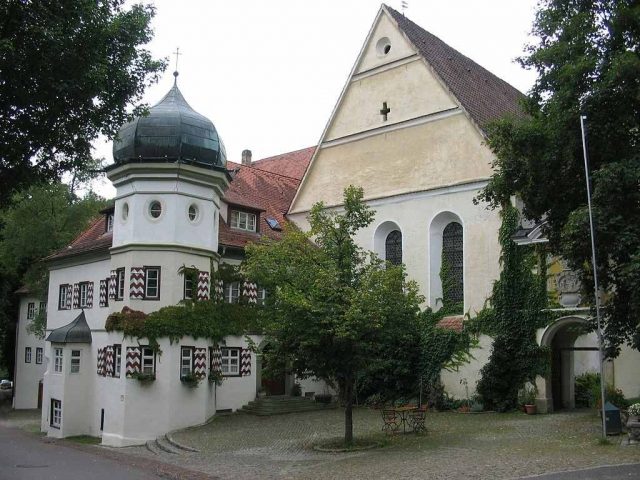
The Benedictine convent of Urspring in Urspring near the town of Schelklingen, founded (after) 1127, dissolved 1806, was a priory of the monastery of St. Georgen in the Black Forest.
History+
Presumably in the 10th century, the spring area of a stream southwest of Blaubeuren near Schelklingen was settled, which received the name "Urspring(en)" after this spring and stream and was part of the Swerzenhuntare. Urspring is first mentioned in a document from 1127, which has only survived in copy. A founding family – three brothers named Rüdiger, Adalbert and Walther – handed over the place Urspring with the church to the monastery of St. Georgen in the Black Forest, represented by Abbot Werner I and the convent. Count Diepold II of Berg (1116/27–1160/66) was entrusted with the vogtei over Urspring. That Benedictine nuns moved into Urspring soon after is evident from later tradition. It is even known that the nuns came from St. Georgen's daughter monastery Amtenhausen. Pope Alexander III's privilege for St. Georgen from 1179 clearly speaks of Urspring's subordination to the Black Forest monastery. The cella, the priory, the daughter monastery, was a women's convent dependent on the Black Forest monastic community "in the right of ownership" of St. Georgen. Although there are no reports to this effect for the 12th century, it can be concluded from later tradition that the women's monastery housed a prior. This was a monk from St. Georgen as a representative of the Black Forest monastery on site. At the same time, the prior functioned as the parish priest of the monastery church, spiritual director and confessor of the nuns. In the first hundred years of its existence, the monastery of Urspring must have been poor. No donation of goods is recorded until 1237. Accordingly, one can only assume a small women's convent, which was under the direction of a mistress (magistra). Since the 13th century, better sources are available for the Benedictine convent of Urspring. After the destruction of the monastery in the battles between the Staufer King Konrad IV and supporters of the papal party (1246/1247), the community of nuns was able to recover. This is evident from a bull of Pope Alexander IV (1254–1261), which he issued for Urspring on March 8, 1258. In the following period, Urspring gained greater prestige – also because it increasingly moved away from its Benedictine monastic foundations – among the noble families of the area, who could now appropriately accommodate their daughters, who were now endowed with their own property. St. Georgen could not and would not counteract this development, especially since – it seems – the women's monastery gained some independence from the monastic community in the Black Forest. Its own seal (1258/1275), the hardly ascertainable involvement of the St. Georgen abbot in Urspring property purchases and sales, a largely absent spiritual and legal supervision over the women's monastery prove this, despite the codification of St. Georgen's rights in a document of April 14, 1328. St. Georgen, which was not reformed itself, was only indirectly involved in the Bursfeld monastic reform for the diminished Urspring women's convent (1475). However, the monastery of Urspring remained subordinate to St. Georgen. The Reformation also did not change this (1536/1566); Urspring had been under the direction of the Catholic abbot of St. Georgen, who resided in Villingen, since 1566. Only disputes in the Urspring convent after the election of Abbess Maria Abundantia von Barille (1797–1806/15) led in 1802 to St. Georgen renouncing its rights in Urspring. The Benedictine convent was secularized in 1806. Today it houses the Urspringschule boarding school.
Mistresses and Abbesses+
Preserved Buildings of the Monastery+
All former monastery buildings are listed as historical monuments and have been entered in the list of Schelklingen architectural monuments.
The monastery church of St. Ulrich, newly built after the fire of the 17th century. The church tower, late medieval in its lower stories, bore an onion dome until the end of 1832: this was removed …
Source: Wikipedia · Licence: CC BY-SA 4.0 · Image: http://commons.wikimedia.org/wiki/File:Kloster-urspring.jpg
This description is a machine translation of an excerpt from the linked Wikipedia article. The source text was written by its authors, the translation is by Mobile History; like the original it is licensed under CC BY-SA 4.0.
Location: 48.3819, 9.7188