The church can be visited
ChurchLohr am Main
St. Michael Church
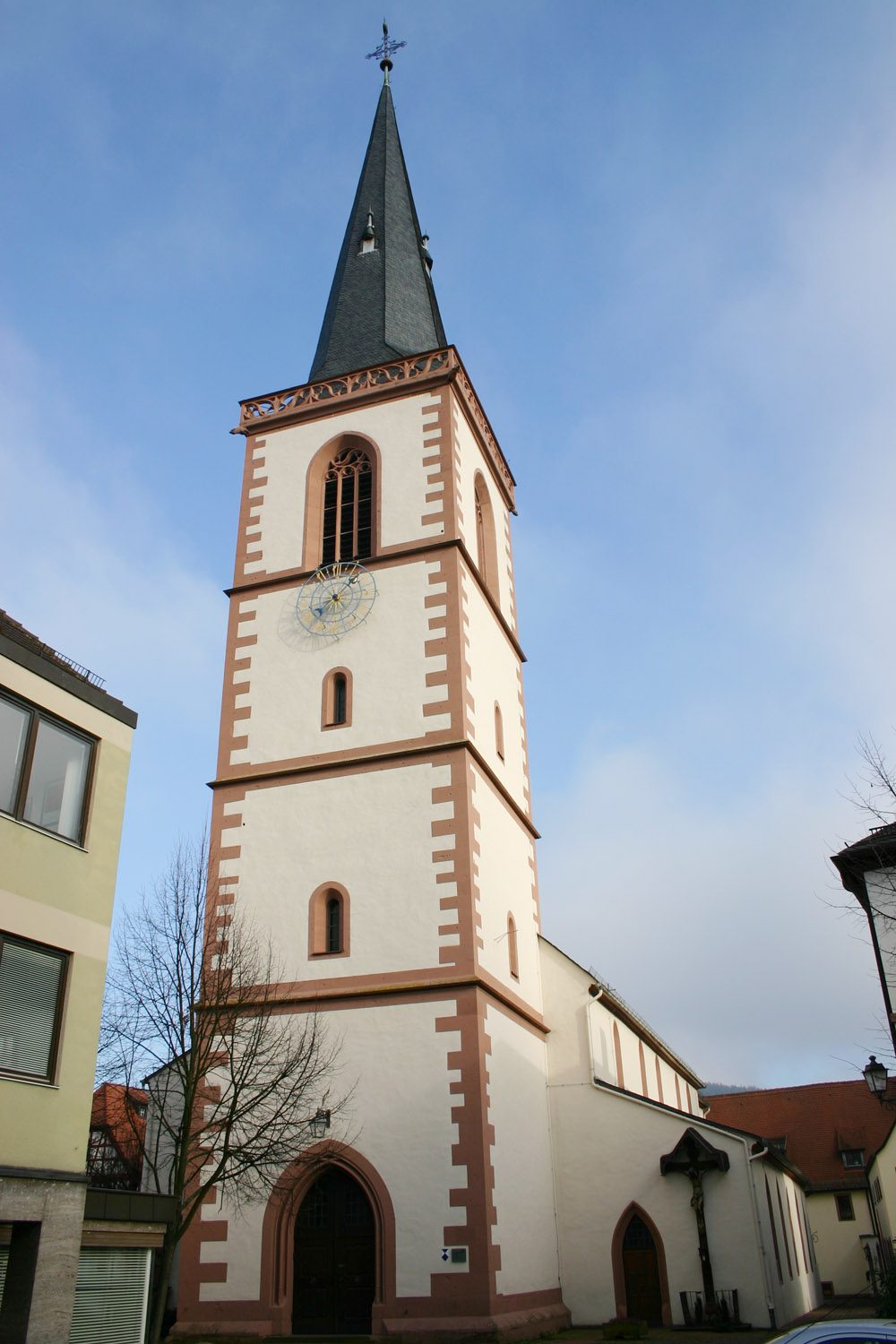
The Roman Catholic parish church of St. Michael is a listed church building in Lohr am Main in the Main-Spessart district (Bavaria). The parish belongs to the Main-Spessart deanery in the Diocese of Würzburg. The church tower, together with the Bayersturm and the castle, shapes the townscape. The church is located on the former castle grounds of the Counts of Rieneck on the edge of Lohr's city center.
History+
The current parish church is aligned exactly to the east. It is said to have originally been under the patronage of St. Martin. In addition to the filial churches of Sackenbach and Wombach, the parish also included the villages of Langenprozelten, Nantenbach, Rodenbach and Neuendorf, but hardly any information about them has been preserved. A parish administrator named swickerus plebanus in Lare was first mentioned in a document in Lohr in 1295. Another priest, notary and head of the church, named Johann, was mentioned in 1316. It can be assumed that due to the patronage of Martin, the parish is much older, but there is no evidence for this. Initially, the Lords of Rieneck acted as patrons. Alfons Ruf carried out excavations in 1978 and was able to prove several predecessor churches dating back to the seventh or eighth century. Possibly an earlier wooden building, not clearly verifiable, which probably stood at the southeastern corner of the present nave, is even older. The church building was first a castle chapel, it also served the settlement around the castle as a parish church and was repeatedly expanded as the settlement grew. During the excavations by Alfons Ruf, shards from the Hallstatt-La Tène period were recovered near the pulpit, i.e. in the area of the oldest church; the church hill was probably already settled in Celtic times. In the 10th and 11th centuries, the now elongated building was extended northwards. The chancel of the resulting single-nave church was recessed, ending in a round apse. The building was probably early Romanesque in style and about as wide as the present building, but only half as long. Somewhat later, a tower was added on the west side; its foundation was excavated in the area of the western bay. The present sacristy was built in the 12th century as a cemetery chapel, it was freestanding to the north and west and was accessed by a round-arched sandstone portal located in the west, now walled up.
Around 1300, due to the growth of the population, an extension became necessary. Side aisles were added to the north and south sides, and the former longitudinal walls were dissolved by round-arched arcades, which still define the interior today. A three-nave Romanesque pillar basilica was created. For the construction of the southern side aisle, buildings north of the former castle district of the Rienecks had to be demolished. Between 1488 and about 1500, the last fundamental changes were carried out. The Romanesque choir was demolished and replaced by a higher late Gothic hall choir with pointed-arched tracery windows. For this, the three naves had to be raised. The side aisles and the clerestory zone received new pointed-arched windows, documented by the year 1488 in the reveal of the eastern window of the northern side aisle. The nave was extended by two pointed-arch bays to the west and the Gothic west tower was erected, the start of construction of which is documented by the year 1496 above the portal. A pointed-arched portal, the so-called Sackenbacher Tor, was inserted into the outer wall of the northern side aisle.
In 1543, the Reformation arrived in Lohr and the church became Protestant. In 1559, after the death of Philipp III. von Rieneck, Lohr fell to the Electorate of Mainz. As was customary in Protestant churches, side galleries were also installed in St. Michael in 1596. Erasmus Schraum from Karlstadt decorated them with historical paintings. The Counter-Reformation began in 1603 under Elector Johann Adam von Bicken. A new high altar was erected in 1605 and repaired and reframed by Erasmus Schraum in 1627. In 1671/72, a new high altar was acquired from the sculptor Lenhart Caspar from Karlstadt, with an altarpiece painted by Sebastian Vogt from Karlstadt and statues of Saints Michael, Rochus and Sebastian. When new windows were installed in 1710, all Gothic tracery, with the exception of the central choir window, was removed. A Fourteen Holy Helpers altar was probably erected as the right side altar in 1714 and removed again in 1796. In 1796, the high altar was demolished and replaced by a classicist one. Georg Schäfer from Karlstadt took over the carving work on this altar. Two years later, Schäfer made two side altars in the same style and the pulpit in 1804. In the second half of the 18th century, new vaults were installed in the sacristy and choir. Renovations were carried out in 1868/69 and 1889/90. During these, the south portal was walled up, an oratory was installed above the sacristy, the dilapidated roof truss was removed and a new one was rebuilt more than three meters lower. After the removal of the three classicist altars, the church received winged altars in the Neo-Gothic style, which belong to the current furnishings: the high altar in 1890 and the two side altars in 1905. Heinz Schiestl created the Stations of the Cross for the church in 1916.
A more comprehensive renovation took place in 1928/29. At that time, the side galleries from the Reformation period were removed. Instead, Oskar Martin-Amorbach provided the high walls of the nave with six frescoes. On the north wall, he designed the motifs Adoration of the Magi, Entry of Christ into Jerusalem and the Crucifixion of Jesus (from west to east), on the south wall the Resurrection of Jesus, the Sending of the Holy Spirit and the Last Judgment with Mary and John the Baptist as intercessors (from east to west). The fresco of the Sending of the Holy Spirit was whitewashed during the 1963 renovation, all others were painted over in 2015. The gallery on the west side was enlarged and ornamentally painted by a painter Angermeyer from Munich. However, his painting was removed again in 1979. A Rabitz vault was installed in the choir and flat Neo-Romanesque wooden coffered ceilings were installed in the central and side aisles. Further minor interior renovations were carried out in 1951, 1963, 1978 and 1980, the exterior was renovated in 1966. Hermann Amrhein created an ambo in 1964 depicting the four evangelists and their symbols, which was moved to the tower vestibule in 2015. In 1980, the west gallery was altered and a new organ was installed.
Architectural Description+
The data from the Bavarian State Office for Monument Preservation: Romanesque sacristy with round apse 12th century, essentially late Romanesque nave 13th century, late Gothic choir and tower 2nd half of 15th century.
Furnishings+
Since the 16th century, records of the acquisition of objects for the interior furnishings have been preserved. Not all of the numerous works by various artists and craftsmen are still present; they were lost over time or replaced to suit contemporary taste. The current furnishings predominantly date from around 1900.
Choir+
High Altar
The high altar was built in 1890 by Franz Wilhelm Driesler from Lohr in the style of historicizing Neo-Gothic. The necessary carpentry work was carried out by Josef Fleckenstein according to Driesler's instructions. The reliefs on the wings and in the central part show the mysteries of the Sorrowful Rosary. From left to right, the motifs are Christ on the Mount of Olives, Flagellation, Crowning with Thorns, and Carrying of the Cross. The fifth mystery, his Crucifixion, is inserted elevated in the center of the altarpiece above the tabernacle and remains visible even when the wings are closed. In the predella, the four evangelists are depicted seated with their symbols. On the antependium, the sacrifice of Melchizedek, the sacrifice of Isaac, and the raising of the bronze serpent can be seen. The outer sides of the wings are painted with the Expulsion from Paradise and the Archangel Michael's fight with the devil. The central shrine is flanked by figures of the Apostles Peter and Paul, which are not visible when the wings are open. The altar is crowned by a pinnacle work consisting of tracery, finials, and two carrying consoles, each with an angel sculpture. In front of the high altar, under the choir arch, stand the celebration altar, an ambo, and a priest's seat, which were created in 2015 in the Arnold and Eichler studio. They are made of bronze in a cube shape, hollow inside, with open sides. The visible, radiant golden inner surfaces of the altar and ambo are decorated with vine leaf patterns. In the center of the altar floor, a small pyramidal rock crystal stands above the spot where relics of St. Martin, St. Barbara, and Blessed Liborius Wagner are located. Above the altar, at the apex of the choir arch, hangs a larger-than-life crucifix, created around 1550. On the sides of the choir room, the early Baroque choir stalls are set up, dating from 1654 by Valentin Maher from Lohr.
Stained Glass Windows
The five colored stained glass windows in the choir were made by the court glass painting workshop Zettler from Munich between 1899 and 1904. They show the mysteries of the Glorious Rosary: Resurrection and Ascension of Christ, the Sending of the Holy Spirit, the Assumption of Mary into Heaven and her Coronation. A sixth window (from 1904) in the northern side aisle next to the Cross Altar depicts the vision of Christ by Saint Margaret Mary Alacoque.
Epitaphs
From the beginning of the 15th century, the choir of the church served as a burial place for the Counts of Rieneck. The tombs from the 15th and 16th centuries are important testimonies to Würzburg sculpture in the late Gothic period. On the northern side of the choir, to the left, stands the epitaph for Count Ludwig von Rieneck; he died in 1408. It is carved in sandstone and shows the count standing in full armor on a lion, a symbol of bravery. To the right of it is the tombstone for Elisabeth von Rieneck, née von Castell, who died in 1419. This is followed by a 2.75 m high inscription tablet for Philipp III, the last Count of Rieneck in Lohr, whose life ended in 1559. Peter Dell the Younger created this tablet. The next epitaph is made of red sandstone and shows Margaretha von Rieneck, née von Eppstein and Königstein, whose year of death is given as 1463. The series concludes with a black inscription tablet from 1574, commemorating Philipp III's widow, Margarethe, née Countess von Erbach. On the southern choir wall, next to the high altar, is the epitaph of Count Johannes von Rieneck (1363–1401), who was a parish priest in Lohr. He is depicted in choir vestments with a dog at his feet as a symbol of loyalty to God and the Church. His tomb is the cover plate of a tumba. The tomb next to him is dedicated to Thomas II von Rieneck (1386–1431), the husband of Countess Elisabeth. The very plastic figure stands on a lion with a spear and sword. The last monuments in this series are the epitaphs of Count Reinhart von Rieneck (1497–1518) and his wife Agnes von Rieneck, née von Gleichen, who died in 1519, who also stand on a lion. These two tombs already show the transition from Gothic to Renaissance. On the south choir wall, above the choir stalls, is a richly decorated alabaster epitaph for Georg Friedrich von Kerpen, who died in 1629 at the age of ten weeks. In the central field, a Pietà framed by columns is flanked by John the Baptist and Catherine. The figure of the deceased child above is surrounded by the allegories of Faith and Love. It was created by Zacharias Juncker the Elder, who had created the altarpiece of the Blood Altar with alabaster reliefs in sandstone in the pilgrimage basilica in Walldürn in 1626. On the left choir arch pillar, an inscription on a black marble slab from 1738 commemorates Eva Regina Barth, the wife of the Mainz electoral administrator Johann Jacob Barth in Lohr.
Nave+
The church pews with their carved decorations on the cheeks were created in 1711 by Joseph von Denebroch.
Altar of Mary
In 1905, Driesler created the two side altars at the choir arch. Josef Fleckenstein also did the carpentry work for them. The Altar of Mary, as the northern side altar, shows, from right to left, the mysteries of the Joyful Rosary. On the right wing, the Annunciation and the Visitation of Mary are depicted, in the central part the Birth of Christ, and on the left wing the Presentation of Jesus in the Temple and the Finding of the twelve-year-old Jesus in the Temple (Luke 2:41–52). In the predella there is a remarkable relief depicting the Death of Mary. The pinnacle work features the Holy Family, accompanied by two musical angels. On the backs of the wings, Mary with the Child Jesus can be seen, handing the rosary to Saint Dominic. On the sides of the shrine, hidden by the open wings, are figures of Anna and Joachim.
Altar of Joseph
The southern side altar is dedicated to Saint Joseph. The relief in the central part depicts the marriage of Joseph to Mary before the high priest, on the two wings the Flight into Egypt is shown, and on the predella the Death of Joseph. In the pinnacle work, a statue of Christ as Salvator Mundi is flanked by two angels with folded hands. The outer sides of the wings show the Fourteen Holy Helpers in front of a depiction of the city of Lohr. On the sides are figures of Saints Valentine and Aloysius, which are only visible when the altar is closed.
Pulpit
The classicist pulpit was created in 1804 by Georg Schäfer from Karlstadt. The sounding board is crowned by a baroque statue of Saint Michael as a weigher of souls from the 17th century. He stands on the defeated devil in the form of a dragon. The statue comes from the former high altar of 1672 and was placed on the sounding board in 1963. On the underside of the sounding board, a dove symbolizes the Holy Spirit. Two reliefs are attached to the pulpit basket; the Nativity of Christ can be seen at the front, and the Parable of the Sower to its right. Between the two reliefs, an eagle made of white stucco is placed on the pulpit balustrade, and to the right of the second relief, a winged human, both with a quill and a book as attributes. These are the symbols of the Evangelists John and Matthew. On the molding of the pulpit, much smaller, are depicted a lion and a bull, the symbols of Mark and Luke, as gilded high reliefs. The symbols of two of the three divine virtues adorn the two ends of the balustrade in the form of small golden bas-reliefs, on the left an anchor for hope, on the right a heart for love. Faith is symbolized by a putto made of white stucco with a book and a cross, sitting on the molding to the left of the Christmas relief.
Baptismal Font
The baptismal font made of red sandstone has stood in the central aisle at the height of the northern side entrance since 2015 on a round bronze plinth. Its octagonal base transitions into a square foot decorated with round rods, which supports a massive, round basin. This is decorated with pointed-arch tracery filled with tendril-like Gothic tracery. A bronze lid with four handles closes the basin, into which the year 1488 is carved.
Northern Side Aisle+
Holy Cross Altar
In the east of the northern side aisle stands the Holy Cross Altar, which was made in 1756 by Andreas Herwith from Karlstadt in the Rococo style and gilded by Michael Seitz from Lohr. Its antependium is opened every Good Friday. This reveals a nearly life-size sculpture of the body of Jesus in the tomb behind it, created by the Würzburg sculptor Josef Gerngras in 1926. The altarpiece, which probably comes from an earlier altar, is based on the style of Matthias Grünewald and shows a crucifixion scene with Mary and John as well as Mary Magdalene. The painting had been sold in 1890, but returned to its place in the Holy Cross Altar in 1951. The altarpiece, framed by rocaille, is flanked by two angels with instruments of the Passion. The altar is crowned by a baldachin, under which the Lamb of God rests on a book.
Further Furnishings
To the left of the Holy Cross Altar stands a wooden figure of Saint Joseph of Nazareth with the Child Jesus in his arms, created by the sculptor Martin Lossa from Wuppertal in 1950. Not far away, on the north wall, is the 17th-century sculpture of the Mater Dolorosa, followed by fourteen wooden relief panels of the Stations of the Cross by Heinz Schiestl from 1916. At the western end of the side aisle, on the pillar opposite a confessional, one can see an 18th-century processional figure depicting Saint Anthony of Padua.
Southern Side Aisle+
In the east of the southern side aisle, in the former baptistery, is placed the 4 m high sandstone epitaph by Zacharias Juncker the Elder for the councilor Johann Koler († 1635). In the aedicule-like structure, the Entombment of Jesus can be seen, flanked by Saints John the Baptist and Barbara. In the superstructure above, Jesus' Resurrection is depicted in relief in a medallion, crowned by a putto with an hourglass and skull. To the left of the tomb is a memorial tablet by Franz Wunderlich from Munich from 1928 for the fallen of the First World War, which Oskar Martin-Amorbach decorated with a Pietà painting. A modern statue of the Sacred Heart of Jesus is attached to the right choir arch. It was created in 1960 as a wooden sculpture by the sculptor Fidelis Bentele. The two female figures in front of Jesus are intended to embody the Church and the world. On the south wall follow the epitaphs for Elisabeth von Lauter, née von Ussigheim († 1543), the chief bailiff of Lohr Philipp von Dienheim († 1572) and for Christian Philipp Johann Alexander von Löwenstein-Wertheim (1719–1781). Between the first and second epitaph is the statue of Saint Martin, created by Zacharias Juncker the Elder in 1630. It shows the Saint dividing his cloak. The last two artworks are two depictions of Mary. Next to the painting of the Madonna in a halo with the Child Jesus in her arms stands the statue of Mary crowned as Queen of Heaven from 1652, also with the Child Jesus on a crescent moon and with a scepter in her right hand.
Tower Vestibule+
The tower vestibule is dominated by two epitaphs, both from the workshop of Zacharias Juncker the Elder. To the south is the monument to the Knight of Malta Johann Walter von Kerpen, completed in 1643, who was murdered in 1627. The epitaph opposite was erected in 1625 in memory of Margaretha Magdalena Wentzel, née Wolzin († 1620). In the central field of the aedicule-like structure, flanked by Saints John and Mary Magdalene, the donor family kneels before the Throne of Grace. As a crowning, a relief with the Resurrection of Christ can be seen in a medallion. Next to the tombs are wooden sculptures of the patron saints against the plague, Rochus and Sebastian, which probably come from the former high altar of 1672. In the center of the tower vestibule, since 2015, stands the ambo created by Hermann Amrhein in 1964, depicting the four evangelists and their symbols.
Organ+
A first organ, a portable instrument, was mentioned in a document in 1585. The first permanently installed instrument has been documented since 1652. The case, with a new mechanism, now stands in the pilgrimage church of Schönau. From 1701 to 1702, Johann Jost Schleich from Lohr built a new organ, which was severely damaged by a lightning strike in 1777. The organ builder Johann Hoffmann from Würzburg built an organ for Oberzell Abbey in Zell am Main around 1714, which was acquired and installed in 1819. The instrument had two manuals and two sub-basses, one of which was made of wood and one of tin. This organ was replaced in 1854 by the organ builder Balthasar Schlimbach from Würzburg, retaining the case, and returned to the monastery in Oberzell in 1905. The organ builder Steinmeyer from Oettingen built a new organ with a Neo-Gothic case, which was equipped with a remote division. Some registers of the second manual were located in the roof above a separate windchest. The sound was directed into the interior through a grated hole in the ceiling. This organ had been out of order since 1976. The organ building company Sandtner from Dillingen an der Donau built a new organ from 1978, which was installed on the west gallery and inaugurated in 1980. The carvings on the case are by Julian Walter from Vasbühl. The organ has slider chests with mechanical key action and electric stop action. 40 registers are distributed over three manuals and pedal. A two-manual choir organ was built by Norbert Krieger behind the high altar in 1980. It had a movable console, eleven registers and electric action. The instrument was used for smaller services or as an accompanying instrument for church concerts. The organ was dismantled during the 2016 renovation.
Couplers: III/II, III/I, I/II, III/P, II/P, I/P Playing aids: Pleno, Pianopedal, 6 setter combinations The register "Chorbächlein" in the Rückpositiv commemorates the Lohr dean and parish priest Joachim Korbacher, who was the driving force behind the new organ construction.
Bells+
The peal consists of six bells. Three bells from the 15th and 17th centuries have been preserved. The losses in World War II were replaced by three new bells in 1956.
Nativity Scene+
At the beginning of 2012, parishioners donated funds for the acquisition of additional figures for the Christmas nativity scene. The Holy Family was set up in 2011 and completed with a forest worker and ox and donkey. The figures were carved in linden wood, the entire scene of the birth of Christ was enhanced by a landscape painting in the background.
Take Mobile History with you
You are reading this text for free. Premium adds what matters on the road: descriptions read aloud, sites found through your camera, whole regions taken offline.
- Every description, including the ~17,700 Premium sites
- Audio guide: have descriptions read to you on location
- AR finder: see sites through your camera, with distance and bearing
- Unlimited saved sites
14 days free, then from €2.99 a month. Cancel anytime.
Source: Wikipedia · Licence: CC BY-SA 4.0 · Image: Sven Teschke · Wikimedia Commons · CC BY-SA 3.0
This description is a machine translation of an excerpt from the linked Wikipedia article. The source text was written by its authors, the translation is by Mobile History; like the original it is licensed under CC BY-SA 4.0.
Location: 49.9942, 9.5772