The church can be visited
ChurchArnstein
Maria Sondheim
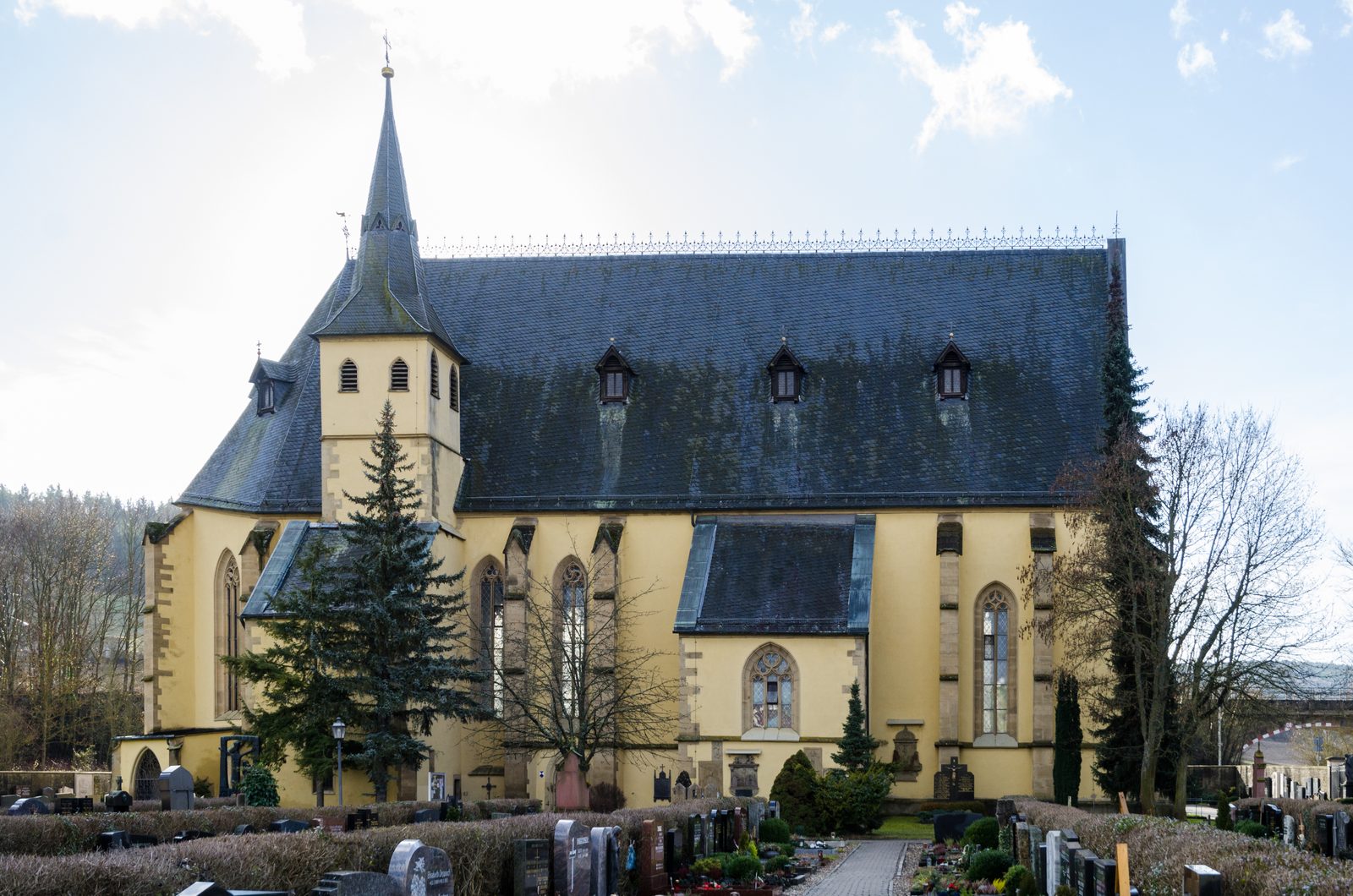
The parish and pilgrimage church of Maria Sondheim (actually Our Lady of the Rosary) is a sacred building predominantly erected in the late Gothic style, located southwest and slightly outside the town center of Arnstein in Lower Franconia. The current church was begun in the mid-15th century and is one of Arnstein's most significant architectural monuments. It belongs to the parish of Our Lady of the Rosary Arnstein in the parish community of Um Maria Sondheim in the Karlstadt deanery of the Diocese of Würzburg.
Church Building and Architecture+
The initiative for the construction of the present church is documented in letters of indulgence from Pope Eugene IV and Bishop Gottfried IV Schenk von Limpurg from the years 1444 and 1445. Previously, there had been a building at the same site, which had been devastated along with the town of Arnstein in the First Margrave War. The plans initially envisioned a three-aisled Gothic hall church. This can be seen from the visible buttresses in the eastern part of the church with the beginnings of arches, ribs, and transverse arches. These, along with the pointed arches of the planned straight choir termination, were incorporated into the much simpler final form of the building in the second half of the 15th century. The western part was then designed even more simply in the second half of the 15th century, as the smoother buttresses on the exterior of the church illustrate. The completion extended into the early 16th century.
Exterior Appearance+
The church is located opposite Arnstein on the other side of the Wern in the river meadows and forms the center of the walled Arnstein cemetery. The nave extends on the east-west axis. The simple late Gothic exterior with its buttresses bears a high, steep slate roof. On the north facade, a tower was erected above the sacristy, which only slightly overtops the steep roof and resembles a roof turret. Two side chapels with lean-to roofs in the north and south structure the long sides. A flat, outwardly open annex at the northeast corner of the choir houses an Mount of Olives group. Christ and the sleeping disciples are executed in larger-than-life sandstone figures dating from the end of the 15th century. On the south facade, there is a balcony built in front of the south portal above the entrance. It probably served for the display of relics to pilgrims in the Late Middle Ages.
Interior+
The current appearance of the interior was completed under Prince-Bishop Julius Echter von Mespelbrunn. In 1605, the decision was made to forgo the planned vaulted ceiling inside and to install a flat ceiling, as can still be seen today. The single-nave hall church is divided into two unequal parts by three wide pointed arches in the middle of the room: the choir on the east side and the nave with a smaller footprint in the west. In the choir area, there is a slightly raised platform for the altar.
Furnishings+
On both sides of the nave, rows of epitaphs line the walls, mostly from members of the Lords of Hutten family, followed by those of the Zobel von Giebelstadt family. Above the entrance to the sacristy on the north wall is a larger-than-life crucifix from the early 16th century. On the flat ceiling of the choir area is a large ceiling fresco by Johann Philipp Rudolph, created in 1770, depicting the Battle of Lepanto. In 1879, Johann Mayer renovated the ceiling fresco. From 1892 to 1893, a general renovation of the interior took place, in keeping with the spirit of the times, with neo-Gothic paintings and furnishings. In the choir area stands a simple, freestanding sandstone altar table in a modern style. From here, one can see the three colorful church windows that surround the choir and are drawn far down. In the middle is the four-axis window, designed in 1954 by the Munich artist Brother Wilfried Braunmüller. In the three-axis windows on the two slanted sides to the left and right of the central window, stained glass windows from the 15th and early 16th centuries have been preserved.
List of Tombs in the Church+
Epitaph for Hans von Hutten († 1515) from the Frankenberg line, with a central full coat of arms of the von Hutten and four ancestral coats of arms of the von Hutten, von Rechberg, Speth von Hohenegk, and Speth von Neidlingen. Inscription: "Anno d(o)m(ini) Mo VCo und 15 / uff montag nach dem s(on)ntag Ca(n)tate starb d(e)r E(h)rb(are) u(nd) e(h)r(e)nfeste / hans vo(n) hutte(n) d(e)r durch / hertzog ulrich vo(n) wirt(t)e(m)berg unschuldig entleibt d(e)m g(ott) g(nade)". He was murdered by Duke Ulrich von Württemberg in the Böblingen Forest. Epitaph for Catharina Zobel von Giebelstadt († 1533) from the Guttenberg and Rockenstadt line, with husband's coat of arms von Hutten and the four ancestral coats of arms Zobel von Giebelstadt, von Crailsheim, Rüdt von Collenberg, and von Zwingenberg (incorrectly restored). Inscription: "An(n)o D(o)m(ini) 1533 / am .. Son(n)tag nach Cantate Starb die E(h)rbare / und Tugenthafte / (fraw cath)arina vo(n) hutte(n) gebor(e)ne zoeblin d(er) G(ott) g(nade)". She was a sister of the Würzburg Prince-Bishop Melchior Zobel von Giebelstadt. Epitaph for Wolff von Hutten († 1517), with a central full coat of arms of the von Hutten and four ancestral coats of arms of the von Hutten, von Steinau gen. Steinrück, von Thüngen, and von Münster. Inscription: "Anno d(omi)ni M / ccccc und xvii ja(h)r am sambstag sa(nc)t Ciriacg tag / starb d(e)r E(h)rber / und vest wolff vom hutten dem got(t) gnad(e) amen". Wolff von Hutten was a canon of Würzburg Cathedral. Epitaph for Anna von Rosenberg († 1528), bottom center with a coat of arms of the von Hutten for the husband, Ulrich Lorenz von Hutten, four ancestral coats of arms, top one of the von Rosenberg and one of the von Thüngen, bottom two supplemented without content (formerly von Helmstatt and Truchseß von Wetzhausen). Inscription: "Anno d(o)m(ini) 1528 / Samstag nach San(k)t pauls beke(h)rung starb die e(h)rber(e) und / thugenthafte Fraw / Anna von Hutten gebor(e)ne von Rosenberg d(er) got(t) gn(a)edig sey a(men)". Epitaph for Agapitus von Hutten († 1520), with a central full coat of arms of the von Hutten and the four ancestral coats of arms of the von Hutten, von Thüngen, von Steinau gen. Steinrück, and von Münster. Inscription: "anno dom(ini) 1(52)0 / ia(h)r am mit(t)woche(n) nach assu(m)ptio(n)is mari(a)e ist / verschi(e)de(n) der e(h)rber(e) und / veste ag(a)pit(us) vo(n) hut(t)e(n) a(m)pt(mann) zw sa(a)leck dem g(ott) g(nade)". He was bailiff of Saaleck and involved in the raid on Nuremberg merchants in 1512. Epitaph for Ludwig von Hutten the Elder († 1517), knight, captain, Würzburg councilor, Würzburg bailiff in Arnstein, Fulda hereditary bailiff in Hammelburg, and Würzburg bailiff in Trimberg. Four coats of arms of an ancestral proof, von Hutten, von Rechberg, von Frankenstein, and von Hirschhorn. Inscription: "Anno D(o)m(ini) M CCCCC und xvii auff Samb/stag nach Sanct Barthol(o)m(a)eus Ist der Gestreng(e) e(h)rber(e) / vest herr ludwig von hut(t)en Ritter czu Augspurg verschi(e)d(en)". Drolleries on the plinth, two dragons with intertwined necks on the upper curve. It was created by Peter Dell the Elder. Gravestone for the aforementioned Ludwig von Hutten († 1517), full coat of arms of the von Hutten in the central field, above it indicated blind tracery, Inscription: "Anno D(o)m(ini) M ccccc /xvii am sambstag nach barthalomey starb der gestrenge / e(h)rbe(re) und veste / herr ludwig vom hutten Ritter de(m) got(t) gen(a)edig sei am(en)". Epitaph for Ludwig von Hutten the Younger († 1548) zu Frankenberg and his wife Agatha von Liebenstein († 1547), marital coats of arms von Hutten and von Liebenstein, ancestral coats of arms on the sword side Speth von Hohenegk and Steingebronn, von Rechberg, Speth von Neidlingen, on the spindle side von Wernau, von Kaltental, and von Ellerbach. First inscription above: "An(n)o 1548 uff Mit(t)/woche(n) den tag Jacobi / Verschi(e)d Der Gestreng(e) / Edel(e) und E(h)r(e)nvest(e) Her(r) / Ludwich vo(n) Hutten / Ritter zum forderen / Franckenberck Würcz/burgischer Rathe De(m) / Got(t) Ein fro(eh)liche Ur/stend Verleihe(n) wolle a(men)". Second inscription below: "An(n)o D(omi)ni 1547 Uff Son(n)tag nac(h) / Marthini de(n) 19. Novembris Ver/schi(e)d die Edell thugenthafft Fraw / Agatha vo(n) Hutten gebor(e)ne Von / Liebenstein der Got(t) gn(a)edig sey a(men)". Ludwig von Hutten was the acquirer of Frankenberg. Gravestone for the aforementioned Agatha von Liebenstein († 1547), with a large coat of arms of the von Liebenstein in the central field, above between the buffalo horns of the crest a shield of the von Hutten for the husband, and the four coats of arms of the ancestral proof in the four corners of the plate repeat the coats of arms already known from the epitaph of the von Liebenstein, von Wernau, von Kaltenthal (completely destroyed) and von Ellerbach. Inscription: "An(no) D(omi)ni 1547 / am s(o)nntag nach martini ist verschieden die / edel u(nd thuge)/nthafftige fraw Agatha vom hutten gebor(e)ne vo(n) / liebe(n) / stain / der se(e)/len got(t) / gnad(e) / amen". Epitaph for Bernhard von Hutten († May 8, 1539) from the Birkenfeld line and Gertraud von Ebersberg gen. Weyhers († 1544), marital coats of arms von Hutten and Ebersberg gen. Weyhers, ancestral proof on the sword side von Bibra, von Rechberg, von Frankenstein, ancestral proof on the spindle side von Hutten, von Thüngen, von Steinau gen. Steinrück, with a logical irregularity on each side, Inscription at the very top: "CHRISTO SERVATORE PROPICIO / MAVRIT(IVS) ELEC(TVS) EISTET(T)EN(SIS) PRAE/POS(VS) HERB(IPOLENSIS) ET WILHELM(VS) PHILIPP(VSQVE) F(RATRE) / IN EXT(REMIS) INDIS AGENTE P(ARENTIBVS) P(RO) P(IETATE) P(OSVERVNT) (F)ILII", Inscription above: "Anno D(omi)ni m ccccc xxxix viii mai ist in got(t) / verschi(e)den Der E(h)renvhest Bernhardt von / hutten zu Birckenfeldt Und darnach im m ccccc / 44 ii febr(uari) Die edel und thugenthafft(e) fraw Gertraut / Gebor(e)n(e) vo(n) weiers sein(e) E(he)liche hausfrab de(r) got(t) gnad(e)". Cenotaph for Philipp von Hutten († 1546), a work by Loy Hering. Coats of arms: Moritz von Hutten, Prince-Bishop of Eichstätt, as founder of the cenotaph, and next to it a simple shield of the von Hutten for Philipp. Inscription: "PHILIP(PO) AB HVTTEN EQ(VI)TI FRANC(ONIO) FR(ATR)I CHARISS(IMO) QVI IN AVLA CAROLI V. CAES(ARIS) EDVC/AT(VS) ET DILATANDI CHR(IST)IANI NO(MIN)IS NOVASQ(VE) GENT(ES) COGNOSCEN(DI) STVD(IO) IN VENEZOLA(M) / VLTERIOR(IS) INDIAE PROVINC(IAM) AN(NO) D(OMI)NI M. D. XXXIIII PROFECT(VS) ET POSTQ(AM) IN DVAB(VS) INDE / EXPEDITION(IBVS) QVARV(M) PRIMA(M) III ANN(IS) ITA SEQVVT(VS) ERAT MILES VT IN DEMORTVI GVBER/NATOR(IS) LOCV(M) AB EXERCITV SVFFECT(VS) ALTERA(M) V ANN(IS) CV(M) IMPER(IO) DVCERET MVLTA / TVLISSET VASTISS(IMA)Q(VE) REGNA SVB ANTARCT(IS) SIDERIB(VS) PARVA MANV PERAGRANS DEVICISS(ET) / IA(M)Q(VE) RE B(E)N(E) ET FOELICITER GEST(A) IN STATIVA SVA CORV(M) VERSVS REG(RE)DERETVR AB AEMVL(O) / Q(V)ODA(M) HISPANO IOAN(NE) CARVESALE AMICITIA(M) SIMVLANTE INTERCEPT(VS) ET CVM BARTHOL(OMEO) WELSER / AVGVSTAN(O) AC DVOB(VS) NOBIL(IBVS) HISPAN(IS) ALPHONS(O) RAMER(O) ET GREGOR(IO) DE PLACENTIA IN IPSA / PARASCEVE AN(NO) M. D. XL.VI MISERABILITER (PROH DOLOR!) TRVCIDATVS AC E SPE PATRIAE / INGENTI EREPT(VS) IBIQ(VE) CARVESALE SCELESTO IN QVATVOR FRVSTA DISSECTO, SEPVLT(VS) / EST MAVRICIVS D(EI) G(RATIA) EP(ISCOP)VS AEYSTETTEN(SIS) AMORIS ET MEMORIAE ERGO MOESTVS P(OSVIT)". The inscription describes the life of the conquistador and his violent death at the hands of Juan de Carvajal. Epitaph for Wilhelm von Hutten († 1554), a work by the Würzburg sculptor Peter Dell the Younger. First inscription above: "An(n)o 1554 auff Ursula / Ist der Edel und E(h)r(e)nvest / Wilhelm vo(n) Hutten zu / Bircke(n)felt zu Coburckg in / Gott verschi(e)den de(m) Got(t) / gn(a)edig sein wolle a(men)." Second inscription bottom right for the first wife: "Und Im Ja(h)r 1541 auff / S(ankt) Walbare obent starb / Die Edele und Tugent/hafftige Fraw Eva von / Hutten Gebor(e)ne vo(n) Hes/perck Erste obgedachts / Junckere(n) E(he)gema(h)el d(er) Got(t) / gnad(e) amen". Third inscription bottom left for the second wife: "An(n)o 15 ..... / ...... verschi(e)d / Die Edele und Tugentha/fftige Fraw Anna Von Hutten Gebor(e)ne Von Selbicz der Got(t) ein frö(h)/liche Urstent verleihe Ame(n)". A total of 24 coats of arms. Ancestral proof of Wilhelm von Hutten horizontally on the entablature, to be read alternately from inside to outside, in logical order von Hutten, von Ebersberg gen. Weyhers, von Bibra, von Hutten, von Rechberg, von Steinau gen. Steinrück, Fuchs von Burglemnitz, von Thüngen. Ancestral proof of the first wife, Eva von Heßberg, on the spindle side vertically, from top to bottom von Heßberg, von Aufseß, Rieter von Kornburg, von Witzleben, not assigned, von Lichtenstein, not assigned, not assigned. Ancestral proof of the second wife, Anna von Selbitz, on the sword side vertically, from top to bottom von Selbitz, von Lichtenstein, Fuchs von Bimbach, von Sternberg, Fuchs von Schweinshaupten, von Bibra, not assigned, Rotenhan. Gravestone for Eva von Heßberg († 1541), first wife of the aforementioned Wilhelm von Hutten (-1554), bottom center coat of arms of the husband, von Hutten, in the four corners ancestral proof with the shields of von Heßberg, von Aufseß, Rieter von Kornburg (destroyed) and von Witzleben. Inscription: "An(n)o D(o)m(ini) 1541 am / obent Phillipi und Jacobi starb die edel und Tugenthafte / fraw eva vo(n) hutten ei(ne) / gebor(ene) vo(n) hedpergk der got(t) genat amen". Epitaph for Konrad von Hutten († 1502), above separately full coat of arms of the von Hutten, in the four corners shields of the von Hutten, von Frankenstein, von Wenkheim, and von Helmstatt. Inscription: "Anno d(o)m(ini) mo ccccco und ii / ia(h)r uff S(anct) gerdrud tag / verschiede d(er) gestre(n)ge un(d) / e(h)r(e)nfest h(e)r(r) conrad / vom hutte(n) ritt(er) etwan hof/meist(er) zu w(ür)tzbb(ur)g de(m) got(t) g(nade) a(men)". Gravestone for Anna von Rechberg († 1471), first wife of the aforementioned Konrad von Hutten († 1502), coats of arms: in the middle above von Hutten, in the four corners von Hutten, von Rechberg, von Helfenstein, unknown. Inscription: "A(nno) (do)m(ini) m cccc 41 im ia(h)r uff son(n)tag nach san(k)t jacob tag starb die / edel fraw anna / vom hutte(n) szu trimpperg gebor(e)n(e) vo(n) rechperg d(e)r got(t) gn(ade) a(men)". The inscription was incorrectly recut during the renovation regarding the year. Gravestone for Elisabeth von Sickingen († 1479), second wife of the aforementioned Konrad von Hutten († 1502), four coats of arms: von Hutten, von Sickingen, unclear, unclear. Inscription: "(A)nno d(o)m(ini) m cccc li / ia(h)r an der mit(t)woche(n) vor dem c(h)rist(t)ag starb die e(h)rbere fraw / Elsze vo(n) hutte(n) gebo(rene) / vo(n) sickyn(g)en der got(t) gen(a)edig sey amen". The inscription was incorrectly recut during the renovation regarding the year. Epitaph for Stephan Zobel von Giebelstadt († 1597) and Cordula Echter von Mespelbrunn († 1599), above marital coats of arms Zobel/Echter, a total of 32 ancestral coats of arms in illogical sequence, including the families von Schwaigern (Schweigern), von Wolfskeel zu Reichenberg, Truchseß von Baldersheim, von Seldeneck, von Thüngen (2×), von Lichtenstein, von Finsterlohe, Zobel von Giebelstadt, Echter von Mespelbrunn, von Bibra, von Habern, von Frauenberg zum Hag, Hofwart von Kirchheim, Marschall von Pappenheim, Clebiz von Nalsbach, Rüdt von Collenberg, von Seckendorff, Stiebar von Buttenheim, von Abersfeld, von Vestenberg, von Diemar, von Schrotzberg, von Horneck zu Hornberg, Münch von Wildsberg/Wildberg, von Elm, von Bettendorff, von Adelsheim, von Heßberg and von Rosenberg. Inscription for the husband: "ANNO CHRISTI M D L XXXXVII AVF DONNERSTAG NACH / EXAVDI DEM XXII MAY IST IN GOTT SELIGLICHE(N) VERSCHIE/DE(N) DER EDLE VND E(H)R(E)NVEST STEPHAN ZOBEL VO(N) GI(E)BEL/STA(D)T ZV DARSTA(D)T VND MES(S)ELHAUVSE(N) FÜRSTLICHER / WIRTZBVRGISC(H)ER RATH VND AMPTMA(NN) ZV ARNSTEI(N) DES/SEN SEHL(E) DER AL(L)M(A)ECHTIG(E) WOLLE GEN(A)EDIG VND / BARMHERTZIG SEIN AMEN". Inscription for the wife: "ANNO NACH C(H)RISTI GEPVRT 1599 AVFF DVNDERSTAGS / NACH IVBILATE DEN 6 MAY IST IN GOT(T) SELIGLICH / VERSCHIEDEN DIE EDLEN VND TVGENTSAME FR/AVEN CORDVLA ZÖEBLI(N) VO(N) GI(E)BELSTAD(T) GEBOR(E)NE / ECHTERIN VO(N) MESPELBRO(NN) … GENAN(N)TS / STEPHAN ZOBELS SELIG GEWESENE EH(E)LICHE HAVS/FRAVEN DERE(N) SEHL(E)N GOTT DER ALLM(A)ECHTIG(E) / WÖLL GENEDIG VND BARMHERTZIG SEI(N) AME(N)". Gravestone for the aforementioned Cordula Echter von Mespelbrunn († 1599), coats of arms of the Echter von Mespelbrunn, von Adelsheim, von Habern and Rüdt von Collenberg. Inscription: "ANNO 1599 VF DVNDERSTAGS DE(N 6) / MAY IST IN GOTT SELIGGLICHE VERSTORBENE EDLE TUGENDSAME FRAUEN / CORDULA ZOBELIN VON GI(E)BELSTA(D)T ZV DARSTA(D)T VND MES(S)ELHAVSE(N) GEBOR(E)NE ECHT(E)RIN VO(N) MESPELBRO(NN) DERE(N) SEHLE GOTT GNAD(E)". Children's epitaph for Johann Julius Zobel von Giebelstadt († 1585), son of the aforementioned Stephan Zobel von Giebelstadt († 1597) and Cordula Echter von Mespelbrunn († 1599), coats of arms on the sword side: Zobel von Giebelstadt, von Finsterlohe, von Bibra, von Schwaigern, coats of arms on the spindle side: Echter von Mespelbrunn, von Habern, von Adelsheim and Rüdt von Collenberg. Inscription: "AN(N)O D(OMI)NI 1585 Auff Donnerstags denn 25. / APRILIS zwische(n) 1 und 2 uhr vor mittag vor/schiedt in Gott des Edlen und E(h)r(e)nvehsten / Steffan Zobels von Giebelstadt Amptman(n) / alhie zu Arnstein u(nd) der auch Edlen und / Thugenthaffte(n) frawen Cordula Zoblin / gebor(e)ne Echterin v(on) mess(p)elbron(n) I(h)rer bei/der Edler Sohn Johann Julius seines Al/ters 2 Jahr(e) 9 monat(e) 13 tage D(em) G(ott) G(nade)". Epitaph for Konrad von Hutten († 1556), above in the superstructure full coat of arms of the von Hutten, coats of arms on the sword side: von Hutten, Speth, von Rechberg, Speth, on the spindle side: von Rosenberg, von Thüngen, von Helmstatt and Truchseß von Wetzhausen. Inscription: "An(n)o 1556 de(n) 29. December Verschi(e)d der / Edel und E(h)renvest Conrad von Hutten / zum Forderen Franckenberck dem Got(t) / gn(a)edig und Barmherczig sein wolle a(men)". Epitaph for Jobst von Hutten († 1483), coats of arms of the ancestral proof: von Hutten, von Thüngen, von Wenkheim and von Buchenau. Inscription: "An(n)o D(o)m(ini) m / cccc im lxxxiii ia(h)r Auf s(on)ntag n(a)ch des / heilig crucztag / das erhabe(n) ward starb der vest iobs(t) / vom hutte(n) / dem G(ott) g(nade) A(men)" Epitaph for Bartholomäus von Hutten the Younger († 1495), coats of arms of the ancestral proof: von Hutten, von Thüngen, von Wenkheim and von Buchenau. Inscription: "Nach xpi (= Christi) geb(u)rt M cccc xcv ia(h)r am di(e)nstag vor Joha(nn)is vor / der pfforten starb der / e(h)rber(e) u(n)d vest(e) bart(h)ol(o)me(u)s von hutten zu saleck de(m) got(t) genad(e)". Gravestone for the aforementioned Bartholomäus von Hutten the Younger († 1495), central full coat of arms of the von Hutten, coats of arms of the ancestral proof: von Hutten, von Thüngen, von Wenkheim and von Buchenau. Inscription: "An(n)o d(o)m(ini) mo cccco xcv ia(h)r auf / di(e)nstag vor ioha(nn)es ante porte Starbe der e(h)rber(e) und vest / barthol(o)m(a)eus vom / hutten zu Sa(a)leck dem got(t) genedig sey amen". Epitaph for Konrad von Hutten († 1447), coats of arms: von Hutten, von Wenkheim, the lower two lost. Inscription: "Anno d(o)m(ini) / m cccc xlvii uf der eilf tusent meid tag verschi(e)d / … / hutten zu Trimperg dem got(t) gnade amen". Gravestone for Konrad von Hutten († 1447), coat of arms: von Hutten. Inscription: "an(n)o d(o)m(ini) 1447". Gravestone for Bartholomäus von Hutten the Elder († 1452), coat of arms: von Hutten. Inscription: "Nach c(h)ris(t)i gebu(r)t / m cccc und im zwey und l ia(h)r starb d(er) / edel u(nd) feste Bart(h)oolome/us vom hutten dem got(t) gen(a)edig sey". Gravestone for Elisabeth (Else) von Thüngen († 1458), wife of the aforementioned Bartholomäus, coats of arms: von Hutten, von Thüngen, von Grumbach or von Wolfskeel, von Buchenau. Inscription: "Anno dom(ini) / mo cccco lviiio uff San(k)t Elizabeth / tag starb els(e) von / hutten gebor(e)n(e) von t(h)u(e)ngen der", last part missing. Gravestone for Amalia von Berlichingen († 1570), coats of arms: husband's coat of arms: von Münster, ancestral coats of arms: von Berlichingen, Rüdt von Collenberg, von Thüngen, von Horneck. Inscription: "An(n)o Do(min)i / 1570 / Den 15 Martz Starb Die Edel und tugenthafft(e) Fraw Am(m)ulay von / Mu(e)nster Gebor(e)ne von Ber/(lichinge)n Her(r)n veltin von münsters Ritters Eheliche Hausfraw D(eren) S(eele) G(ott) G(nädig) S(ei) A(men)".
List of Tombs on the Exterior of the Church+
Epitaph for Anna Maria Eva von Stadion, née Faust von Stromberg († 1682) and two of her children, marital coats of arms Faust von Stromberg and von Stadion, ancestral coats of arms Faust von Stromberg, Frey von Dehrn, Kottwitz von Aulenbach, von Diemantstein, von Warsberg, de Larochette, von Weiler and Fuchs von Dornheim. Inscription: "D(eo) O(ptimo) M(aximo) / Lege viator et Luge / me(m)or mortis et mortuorum / Heic Tresuno conduntur tumuLo / Mater Sanguine et virtute illusTris / D(omina) ANNA MARIA EVA à STADION / Domo Faustiana à Stromberg / nata MDCLXI 28. Decemb(ris) nupta LXXV / 6. octob(ris) defuncta LXXXII 14. Decemb(ris) / Duo cara pignora / MARIA ANNA MARGARITA / breve parentum gaudium / ag usque ad 15. Augusti LXXVII / et FRANCISCUS HENRICUS IOSEPHUS / editus in lucem LXXXII 4. Septemb(ris) / reversus in pulverem 30. Janu(arii) LXXXIII / Fausta Trias StadIonia / Quae decurso velociter stadio / in hac vitae brevis meta quiescit / ut feliciter resurrgat / et aeternum vivat Amen." Epitaph for Barbara Strigel/Strigler née Beur, coats of arms Strigel and Beur, Inscription: "ANNO 1604 / VFF DON(N)ERSTAG 4. MARTI VERSCHI(E)D IN GOTT DIE DVGE(N)DSAME FRAV BARBARA / BEVRIN DES E(H)R(E)NHAFTE(N) MARCVS STRIGEL / FV(E)RS/TLICH) WVRTZ(BVRGISCHEN) KELLERS ALHIE ZV ARNSTEIN EH(E)LICHE HAVSFRAVE". Epitaph for Martin Kühltau, son of the council member of the same name, coats of arms Kühltau and maternal coat of arms, Inscription: "AN(N)O 1596 VF 8 OCTOB(RIS) STARB MARTIN / KVLTHAVE DES E(H)R(E)NHAFTE(N) VND ACH(T)BAR(EN) HER(R)N MARTIN KVLTHAVE /DES RATHS ALHIE EHELICHER SOHN / WART 7 IAHR 10 MONAT ALT DER SEHL(E)N G(OTT) G(ENEDIG) SEIN WOL(LE) A(MEN)". Epitaph for Johann Karl Roßhirt, Würzburg city clerk and mayor, coat of arms Roßhirt, Inscription: "ANNO 1677 / DEN 12 NOVEMBRISS / IST IN GOTT SEELIG ENDTSCHLAFF/EN DER EHRENVESTE VND VORGEACHTE / HERR IOHANN CARL ROSSHIRDT 40 IAHR / HOCHFÜRSTLICHER WÜRTZBVRGISCH/ER STATTSCHREIBER DESS RATHSS / SENIOR VND 9 IAHR BÜRGER MEIS/TER ALHIER ZV ARNSTEIN SEINES / ALTERS 75 IAHR DESSEN SEEL(E) GOTT / GNADE AMEN". and many others.
Organ+
The historic organ of the pilgrimage church was built in 1880 by the Munich organ builder dynasty Frosch and restored in 1998 by the Rensch organ building workshop. The purely mechanical instrument has 21 stops on two manuals and pedal.
Bells+
Three bells form the peal of Maria Sondheim. They were cast in 1951 by the Karl Czudnochowsky bell foundry in Erding. All bells are inscribed: MICH GOSS KARL CZUDNOCHOWSKY J.BACHMAIR NACHFOLG. ZU ERDING OBB 1951
Renovation and Restoration+
From 1954 to 1960, in the course of a large-scale renovation, some neo-Gothic elements and the ornamental paintings from the 1890s were removed again. From 2000, the church had to be renovated, with the roof in particular causing a high renovation effort. During the redesign of the choir area between 2000 and 2002, the 16th-century cross was rehung above the altar. In the course of this, a new, abstract altarpiece by the artist Matthias Kroth was installed, which stands out due to its luminous orange, yellow, and red tones. Also during the renovation, the miraculous image of the Arnstein pilgrimage, attested for centuries, was given a more prominent place by moving it from the right edge to the front edge of the altar platform. The late Gothic Vesperbild is a painted wooden figure of the Pietà and was created around 1470 in the workshop of an unknown master from Mainfranken. The history of the pilgrimage dates back to the time of the church's construction. Even today, Maria Sondheim and the miraculous image attract a large number of pilgrims every year.
Take Mobile History with you
You are reading this text for free. Premium adds what matters on the road: descriptions read aloud, sites found through your camera, whole regions taken offline.
- Every description, including the ~17,700 Premium sites
- Audio guide: have descriptions read to you on location
- AR finder: see sites through your camera, with distance and bearing
- Unlimited saved sites
14 days free, then from €2.99 a month. Cancel anytime.
Source: Wikipedia · Licence: CC BY-SA 4.0 · Image: Tilman2007 · Wikimedia Commons · CC BY-SA 3.0
This description is a machine translation of an excerpt from the linked Wikipedia article. The source text was written by its authors, the translation is by Mobile History; like the original it is licensed under CC BY-SA 4.0.
Location: 49.9734, 9.9627