The remains of the castle can be visited
CastleRothenburg ob der Tauber
Reichsburg Castle
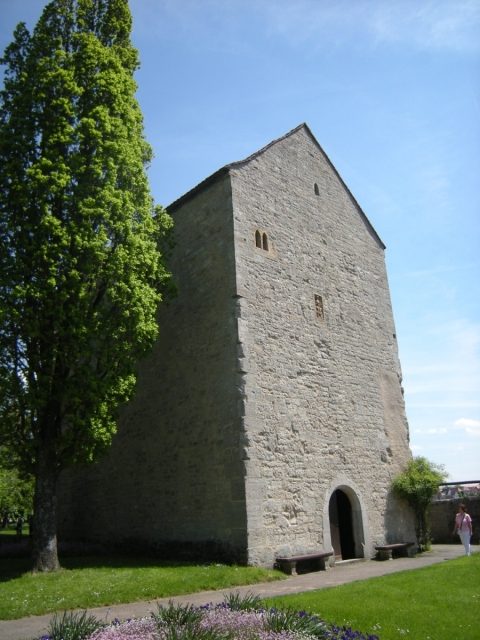
Rothenburg ob der Tauber Castle, also known as Alte Burg (Old Castle), are the remains of a medieval imperial castle on a projecting mountain spur above the Tauber Valley west of Rothenburg ob der Tauber in the Ansbach district of Bavaria.
In the second half of the 11th century, the Counts of Comburg-Rothenburg founded a castle in the area of what would later become Rothenburg. This lineage died out in the male line in 1116 with Count Heinrich von Rothenburg. Research disputes whether the castle fell to the real estate of the Benedictine monastery of Comburg or (more likely) already passed into the hands of the Staufer at this time. Newer research localizes the completely disappeared castle complex in the Essigkrug area, a mountain spur not far from today's Spitalhof. The Staufer king Konrad III erected a new palatial imperial castle around 1142 on the northern neighboring mountain spur (today's Burggarten). For this, he exchanged the castle hill near Detwang, exposed to the west and steeply sloping to the Tauber on three sides, from the Neumünster Abbey; the original document of Bishop Embricho of Würzburg is preserved. After the death of Konrad III, his son, Duke Friedrich († 1167), resided at Rothenburg. In 1188, the "castrum Rotenburch" is mentioned in a treaty between Emperor Friedrich I Barbarossa and King Alfons VIII of Castile, in which the marriage between Friedrich's son Duke Konrad II of Swabia and Alfons' daughter Berengaria was agreed upon. The castle, along with 29 other Staufer properties, belonged to the bride's morning gift. However, this marriage was never consummated. In the early 13th century, the imperial castle played hardly any role as a royal residence; only the last Staufer king Konrad IV stayed in Rothenburg a total of seven times between 1238 and 1251. In post-Staufer times, Rothenburg was hardly used by the monarchy, while the adjoining settlement to the east was elevated to a Free Imperial City in 1274. During the Rintfleisch pogrom in July 1298, about 400 Jews sought refuge in the old imperial castle, but had to surrender after a three-day siege; all were killed. Friedrich the Fair pledged the castle to Kraft II von Hohenlohe in 1314. In 1356, Rothenburg was damaged by the Basel earthquake; the extent of this destruction or the extent to which the castle had already fallen into disrepair before is disputed in research. Emperor Karl IV allowed the citizens of Rothenburg to use the stones for the construction of urban buildings, but the castle seats remained partially inhabited until their successive sale to the imperial city in the 1380s. In 1407, the city authorities completely dismantled the former imperial castle in the feud with the Burgraviate of Nuremberg to prevent its use as a siege castle against the city by Friedrich VI. For this purpose, the deposed King Wenzel ceded to the city, which was under imperial ban, "the desolate tower in the fortress (...) with its surroundings," i.e., the eastern keep and the adjoining walls, which were then demolished; the donation was confirmed in 1425 by King Sigismund. The square keep at the western tip ("Pharamundsturm") remained part of the city fortifications and was only demolished in 1803. Since 2010, a Staufer stele in the Burggarten commemorates the imperial castle.
Layout+
The approximately 250-meter-long and between 30 and 40-meter-wide spur castle complex with two now disappeared keeps was divided into a fore-castle, middle-castle, and rear-castle.
Source: Wikipedia · Licence: CC BY-SA 4.0 · Image: http://schloesserrundschau.de/bayern/schloesser01/rothenburg06.html
This description is a machine translation of an excerpt from the linked Wikipedia article. The source text was written by its authors, the translation is by Mobile History; like the original it is licensed under CC BY-SA 4.0.
Location: 49.3755, 10.1725