The Roman Castle can be visited
Ancient BuildingWinterthur
Roman Castle Vitudurum (Winterthur)
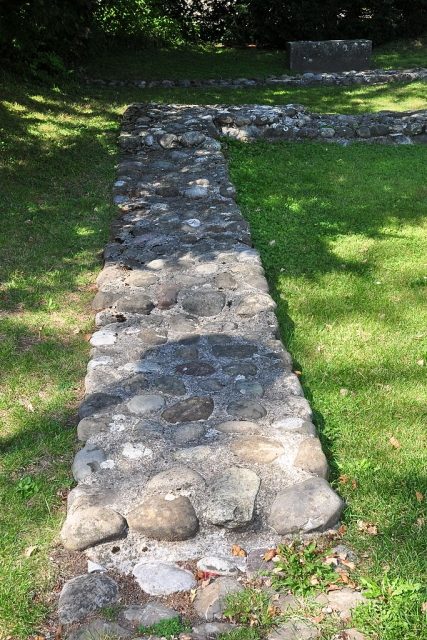
Vitudurum (sometimes also Vitodurum) was a Roman settlement in the area of today's city of Winterthur.
Around the year 1 AD, the first reliably documented buildings were erected northeast of the church hill of Oberwinterthur, along the Roman road that led from Vindonissa to Lake Constance. Following continuous expansion, a vicus, a Roman roadside village, developed by 70 AD. It featured characteristic strip houses in half-timbered construction, a water supply system fed by a nearby spring house with a volume of 2 m3, and workshops such as smithies, potteries, a tannery evidenced by preserved vats, and a shoemaker, whose presence was confirmed in 2007 by the discovery of the first complete pair of shoe lasts from the Roman era.
Public buildings were also found, located on the church hill, which is now well excavated and documented. These include a Gallo-Roman temple, a so-called fanum, erected around 80 AD, with a rectangular floor plan, a tower-like cella, and an ambulatory supported by columns. Southeast of it was an ancillary building belonging to the temple. Both were enclosed by a wall, thus forming the temenos, the sacred precinct. This was flanked on its eastern long side by three more strip houses, with the middle strip house showing significantly higher living comfort and thus interpreted as a public building. The stone building flanking the temple district on its southern narrow side is interpreted as a thermal bath due to the layout of its water supply system.
During the repeated Alemannic invasions in the mid-3rd century, the church hill was fortified in 294 AD and expanded into a castellum. The foundation date was preserved by a building inscription, which was possibly embedded in the main gate of the castellum wall and is now located in Winterthur City Hall. The burial of a hoard in the so-called "Untere Bühl", the western part of the vicus, also dates to this period.
In addition to building finds, current knowledge about the appearance, daily life, and development of Roman Oberwinterthur is based on numerous small finds, of which the ceramic finds, fibulae, bronze votive statuettes, smaller terracottas, and unusual glass vessels mentioned here represent only a small selection of a large abundance of find material. However, none of the finds date later than 400 AD. With the withdrawal of Roman troops from the Rhine border and the decline of the castellum, Vitudurum experiences a break in archaeological sources. In the rescue excavations in the Untere Bühl alone, on an area of 4500 m2 on the western edge of the settlement, over 1 million individual finds were discovered.
Inscription Tablet+
The Roman fort Vitudurum had an inscription tablet, which perhaps adorned the gate of the Roman fort built around 294 AD.
Source: Wikipedia · Licence: CC BY-SA 4.0
This description draws on the facts documented in the linked Wikipedia article; Wikipedia content is licensed under CC BY-SA 4.0. Wording and editing: Mobile History.
Location: 47.4970, 8.7370