The remains of the Castle can be visited
CastleDreieichenhain
Hayn Castle (Ruin) (Dreieichenhain)
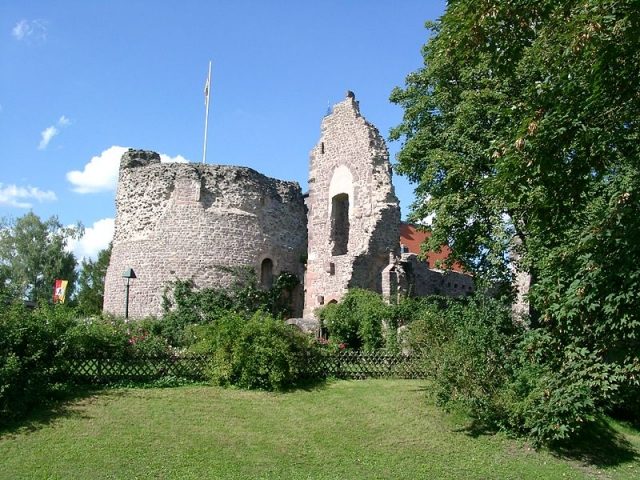
Hayn Castle, also known as Hain or Dreieichenhain, is a high medieval castle ruin in Dreieichenhain, a district of the Hessian town of Dreieich, in the Offenbach district.
The tower castle was the seat of the imperial bailiffs, who administered the Dreieich imperial forest on behalf of the emperor.
Originally, in the time of Emperor Charlemagne, there was only a small hunting lodge in the middle of a primeval forest rich in game at this location. In 850, this area is referred to in documents as "Forestis Dreieich". From about 950, a royal hunting lodge, surrounded by a moat, had developed here on old imperial land as the center of the Dreieich imperial forest. The royal and bailiff's court consisted of several stone buildings, horse and dog stables, and a (probably) two-story manor house, which served as accommodation for the emperor. Emperors and their retinue stayed here to hunt in the imperial forest surrounding the hunting lodge. Dreieichenhain was therefore also referred to as "The Holy Roman Empire of the German Nation's Dog Kennel". Beneath the present Evangelical Church are the foundations of a chapel from this period.
Against the background of the Dreieich imperial forest, Karl Nahrgang's (1899-1967) assumption of a royal hunting lodge - in connection with the Frankfurt Palatinate - is certainly correct. However, it is not certain whether the hunting lodge belongs to the Ottonian period, i.e., the 10th century, or to the Salian period, i.e., the first half of the 11th century. This early dating to the Carolingian and Ottonian periods is now doubted by experts according to the latest findings. Karl Nahrgang himself cautiously corrected this, his own theory, in his last publication, which appeared posthumously in 1970.
According to legend, the old hunting lodge was founded by Charlemagne. He is said to have liked the Hengstbach valley so much that he decided to build his hunting lodge here. Charlemagne's fourth wife, Fastrada, is said to have possessed a magic ring and sunk it in the castle pond here. The emperor was thereby magically bound to this hunting lodge in the Hain and made it his favorite hunting ground.
Eberhard von Hagen, the first bailiff of Dreieich and a close confidant of Emperor Henry IV, is mentioned in a document from 1076. With the assumption of his bailiff's office, Eberhard and his descendants called themselves von Hagen. In Old High German, Hagen means "enclosed courtyard". Around 1080, he built a five-story Salian residential tower on a small island (30 x 40 m) in the Hengstbach at the hunting lodge. The residential tower had a wall thickness of 2.80 m on the ground floor over an area of 12.50 x 13.20 m. Its height was approx. 25 m. The residential tower was surrounded by high curtain walls and a wide moat. One wall (22 m) is still preserved today. The residential tower collapsed in 1750. From these stones, a church was built in Neu-Isenburg in 1773 for the Huguenot settlement founded by the Counts of Isenburg. The remains of the residential tower are today among the best-preserved secular buildings from the Salian period in Germany.
The castle, which became the ancestral seat of the influential Lords of Hagen-Münzenberg, was expanded into an imperial fief castle by 1180 during the reign of the Hohenstaufen. The residential tower was incorporated into a castle wall. A round keep, a Romanesque palas, and a chapel were added. The castle wall was surrounded by a wide moat. Burgmannen (castle men) were settled to protect the castle. Their farmsteads were built outside the castle. Next to the castle, a Fronhof (manorial farm) (today Restaurant Faselstall) with kennels for hunting dogs was built. In the Middle Ages, Dreieichenhain was therefore ironically also referred to as "The Holy Roman Empire of the German Nation's Dog Kennel". A city wall with a rampart and moat enclosed the emerging city. The Romanesque city gate - the later Mittelpforte, no longer existing today - was the only access to the castle and the city.
Source: Wikipedia · Licence: CC BY-SA 4.0
This description draws on the facts documented in the linked Wikipedia article; Wikipedia content is licensed under CC BY-SA 4.0. Wording and editing: Mobile History.
Location: 50.0016, 8.7164