The remains of the Castle can be visited
CastleGiornico
Santa Maria di Castello (Castle)
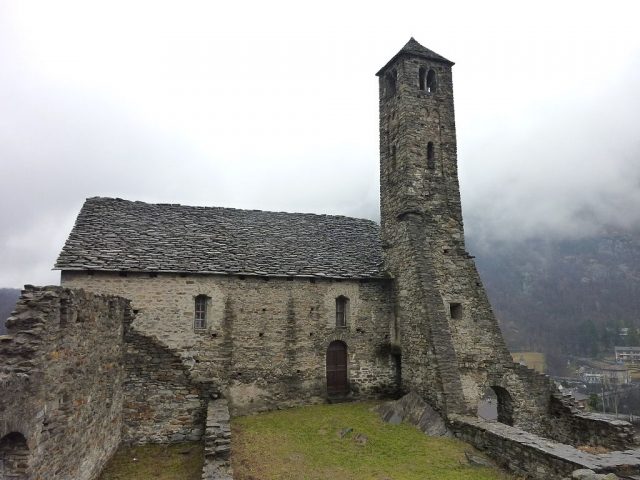
Above Giornico in the Swiss canton of Ticino, the ruins of Santa Maria di Castello are on a rocky hill. This medieval castle complex encompasses a Romanesque church.
History+
The origins of the castle complex are not precisely dated, but an initial settlement with a residential wing, chapel, and enclosing wall may have emerged as early as the 11th century. Expansions followed in the 12th and 13th centuries. The outer ring walls and approach obstacles were possibly added only in the 14th century. The Lords of Giornico are presumed to be the founders of the complex, a noble family who, under Emperor Barbarossa, sought to establish a territorial lordship in Leventina. Following Barbarossa's defeat in 1176, Bernardo of Giornico submitted to the canons of Milan, transferring ownership of the castle to them. In the mid-14th century, the Visconti family took over the sovereign rights, and the castle lost importance as the new rulers focused on the fortifications in Bellinzona. By the 15th century, the castle was likely abandoned and played no further role in subsequent conflicts. The chronicler Giovanni Rigolo reports that the fortress was demolished in 1518 by the Confederates on the orders of Uri. Between 1954 and 1955, numerous sections of walls were uncovered and partially reconstructed during restoration work, though without scientific documentation.
Location+
The ruins of Santa Maria di Castello are situated at an elevation of approximately 421 m above sea level, west above the municipality of Giornico in the Leventina district, in the canton of Ticino, Switzerland.
On site+
The complex includes the two-aisled Romanesque church of Santa Maria, which was expanded in the 13th century and houses frescoes by Christoforo and Nicolao da Seregno from 1448, as well as a painted coffered ceiling from 1575. Terraces with remnants of surrounding walls extend around the castle rock. To the north, the foundations of a square tower are visible. South of the church, a rebuilt archway leads into a small courtyard, on whose south side stand the walls of a residential building and the ruins of a multi-part building complex.
Take Mobile History with you
You are reading this text for free. Premium adds what matters on the road: descriptions read aloud, sites found through your camera, whole regions taken offline.
- Every description, including the ~17,700 Premium sites
- Audio guide: have descriptions read to you on location
- AR finder: see sites through your camera, with distance and bearing
- Unlimited saved sites
14 days free, then from €2.99 a month. Cancel anytime.
Source: Wikipedia · Licence: CC BY-SA 4.0
This description draws on the facts documented in the linked Wikipedia article; Wikipedia content is licensed under CC BY-SA 4.0. Wording and editing: Mobile History.
Location: 46.4011, 8.8712