Internat
Bieberstein Castle (Hofbieber)

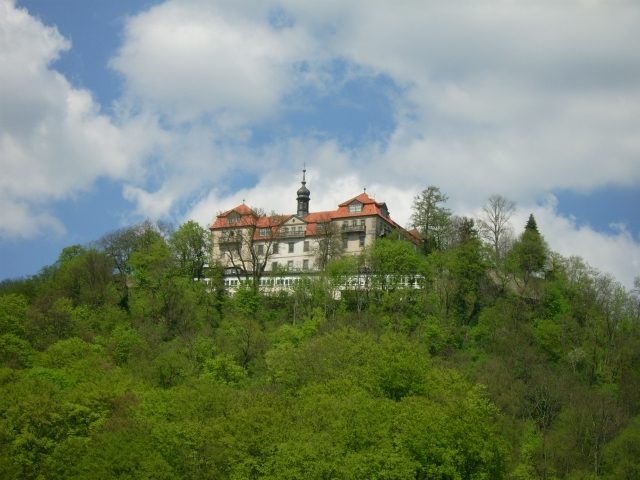
Bieberstein Castle is a Baroque castle built between 1710 and 1740 by the Bamberg master builder Johann Dientzenhofer. It belongs to the municipality of Hofbieber, located about 2 km from Hofbieber on the Kugelberg, a southern spur of the Hessenliede. South of the Kugelberg, the terrain slopes down into the Biebertal. From Fulda, the district's main town, the castle is located approximately 16 km to the east.
Bieberstein Fortress
Since the 9th century, the area around Hofbieber belonged to the Fulda Monastery. With the assumption of office by Abbot Markward (1150–1165), the construction of a castle, which had reportedly been considered for a long time, was put into practice. The argument for this was that potential enemies of the church, who might establish their seat here, had to be preempted. Thus, the monastery built one of its first fortifications. Although the castle was in the hands of the Fulda Monastery, documents show that at least from the end of the 12th century to the middle of the 13th century, a knightly family of Bieberstein also existed.
However, a different story emerges if one takes the decisive document, which reports on Abbot Marquart's intentions, literally. It states: "For I thought in my mind: Behold, the right place for this castle! If any enemy of the church seizes it, every evil will threaten us from him [...] Therefore I have begun to take possession of that castle [...] and to occupy it with loyal warriors [...]". This could also mean that this castle already existed, in the hands of the aforementioned noble family of Bieberstein, but was now increasingly passing into the possession of the Fulda Monastery.
Thus, it also seems to make more sense that the castle near the town of Hofbieber presented itself as dilapidated, partly even as a ruin, before the middle of the 13th century. The knightly family seems to have become impoverished and ultimately died out. The Fulda Monastery took advantage of this situation and brought the building and the associated land into its possession - perhaps completely only in the 13th century. In any case, Abbot Heinrich IV, in his general fight against robber knights, had Bieberstein Castle restored around 1250 and surrounded by a moat, in addition to building some new castles.
Since the abbots of Fulda, especially since the 14th century, were constantly involved in new conflicts, the monastery frequently faced financial difficulties due to constant warfare. It was often forced to mortgage or even sell part of its possessions. Bieberstein Castle also repeatedly fell victim to this financial distress. However, care was always taken to reserve a right of repurchase, so that the castle always returned to the possession of the Fulda Monastery. From 1486 to 1802, the castle was then in the permanent possession of the Prince-Abbots of Fulda.
The castle was probably the center of one of the Fulda offices since the 13th century, later even a higher office. Thus, the so-called Zentgerichtsbarkeit (centenary jurisdiction) was exercised here. However, the Zentgraf (centenary count) only had his residence in Bieberstein since the end of the 17th century; before that, he lived in Hofbieber, where the actual Zentgericht was held. According to a list from 1510, the following villages belonged to the Bieberstein office: Allmus, Batten, Bernharts, Dietges, Elters, Findlos, Gotthards, Gruben, Hofbieber, Langenbieber, Liebhards, Margretenhaun, Niederbieber, Schwarzbach, Seiferts, Steens, Thaiden, Traisbach, Wallings and Weihershof. In addition, some places that died out in the 14th century, possibly due to the plague and various famines, and have since been considered deserted, also belonged to it.
From the 16th to the 18th century, there were recurring problems with the following places: Schackau, Kleinsassen, Eckweisbach, Langenberg, Horbach, Dornbach, Rupsroth, and half of Dietges. These did not belong to the Bieberstein office but were owned by the von Eberstein family; however, they were subject to Fulda jurisdiction. This not only entailed the obligation to appear regularly before the Zentgericht in Hofbieber but also the obligation to contribute a certain share to the maintenance of the castle. The latter, in particular, was a recurring point of contention between the Fulda Monastery and the von Eberstein family.
For the inhabitants of the Biebertal, the presence of Bieberstein Castle nearby offered, on the one hand, a good possibility of protection in case of passing armies or in times of war - which, however, apart from the Thirty Years' War, probably rarely occurred. On the other hand, it primarily meant performing forced labor and paying taxes - which was certainly less appreciated. Only in 1808 were they freed from this burden by Napoleon's abolition of serfdom.
In 1672, the buildings of Bieberstein Castle were restored on behalf of Prince-Abbot Cardinal von Baden - presumably, war damage still needed to be repaired here as well.
However, the castle not only served to secure the area and as the seat of an important court but was also frequently used as an alternative residence for the Fulda Prince-Abbots. The stay of Balthasar von Dernbach is significant in this context. He was temporarily removed from his office and assigned the castle as his residence. This was between 1576 and 1602. The notorious witch hunter Balthasar Nuss was master of the horse and forester during Dernbach's time; later he received the office of Zentgraf of Hofbieber.
Bieberstein Palace
Just a few decades after the last renovation work in the last third of the 17th century, Prince-Abbot Adalbert von Schleifras forged a completely different plan: influenced by the spirit of his era, he desired a more imposing building that could also serve for representation. In 1709, he commissioned Johann Dientzenhofer, a renowned master builder who was also to construct the cathedral and the palace in Fulda in the Baroque style. Construction finally began in 1710, but it was not completed until 1723, so the patron would not live to see the completion of Bieberstein Palace. Adalbert von Schleifras died 9 years before the end of construction, namely in 1714.
Very useful - especially for the peasants performing forced labor - was the construction of a approximately 57 m deep draw well. From then on, water no longer had to be laboriously transported up the mountain or carried up from the spring located below the castle.
Since the transformation of Bieberstein into a palace, the Prince-Abbots of Fulda seem to have always enjoyed coming here, to their summer residence. Many reports tell of festivities where not a little wine is said to have flowed to entertain the numerous guests.
All this was to end with the secularization in 1802/03. Bieberstein Castle became almost deserted in the following decades. The now changing secular lords seemed unable to do anything with the remote country palace. From 1802-1806, it was in the possession of the House of Orange-Nassau, then it was under French military administration until 1810, was assigned to the Grand Duchy of Frankfurt in 1810, and was already ceded to Austrian possession in 1813. According to the provisions of the Congress of Vienna, it fell to Prussia in 1815, but Prussia preferred to exchange it with Electoral Hesse for Rhenish territories. The castle remained in the possession of Electoral Hesse until 1866 and then again passed into Prussian possession.
Little sensible use was found for the castle. For a time, foresters were housed here. But even that was not a permanent solution, as the maintenance of such a castle costs considerable money. In 1852, Electoral Hesse seriously considered converting the castle into a prison; building plans already existed, but they were never implemented. Likewise, the idea of the Prussians to convert the castle complex into a prisoner-of-war camp after the victorious war of 1870/71 against France did not go beyond the phase of initial drafts.
In 1872, a private individual finally bought the castle for 10,000 Reichsmarks. From 1887 to 1901, it was then owned by a railway company. From 1901, many rooms were leased, especially in the basement, where a restaurant was set up. In 1904, Hermann Lietz bought the castle and converted it into a country boarding school in the spirit of his reform pedagogy. He succeeded in defending his project against hostilities, especially from the church in Fulda. The most negatively known alumna of the school is Johanna Haarer, later an NS ideologist, with high book circulations until 1996. Bieberstein Castle is still the upper school of the Hermann-Lietz-Schulen today. In 1967, a fire devastated parts of the attic, but they were soon rebuilt.
The castle survived the two World Wars without significant damage. In the Second World War, it was temporarily used as a military hospital, especially towards the end of the war.
Take Mobile History with you
You are reading this text for free. Premium adds what matters on the road: descriptions read aloud, sites found through your camera, whole regions taken offline.
- Every description, including the ~17,700 Premium sites
- Audio guide: have descriptions read to you on location
- AR finder: see sites through your camera, with distance and bearing
- Unlimited saved sites
14 days free, then from €2.99 a month. Cancel anytime.
Source: Wikipedia · Licence: CC BY-SA 4.0
This description draws on the facts documented in the linked Wikipedia article; Wikipedia content is licensed under CC BY-SA 4.0. Wording and editing: Mobile History.
Location: 50.5734, 9.8509