International Music School Academy
Kapfenburg Castle

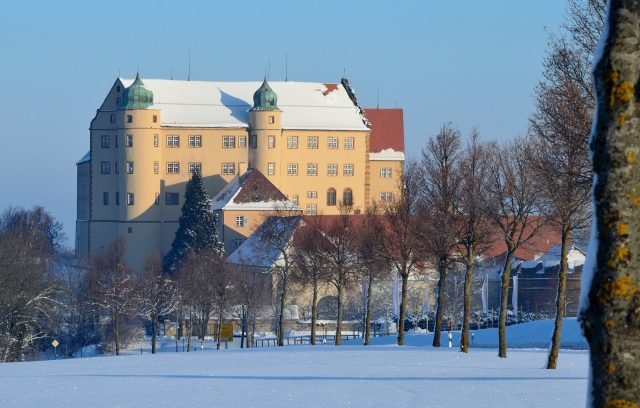
Kapfenburg Castle stands on a mountain spur of the Swabian Jura near Lauchheim in the Ostalbkreis district in Baden-Württemberg.
On the rock of a freely protruding mountain peak on the northern edge of the Härtsfeld above Lauchheim rises the former Teutonic Order castle Kapfenburg, consisting of various building complexes. The history of the Teutonic Order began in 1190 during the Third Crusade with the founding of a hospital community in front of the port city of Acre in Palestine. Already in 1198, the hospital brotherhood was transformed into a spiritual knightly order.
In 1311, Kapfenburg, belonging to the Counts of Oettingen, was first mentioned in a document. In 1364, Marquardt der Zoller von Rottenstein, Komtur of the Teutonic Order House Mergentheim, acquired Kapfenburg. It became the administrative center for the Order's possessions on the Härtsfeld and in the upper Jagst valley, as a commandery belonging to the Bailiwick of Franconia. The main entrance of the castle is formed by the bastion built in 1534. Under Komtur Johann Graf von Hohenlohe, the Hohenlohe building was constructed in 1538. Under Komtur Johann Eustach von Wersternach (1590–1627), lively building activity unfolded at Kapfenburg. On massive substructures, the main wing of the castle, the Westernach building, was erected, transforming Kapfenburg from a medieval defensive structure into a representative lordly castle. The eastern entrance facade is designed as a rich show facade. Further magnificent portals lead into the castle chapel and the knight's hall with stucco decoration by Gerhard Schmidt. Portraits of various Grand Masters and Komturs hang on the walls, which, together with large coat of arms panels, belong to the last remaining inventory of the castle.
During the German Peasants' War in 1525, the castle was attacked three times by rebellious peasants but managed to hold its own. Among the Komturs of Kapfenburg, Johann Eustach von Westernach was the most famous, being appointed Grand Master and Deutschmeister in 1625.
During the Thirty Years' War (1618–1648), the castle was plundered. Only under the reign of Komtur Karl Heinrich Freiherr von Hornstein (1713–1718), who was open to building matters, did a phase of increased construction activity begin in the Bailiwick of Franconia. As house Komtur at Kapfenburg, Hornstein engaged Franz Keller, the master builder of the Teutonic Order, from 1714 onwards to redesign large parts of the old castle complex. In addition to Keller, Hornstein also managed to secure Franz Joseph Roth. Between 1715 and 1719, Kapfenburg received its current appearance.
Around the forecourt behind the bastion, Keller erected various utility buildings and the Lorenz Chapel, which Roth stuccoed. The Lorenz Chapel was originally intended as a burial chapel for Hornstein. Keller had the two residential floors of the Westernach building converted into bright and spacious rooms, which allowed the patron to represent and live in a contemporary manner. A small terraced garden was also created below the Westernach building.
List of Komturs at Kapfenburg+
- Marquart Zoller v. Rotenstein 1364
- Johann v. Kötz 1384
- Walther v. Kaltenthal 1384
- Hans v. Venningen 1396–1428
- Simon v. Leonrod 1441
- Albrecht v. Venningen 1454
- Hans v. Finsterloe 1467
- Christian Truchsess v. Höfingen 1481
- Georg Diemer 1484
- Haimeran v. Stockheim 1499
- Hans Nothhaft 1506
- Wilhelm v. Neuhausen 1513
- Graf Johann v. Hohenlohe 1538
- Alexius Diemer 1541
- Graf Balthas v. Nassau. 1538
- Philipp v. Altdorf gen. Wollenschlag
- David v. Wasen 1569
- David v. Hardt 1579
- Johann Eustach v. Westernach 1590
- Georg Wilhelm v. Elkershausen gen. Küpel 1628
- Graf Ulrich v. Wolkenstein 1635
- Johann Conrad v. Liechtenstein 1639
- Gustav Adolf v. Traundorf 1656
- Johann Adolf Lösch v. Hartshausen 1657
- Philipp v. Grafeneck 1659
- Johann Friedrich v. Weingarten 1669
- Tiborius Christianus v. Sparr auf Greiffenberg 1676
- Johann Adolf Rau v. Holzhausen 1685
- Philipp Adolf v. Hohenegg 1691
- Maxim. Rudolf v. Westernach 1703
- Franz Konrad v. Reinach 1710
- Karl Heinrich von Hornstein 1714
- Franz Konrad v. Reinach 1718
- Georg Daniel v. Buttlar 1725
- Philipp Erwin Anton v. Grossschlag 1730
- Conrad Christof v. Lohrbach 1732
- Reinhard Adrian v. Hochsteden 1753
- Rudolf Heinrich Karl Alois v. Werdenstein 1767
- Johann Baptist Christof v. Andlaw 1784
Elector Duke Friedrich II of Württemberg issued a patent of seizure in 1805 for possessions of the Teutonic Order in Württemberg and adjacent areas, which Bavaria militarily opposed successfully; only with the Confederation of the Rhine Act of 1806 did Kapfenburg and other commanderies pass to the Kingdom of Württemberg. Until 1807, Friedrich's son Paul resided at Kapfenburg Castle. In 1809, Napoleon decreed the dissolution of the Teutonic Order in the Confederation of the Rhine states, and the Grand Master's residence was moved to Vienna.
From 1957–1962, the knight's hall and the castle chapel were restored. In 1986, the town of Lauchheim established a local history museum on the ground floor of the Westernach building.
Since October 1999, it has housed the International Music School Academy Cultural Center Schloss Kapfenburg, an international music school academy and music meeting place.
Take Mobile History with you
You are reading this text for free. Premium adds what matters on the road: descriptions read aloud, sites found through your camera, whole regions taken offline.
- Every description, including the ~17,700 Premium sites
- Audio guide: have descriptions read to you on location
- AR finder: see sites through your camera, with distance and bearing
- Unlimited saved sites
14 days free, then from €2.99 a month. Cancel anytime.
Source: Wikipedia · Licence: CC BY-SA 4.0 · Image: Peter Schneider
This description draws on the facts documented in the linked Wikipedia article; Wikipedia content is licensed under CC BY-SA 4.0. Wording and editing: Mobile History.
Location: 48.8676, 10.2234