Restaurant
CastleKissing
Kissing Castle
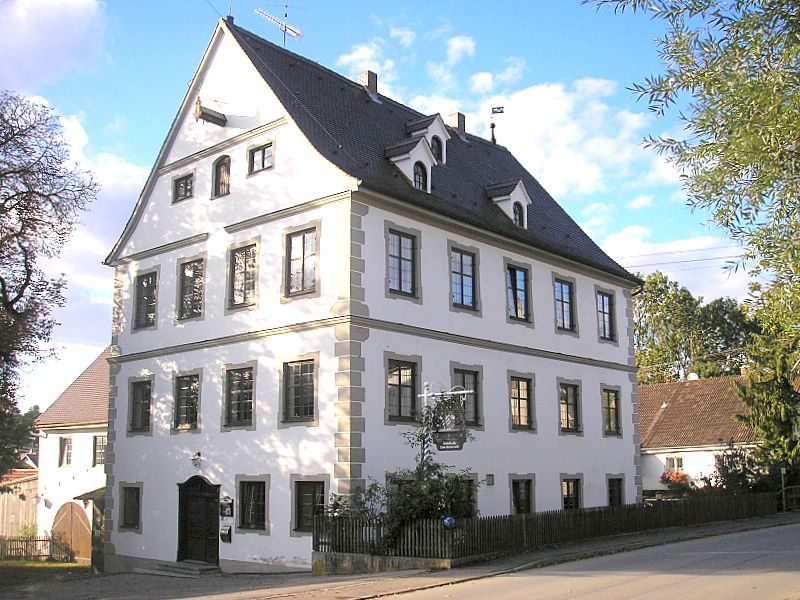
The former Kissing Castle ("Bäckerwirt") was originally the seat of the judge of the Kissing Hofmark in today's Aichach-Friedberg district in Swabia. The three-story gabled building was built around 1715 on behalf of the Jesuits and was converted into an inn in the early 19th century.
History+
Around 1500, Captain Konrad Bering acquired the property from Altomünster Monastery and built a residential house on it. A previous building had to be demolished for this purpose. On July 15, 1530, Emperor Charles V, on the occasion of the Imperial Diet of Augsburg (Augsburg Confession), participated in a banquet in the garden of the property together with 17 princes. In 1560, Melchior Manlich from Augsburg began a new building. Just three years later, the indebted builder had to sell the house to Hieronimus Miesing, who – also due to over-indebtedness – passed it on to Melchior Ilsung. Ilsung was finally able to complete the building. Architecturally significant is the involvement of the young Elias Holl (1595), who reports about it in his autobiography ("...and in his castle a graceful garden wall on round pillars and arches, also a beautiful side aisle newly built from the ground up"). In 1603, the Augsburg Jesuit College St. Salvator bought the property from the Ilsung family. Around 1703/04, the order had the preserved building erected in simple Baroque forms. At the same time, the new building of the nearby Mergenthau Castle Estate was also built. The stately property below the parish church of St. Stephan was assigned to the Hofmark judge as a residence and official seat. Some living quarters for the order brothers were kept on the upper floor. The design is likely to have come from Hans Georg Mozart, whose involvement in Mergenthau is documented by a copy of the building invoice. The Jesuit order was already abolished in 1773. The small castle came into the possession of the Catholic Study Fund Augsburg, which finally had it auctioned in 1809. The successful bidder was master baker Josef Merkl, who set up a bakery and an inn in it. Since this time, the building has borne the house name "Bäckerwirt". In 1970, during a renovation, the original staircase with its wooden baluster railing was removed. However, the stucco work in the rooms on the second floor and the Baroque door frames could be preserved. During a later exterior renovation, the original facade structure could be approximately restored. Today, the small castle still houses a catering business.
Source: Wikipedia · Licence: CC BY-SA 4.0 · Image: No machine-readable author provided. Dark Avenger~commonswiki assumed (based on copyright claims). · Wikimedia Commons · CC BY-SA 3.0
This description is a machine translation of an excerpt from the linked Wikipedia article. The source text was written by its authors, the translation is by Mobile History; like the original it is licensed under CC BY-SA 4.0.
Location: 48.2974, 10.9895