Administration department of castles
CastleGommern-Leitzkau
Leitzkau Castle
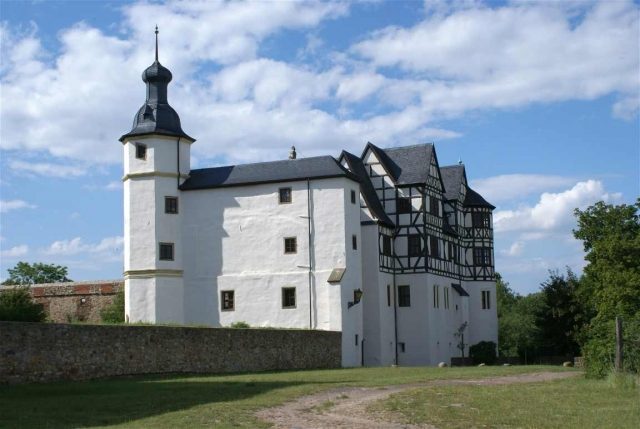
Leitzkau developed from a Slavic settlement. The place was inhabited by the Morzianer, a Slavic, specifically Liutician tribe. The first documented mention, "Liezka", occurred on August 18, 995, by the German Emperor Otto III. At the end of the 10th century, Leitzkau became a rallying point for the German imperial armies for their campaigns against the East Elbian Slavs and the Poles. Thus, Otto III started his fight against the Slavic Liuticians and Obotrites from here in 995, Henry II began his campaign against the Polish Duke Boleslaw Chrobry in Leitzkau in 1005, and in 1029, Conrad II set out from the same place to fight against Mieszko II Lambert of Poland.
Beginnings of Leitzkau Monastery
After the Slavs were finally defeated, Leitzkau transformed into a stronghold of Christian mission. Initially, the Bishop of the Diocese of Brandenburg, Hartbert, had a wooden chapel, existing since 1107, replaced by the stone church of St. Peter in 1114 - only the side aisles were made of wood - and appointed Leitzkau, in place of the cathedral chapter in Brandenburg destroyed and occupied by the Slavs in 983, as the provisional seat of the diocese and thus temporarily as a cathedral. The structural execution is explained in more detail in the "Sights" section. The current village church of St. Peter is thus probably the oldest, albeit in a much altered form, still existing stone church east of the Elbe.
In 1133, the Magdeburg Liebfrauenkloster established a Premonstratensian canonry in the church dedicated to the Apostle Peter, which was tasked with missionizing the areas east of the Elbe. Three years later, the newly elected Brandenburg Bishop Wigger took up residence in Leitzkau, which was thereby temporarily granted the status of a cathedral chapter. After St. Peter's Church no longer met the requirements despite an expansion in 1140, Bishop Wigger initiated the construction of a new collegiate church in 1147. This was also a three-aisled basilica, "Sancta Maria in Monte". It was consecrated on September 9, 1155, in the presence of Archbishop Wichmann of Magdeburg and Albrecht the Bear. Today, it is only preserved as a restored ruin. However, just ten years later, Leitzkau lost its prominent position after the destroyed cathedral chapter in Brandenburg had been restored. The monastery, however, retained a say in the election of the bishop in Brandenburg until the end of the 13th century, which led to later disputes (see Siegfried II). The monastery's possessions were in the surrounding area and were hardly expanded. The monastic convent then quickly fell into poverty and had to sell the collegiate property. Nine manuscripts from the Leitzkau Premonstratensian monastery from the 12th and 13th centuries are now kept in the Herzog August Bibliothek in Wolfenbüttel and in the Dessau City Library.
Conversion of the Monastery into a Castle
Leitzkau, however, remained the seat of a provost. Provost Georg von Maskow became one of the strongest proponents of the Reformation in the Jerichower Land. In 1535, the Brandenburg Elector Joachim II, as a result of the Reformation, ordered the dissolution of the chapter and entrusted the bailiff of Plaue with its administration. At this time, only 4 to 5 clerics lived there. The chapter had to be pledged several times in the following period. In 1554, it passed into the possession of his brother Margrave Johann von Küstrin, who sold it, along with the remaining lands, on April 2, 1564, for an amount of 70,000 Thaler as free property to the royal Spanish colonel and mercenary leader Hilmar von Münchhausen from the Lower Saxon noble family Münchhausen.
He immediately began to convert the existing, partly dilapidated Romanesque buildings for his purposes. In the process, the former convent building was transformed into a rectangular castle complex. The monastery church was converted into a castle church, with its side aisles and choir demolished and the transept turned into a granary, and the north tower was shortened by half. Hilmar's sons took over the property jointly after his death in 1573, but later transferred it to his son Statius alone. He raised the eastern convent wing to form the so-called "Althaus" (Old House) and had the cloister walled up, while he rebuilt the "Neuhaus" (New House) from 1593 on the foundations of the western convent wing. The northern wing of the cloister was demolished and replaced by a large farm building. Finally, the late Gothic provostry, which stood separately next to the cloister, i.e., the former residence of the Leitzkau provost, was also rebuilt in Renaissance style and later renamed "Hobeck-Schloss" (Hobeck Castle), because the possessions acquired in the neighboring village of Hobeck in 1686 were administered from here. The provostry and the Althaus were connected by a four-story loggia facade - modeled after the Vatican - including a stair tower.
Source: Wikipedia · Licence: CC BY-SA 4.0 · Image: Roland Neubert, Halle (Saale)
This description draws on the facts documented in the linked Wikipedia article; Wikipedia content is licensed under CC BY-SA 4.0. Wording and editing: Mobile History.
Location: 52.0624, 11.9490