Museum
CastleVeitshöchheim
Veitshöchheim Castle
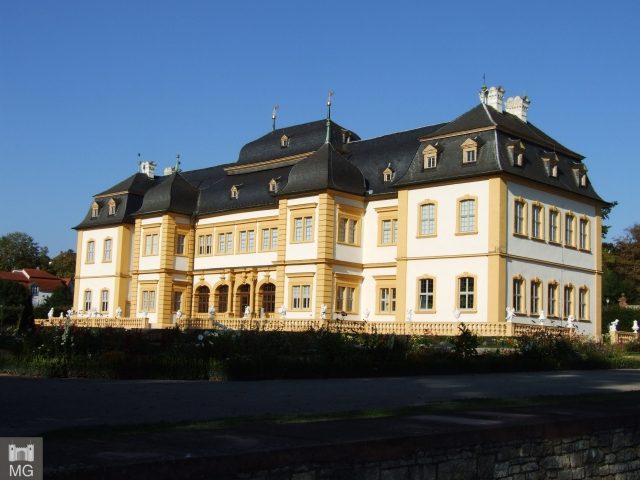
Veitshöchheim Castle is a former summer residence of the Prince-Bishops of Würzburg, later of the Kings of Bavaria, in Veitshöchheim near Würzburg. The castle complex is known for its surrounding Rococo garden.
History+
Construction+
The beginnings of the castle are evidenced on the ground floor, where a hall with five arcades from the Prince-Bishops of Würzburg, dating from 1680–1682, is preserved. It served as shelter after hunting. The current two-story building still features the four bay window projections of the older building. The architect Antonio Petrini was presumably involved in the construction, and the master builder Heinrich Zimmer certainly was. Later, an extension of two window axes and a representative upper floor, bounded by four corner turrets, was added. In 1753, Balthasar Neumann gave the building its current appearance: he added side pavilions, vaulted the entire structure with the distinctive sweeping roof, and incorporated a representative staircase inside. A balustrade adorned with vases and putti groups by Johann Peter Wagner runs around the entire castle. All the floors date from the Baroque period; parts of the Baroque interior decoration are also preserved, adorning one wing of the upper floor: a dining room with card tables, a billiard room, a study, a living room, a bedroom with a retiring room, which features later furnishings. The original stucco by Antonio Giuseppe Bossi is still present in all rooms. The silk wall coverings were largely reconstructed in Lyon according to original patterns; only the living room still retains its original wall covering in the rare ikat technique. A chapel is set up in the stairwell. Antonio Bossi also created the stucco altar, decorated with fantastic color transitions. A convertible prayer stool is preserved. The original wallpaper made of goatskin with embossed print and gold ornaments was stored externally for protection against moisture. A small kitchen, intended for preparing meals, is also found there. From the bedrooms on both sides, one can access a valet's room and further onto small outdoor balconies that lead back into the stairwell around the living quarters.
Usage+
From 1806 to 1814, the castle was the summer residence of Grand Duke Ferdinand III of Tuscany, Elector and Grand Duke of Würzburg. He had some rooms furnished in the contemporary Empire style. Five of these are now displayed on the upper floor with original furnishings: an antechamber with an adjoining study, a living room with a rare flower étagère, a bedroom, and a tower room. The old printed paper wallpapers with detailed plant motifs are noteworthy. The company Sattler from Schonungen, which produced Schweinfurt green with the addition of arsenic ("poison green") to increase the luminosity and durability of the color, was involved in this. The preserved furniture made of cherry, plum, and yew wood and the alabaster oil lamps complete the Neoclassical impression. With the abolition of the Grand Duchy of Würzburg in 1814, the property passed to the Bavarian kings, who, contrary to widespread opinion in local literature, rarely used the castle. However, it was a popular excursion destination for the people of Würzburg.
For this purpose, Veitshöchheim train station received an extraordinary reception building, representative, as for a spa town, with a royal pavilion, the latter in alignment with the castle. The reception building and the royal pavilion are connected by a covered walkway. The building is used by the municipal library. After the First World War in 1918, the castle and garden fell to the Free State of Bavaria, which has opened the castle as a museum for visitors since 1932. From 2001–2005, the castle was extensively restored and can be visited from April to October; events are also possible there.
Court Garden+
Since the 16th century, two small castles can be traced in Veitshöchheim, with an enclosure for pheasants and probably also red deer. In 1681, Prince-Bishop Peter Philipp von Dernbach had land purchased to expand this "Princely Game Garden".
Source: Wikipedia · Licence: CC BY-SA 4.0 · Image: Mobile Geschichte
This description is a machine translation of an excerpt from the linked Wikipedia article. The source text was written by its authors, the translation is by Mobile History; like the original it is licensed under CC BY-SA 4.0.
Location: 49.8317, 9.8747