The castle ruins can be visited
CastleCastell
Castell Old Castle
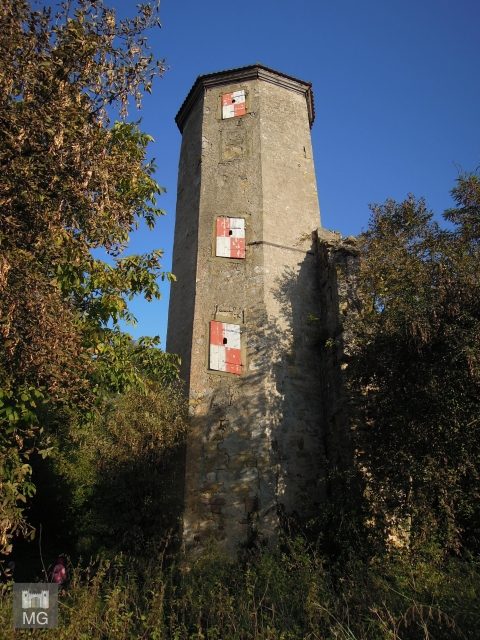
The Burgstall Oberschloss is a vanished hilltop castle in Castell, Lower Franconia. In the early modern period, the so-called Obere Schloss (Upper Castle) was built on the same site, of which some remains still exist. Both fortifications, the castle and the palace, were the original ancestral seat of the Counts of Castell.
The former castle complex is located approximately 277 m from the parish church of St. Johannes in Castell. The preserved remains rise at the western end of an east-west trending ridge, 394.41 m above sea level, known as the Herrenberg. The area where the Burgstall is located was called Schlossberg. The ruin can be reached from the village of Castell via several paths. Further west, in front of the preserved remains of the castle, a hill rises, which represents the motte of the "Altcastell" fortification. The Burgstall itself is located at 396.6 m above sea level. It is thus only 2.19 m higher than the summit of the Herrenberg. The steep slopes of the mountain are now used for agriculture, so the Burgstall is surrounded by vineyards.
History+
Oberschloss Castle was already the ancestral seat of the Counts of Castell in the 13th century. In the 16th century, the castle buildings were divided between two brothers of the family. After destruction in the German Peasants' War, the castle was rebuilt and fell victim to the Thirty Years' War a short time later. With the construction of the lower castle, the Counts moved their seat to the village, and the upper castle fell into disrepair.
Early Mentions (until 15th Century)+
The history of the castle is closely linked to that of the village and the lordship of Castell. The first mention of "Castel" in 816 already indicates a fortification in the village. It is probable that a castle complex already existed in prehistoric and early historical times, of which only a few section ditches have been preserved. Later, the complex was divided into two different castles.
While the predecessor of the lower castle, a circular castle, was expanded into a regional castle, the sources are silent about the upper castle in the 11th century. Only in 1258 do two castles appear in the village. They were the subject of a division treaty between Heinrich II and Hermann von Castell. From then on, two Castellian houses existed in the village, their separation also recognizable by their different residences. Hermann inhabited the upper castle, Heinrich resided further down the mountain. In 1265, the "castris Kastele" reappeared in the sources. The upper castle was again mentioned as "purg ze Kastel" in 1321. In 1328, the lower castle was lost to the Burgraves of Nuremberg. Thus, the upper castle remained the only seat of the Castell family in the village. Since then, the sources have become more abundant: The castle was mentioned in 1342 and 1415 in connection with a brothers' feud.
Divisions (until 16th Century)+
On December 4, 1453, the castle came under the influence of the Bishop of Würzburg. Wilhelm II von Castell agreed with Bishop Gottfried von Limpurg that the castle could not be sold in the next twenty years without the prince-bishop's consent. On February 28, the spiritual princes took over the feudal lordship over the entire county, without affecting the comital status of the Castells. Wilhelm's son, Friedrich IX zu Castell, gave half of the castle as a dowry to his wife Elsbeth, née von Reitzenstein. In the document about this event, the designation "slos Castel" appears for the first time. The guard of tower keepers and guards was also reported. Around 1520, more precise details about the upper castle appeared: It possessed a stone Kemenate (heated chamber) as its oldest element and was equipped with a Zwinger (outer bailey) and a well. Two towers were mentioned. Again, in the 16th century, the castle area was divided. Johann II and Wolfgang I then resided together in the castle, and the chapel was also used by mutual agreement. This was made possible by a so-called Burgfrieden (castle peace), which was drawn up as a contract at that time. This harmony was destroyed in 1525 when marauding peasant hordes plundered and burned down both castles in Castell during the German Peasants' War. In the upper castle, registers and documents were particularly destroyed.
Reconstruction and Conversion (until 17th Century)+
Reconstruction began in Wolfgang zu Castell's part of the castle as early as 1525. At that time, the Kemenate was rebuilt. From August 10 to September 8 of the same year, the castle roof was covered. Johann II, on the other hand, took his time with his part of the castle and only began reconstruction in 1528. By the end of 1530, the castle was largely restored, and in 1545, a clock was installed on one of the towers. During the Second Margrave War in the 1550s, the castle's defenses were improved. In 1553, the walls were reinforced, and in 1554, the moats were deepened. For this, the areas previously occupied by the outer baileys were used. A poem mentions "Eight towers and walls." However, these figures were exaggerations, as the castle never had more than four towers at any time. For further reconstruction measures, stones were taken from the ruinous lower castle in 1576. At the beginning of the 17th century, much construction took place again in the castle. In 1602/1603, the ovens were repaired and the windows mended, and in 1604, the castle received a new gatehouse. In addition, the main tower was raised; four towers on the building are documented from this year. A year later, a tower had to be demolished due to dilapidation. In 1606, the castle received a new corridor connecting the Kemenate with the bakehouse. The most extensive castle new constructions took place in the years 1607–1615. Again, stones from the ruins of the lower castle were used. In 1614, the planning of the octagonal stair tower began, which today represents the last preserved structural element of the Upper Castle. Johann Heinrich from Kitzingen was consulted for the design of the coats of arms on the tower. During the reconstruction work, the Counts resided in their second castle in Remlingen, where they also experienced the outbreak of the Thirty Years' War.
Source: Wikipedia · Licence: CC BY-SA 4.0 · Image: Mobile Geschichte
This description is a machine translation of an excerpt from the linked Wikipedia article. The source text was written by its authors, the translation is by Mobile History; like the original it is licensed under CC BY-SA 4.0.
Location: 49.7388, 10.3547