Museum
Dannenberg Castle

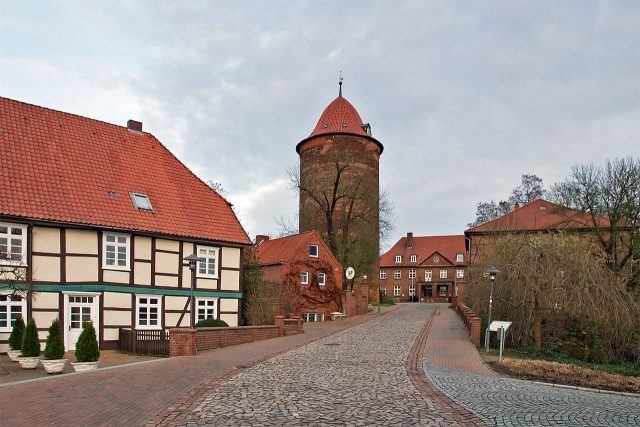
Dannenberg Castle was a castle complex in Dannenberg (Elbe) in present-day Lower Saxony, which Duke Heinrich of Brunswick-Lüneburg had built as a residence from 1569 on the site of a medieval castle. The castle buildings were demolished in the 18th and 19th centuries. Only the former keep, in the form of the Waldemarturm, has been preserved.
The predecessor of the castle was a medieval fortress, built on a sand island in a loop of the Jeetzel river. By piling up earth, the elevation of the castle hill, later known as Amtsberg, was created. Even before the castle's construction, a Slavic ring fort is suspected to have existed on the site.
The first castle complex was built by Volrad I of Dannenberg, who had received the order from Duke Henry the Lion to establish a settlement. While the castle was first mentioned in 1153, Dannenberg is named in a Magdeburg document dated October 18, 1157. The Waldemarturm, as the keep of the castle, was erected around the year 1200 under Count Heinrich I of Dannenberg. The tower, already over 30 meters high at that time, features walls up to 3.5 meters thick, made of brick in a double-shell construction. Between 1223 and 1224, the Danish King Valdemar II was hidden and imprisoned in the tower, after whom the tower was named. His son Valdemar the Young was also a prisoner.
In 1303, the line of the Counts of Dannenberg ended when Count Nikolaus relinquished his rights to Otto the Strict of Brunswick-Lüneburg for a life annuity. Later, Dannenberg Castle was involved in the Lüneburg War of Succession (1370–1389). In 1375, the knight Silvert von Saldern defended the castle against the Ascanians and surrendered it in 1377 during the siege by Gerhard von Attendorn. Ultimately, the castle and town remained in the hands of the Welfs after the war.
In 1569, the Lordship of Dannenberg was established as an independent principality in Dannenberg. It belonged to Duke Heinrich of Brunswick and Lüneburg, who had renounced further participation in the government of the Principality of Lüneburg and was compensated for it. From 1569, he had Dannenberg Castle built as his residence. Heinrich had the dilapidated buildings of the medieval castle renovated and added further structures, while the medieval Waldemarturm was preserved. Heinrich's son Julius Ernst, with his brother August, continued their father's work. A closed ensemble of buildings with stone plinth floors and half-timbered superstructures was created, as shown in a Merian copperplate engraving from 1654.
In 1671, the castle and the Dannenberg district returned to the Celle line of the Welfs and were subsequently under state administration. In 1672, the half-timbered superstructure of the Waldemarturm burned down after a lightning strike. It was only renovated in 1720 and received a stair tower as an annex. This was necessary because some parts of the dilapidated castle, from which the tower was accessed via a drawbridge at the height of the second floor, had been demolished. During this time, the castle was no longer a residence but the seat of the Dannenberg district office. Between 1774 and 1776, further castle buildings were demolished. Afterwards, the complex lost its enclosed nature and became an administrative courtyard, where a new residential building for the district administrator was erected. Initially, the castle chapel remained, serving as a bakehouse, slaughterhouse, and washhouse, and was only demolished in the 19th century. During this period, the tower served as a repository for court records. In World War II, the tower was damaged during air raids. After the war, the buildings on the former castle grounds were used by the British military administration, then until 1959 by the Federal Border Guard.
Today, on the grounds of the former castle, in addition to the Waldemarturm, there are several individual buildings from more recent eras. These include a half-timbered building erected in 1854 as the Dannenberg Higher Court and the district administration office, built as a brick building in 1914, which today houses the Dannenberg District Court. Since 1955, the local history museum of the city of Dannenberg, now the Museum in the Waldemarturm Dannenberg, has been housed in the Waldemarturm.
Take Mobile History with you
You are reading this text for free. Premium adds what matters on the road: descriptions read aloud, sites found through your camera, whole regions taken offline.
- Every description, including the ~17,700 Premium sites
- Audio guide: have descriptions read to you on location
- AR finder: see sites through your camera, with distance and bearing
- Unlimited saved sites
14 days free, then from €2.99 a month. Cancel anytime.
Location: 53.0994, 11.0979