The town fortifications can be visited.
Town FortificationDettelbach
Dettelbach Town Fortification
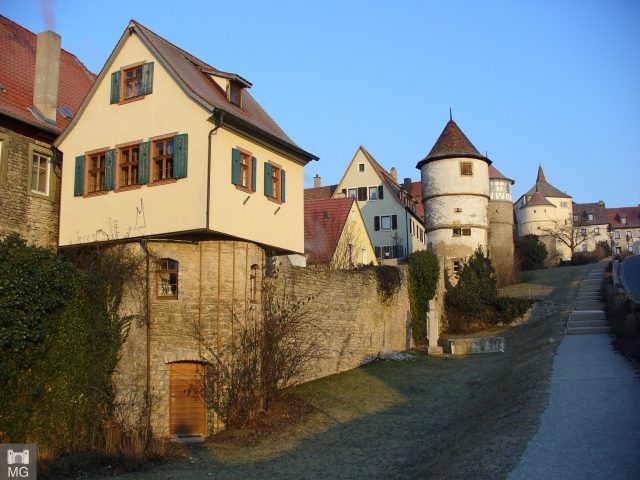
The former Dettelbach town fortifications surround the old town of Dettelbach in Lower Franconia as a ring wall with towers, gates, and remnants of a moat. Large parts of the complex, which dates back to the time of the town's elevation at the turn of the 15th to the 16th century, have been preserved to this day.
History+
Town Elevation and Fortification (until 1631)+
The creation of Dettelbach's town fortifications is closely linked to the development of the core town. For a long time, Dettelbach did not have an urban character but presented itself as a village settlement. Already since Carolingian times, a royal manor existed on the highest elevation in the present-day urban area, the Kirchenzinne. In the High and Late Middle Ages, the Knights of Dettelbach fortified the hill and built a castle, their ancestral seat, on the site of the former Rentamt. At that time, the village was perhaps surrounded by a hedge and a ditch (Dorfhag). This first fortification was only replaced in the second half of the 15th century. The Würzburg bishop Rudolf II von Scherenberg promoted the village of Dettelbach during his reign and had Emperor Frederick III grant it town and market rights in 1484. Shortly thereafter, the construction of the town wall probably began, which also externally distinguished the settlement, which had become a town, from its surroundings. Older literature, however, indicates that an imperfect fortification already existed earlier. Thus, the Mainstockheim Tower at the southwest corner is said to date back to 1453. The maintenance of the town fortifications was largely in the hands of the town's population after they had received market rights. Therefore, the fortification first appears in a mayor's account of the young town. In 1532, there is mention of the five "gatekeepers" who were to receive an annual wage of 5 guilders. Already at that time, the original five gates existed as the only passages. The walling was largely completed by 1532. The Faltertor was probably renovated for the first time in 1550. The gatekeepers mentioned in the document played a significant role in maintaining the integrity of the fortification. They opened the gates at dawn and closed them again at sunset. They were also responsible for monitoring the traffic reaching the town, which particularly affected the east-west axis coming from Würzburg or Bamberg. If they failed to fulfill their duty, the gatekeepers were sentenced to high fines. In 1641, the gatekeeper of the Brückertor was even imprisoned in the Herrenturm. The fortifications probably experienced their first military conflict already in the German Peasants' War in 1525, when Stadtschwarzach peasants allied with Dettelbach farmer-citizens and marched together against Würzburg. In the Thirty Years' War, about 100 years later, the town's circumvallation had largely lost its defensive function. The medieval fortifications could not counter the modern artillery of the warring parties. Thus, in 1631, the population opened their town to the Protestant Swedes without a fight.
Dissolution of the Fortification (to the present day)+
Subsequently, those responsible no longer invested anything in the outdated facilities. The gates served solely as a customs station where goods traffic for the local market was taxed. The result was a decay of the less representative parts of the fortification. Thus, in 1777, the moat, which was filled with water in many places, was parceled out, and vegetable gardens were laid out here. At the same time, many of the smaller wall attachments and towers, of which there were originally supposed to have been 52, disappeared.
In 1857, a chronicler lamented that the walls "are largely ruinous." However, those responsible tried to save the characteristic towers by selling them to private individuals. In the middle of the 19th century, the striking square wooden superstructures were built above the medieval tower stumps. Here, the poor and day laborers could live. The growing town expanded close to the fortification; the walls were partly built over with barns and sheds. From the middle of the 19th century, increasing traffic also became a problem for the remains of the fortification. In particular, the Neutor and the Steigtor on the road between Würzburg and Bamberg hindered the wagons. The first complaints arose in 1844. Between 1872 and 1873, three of the five medieval gates were therefore demolished. The Brückertor probably survived because it had already been sold to private individuals in 1833 and a house fire had created another breach in the fortification. Young monument protection only became aware of the fortification in 1903 and saved the Faltertor from demolition. In 1887, the town converted the southern parts of the moat into the so-called Anlage, a circular park for the local population. At this time, large parts of the still existing moat were filled in. At the same time, at the beginning of the 20th century, the approach to the town fortification as a monument changed. Although individual towers are still threatened with demolition, the ensemble as a whole has been preserved. The growing tourism after the Second World War also contributed to this. From the 1970s onwards, the town repeatedly invested money in the renovation and maintenance of particularly representative sections of the wall. The locations of the former gates were marked with artworks by local sculptors. Today, the Dettelbach town fortification forms the boundary of the Dettelbach Old Town ensemble. Most of the preserved gates, towers, and wall remains have been placed under protection as architectural monuments by the Bavarian State Office for Monument Preservation. Underground remains of earlier buildings are noted as archaeological monuments.
Gates+
Dettelbach had a total of five gates – a sixth into the Kühngasse suburb may have been destroyed as early as 1631 – which between the 15th and 19th centuries were the only accesses to the old town. Particularly important for economic development were the Steig- and Neutor, which pointed towards Würzburg and Bamberg respectively. All gates had defensive functions, so they could only be reached by a drawbridge over the moat in front of them and at the same time formed the customs borders of the town. Most of the gates disappeared in the 1870s; today, only the Faltertor and Brückertor have been preserved.
Faltertor+
The Faltertor is considered the more significant of the two preserved gates. It borders the old town in the northeast on the Falterstraße named after it and was formerly responsible for traffic coming from Volkach and Sommerach. After the gate was probably completed in 1532, it was already renovated in 1550. At that time, the coat of arms of the Würzburg Prince-Bishop Melchior Zobel von Giebelstadt was also affixed to the building. The customs function of the gate was emphasized by the construction of a small customs house, which was demolished in 1888. After the more important gates for traffic were demolished in 1872 and 1873, the city council debated in 1899 whether to also remove the Faltertor. Only the intervention of the then General Conservatorium of the Kingdom of Bavaria, the predecessor of today's State Office for Monument Preservation, saved the gate. Subsequently, the ensemble of Faltertor and the neighboring Männerturm became a popular postcard motif. Since the 1960s, the Kolping and Craftsmen's Museum Dettelbach has been located in the gate tower. The Falterturm presents itself as a three-story rectangular building with a hip roof. It is topped by a metal spire, which, however, is surrounded by bricks and gives the tower its distinctive appearance. A round-arched passage dominates the ground floor. On the town side, a small stair tower was added to the actual gate tower; it provides access to the museum on the upper floor. Due to its use as a residential building and museum, the original window arrangement has been altered.
Brückertor+
The Brückertor (also Brücker Tor, Brückenturm) is located in the north of Dettelbach's old town in Eichgasse by the Dettelbach stream. This gate led to the present-day district of Brück, from which it takes its name, and from here, traffic from the direction of Prosselsheim reached the Dettelbach market. The Brückertor was also indirectly mentioned for the first time in 1532. In 1833, it was sold to private individuals. However, the town reserved the right to use the gate passage. The gate's location on a merely regional connection and its early sale contributed to its preservation. A fire in 1897 was also decisive for this: the catastrophe created a breach in the wall further west, so that the gate became isolated. The gate is still inhabited today, and a comprehensive renovation took place at the beginning of the 21st century. It presents itself as a two-story gabled building with a half-timbered upper floor.
Source: Wikipedia · Licence: CC BY-SA 4.0 · Image: Mobile Geschichte
This description is a machine translation of an excerpt from the linked Wikipedia article. The source text was written by its authors, the translation is by Mobile History; like the original it is licensed under CC BY-SA 4.0.
Location: 49.8021, 10.1622