Church visitable
ChurchGörlitz
Annen Chapel Görlitz
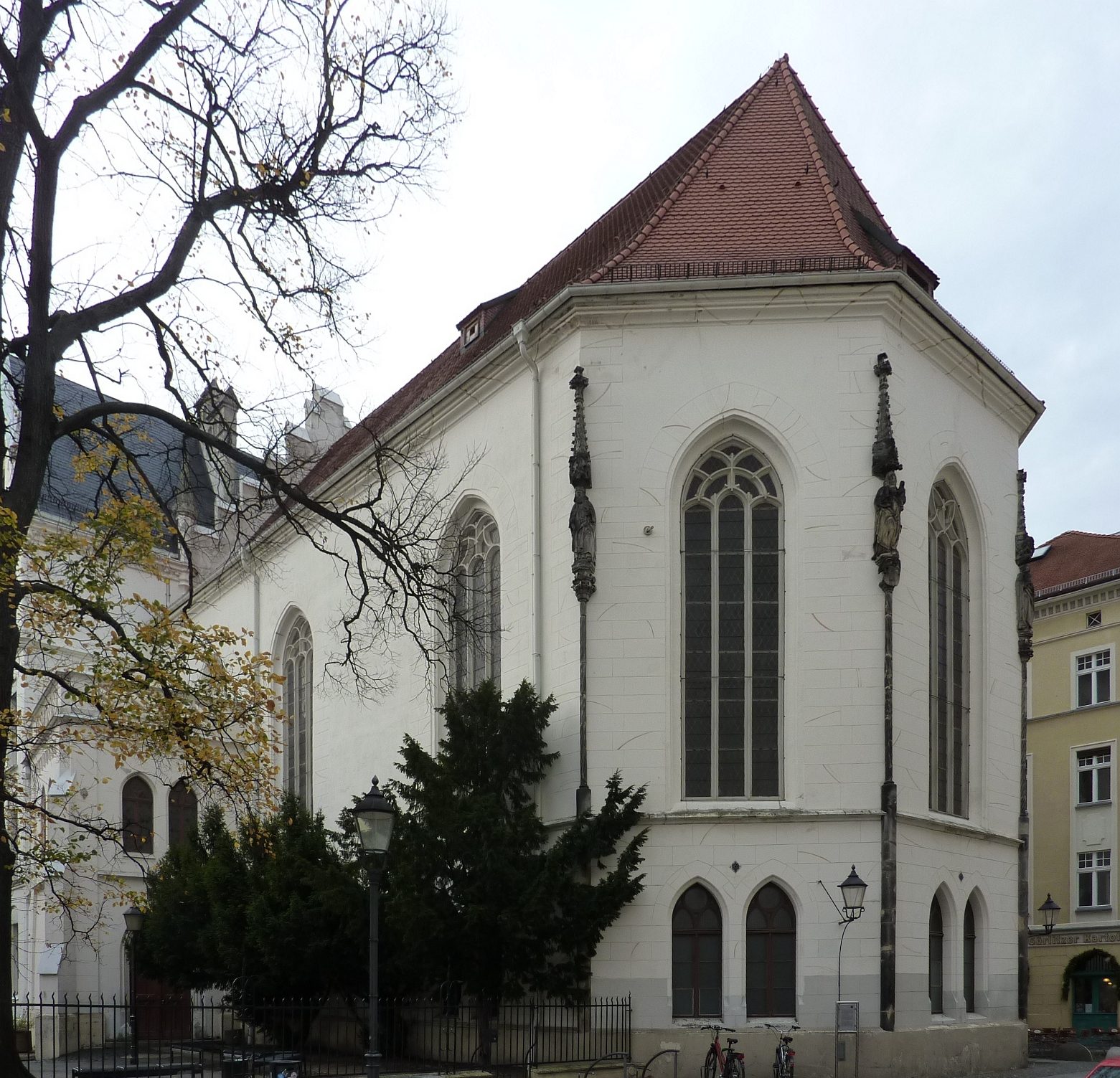
The Annenkapelle (St. Anne's Chapel) on Görlitz's Marienplatz was built between 1508 and 1511 by master builder Albrecht Stieglitzer as a memorial chapel for the wealthy Görlitz merchant Hans Frenzel (1463–1526). It was dedicated to Saint Anne – Frenzel's patron saint. Later, it was used as an orphanage and penitentiary church. Today, the former chapel is used as a gymnasium and assembly hall for the adjacent Annenschule.
History and Building+
In 1505, Frenzel asked the council "for the umpteenth time" for permission for the chapel, but the council replied, in what Christian Speer described as "superficial" attire, that the new priests would reduce the income of the other Görlitz clergy and that the former could also import and sell beer. (See also: Beer Dispute in Upper Lusatia) Hans Frenzel is said to have even visited the Pope (Julius II) for his project. Before 1507, the council finally relented and allowed the Annenkapelle on Topfmarkt, located at the western end of Lange Straße. However, this location was "out of the way for the people," as Frenzel rightly objected, and so it took until after the death of Frenzel's opponent Georg Emmerich († 1507) until he was assigned a respectable building site, namely the one on the grounds of the former ducal castle built by Charles IV in 1369 and demolished in 1474 on the southwestern city wall, at Frauentor opposite the Frauenturm. On June 26, 1508, construction began, which, however, proved difficult. An old, filled-in moat belonging to the old castle was encountered. The construction work was led by the master builder Albrecht Stieglitzer.
The construction cost 8550 guilders and was also lavishly furnished inside. The elaborately designed altar, depicting Saint Anne and her family, was already delivered in 1503 by the sculptor Hans Olmützer. Outside the chapel are seven sandstone figures, including the patron saint of the builder, Anne with the Virgin and Child and Saint Joseph, Mary with the Child and Joseph, John the Baptist, the blessing Christ, and Lawrence. The fact that the building was called a chapel could be related to the assumption that a chapel was probably more likely to be approved than a church. The dimensions of the "chapel correspond to those of a 'full-fledged church'." It was completed in the autumn of 1511. It is – alongside the Fugger Chapel at St. Anne's in Augsburg – one of two churches "of that time" built on a "larger scale" by private hands in Germany.
On April 16, 1512, Frenzel arranged for the council to ask the Bishop of Meissen (Johann VI von Saalhausen) for the consecration of the chapel; on May 28, his request was granted and the chapel was consecrated to St. Anne by Saalhausen's representative, the Bishop of Halberstadt (Ernst II of Saxony). The chapel had three altars, each with two altarists, who in turn each represented a ministerium of five masses. In total, that was thirty masses per week. The services were private, for Frenzel and his family. During Hans Frenzel's lifetime, services took place regularly, after which it remained "unused except for a few isolated cases" for over 100 years.
Frenzel left behind his underage son Joachim, who in 1531 ceded the endowment assets and the chapel to the city council. However, neither Joachim nor his father had "dispositional power" over the chapel. Thus, it was ecclesiastically subordinate to the pastor and the Bishop of Meissen, and the council, which assumed administrative tasks, provided a "church father and provider," also referred to as an administrator. Initially, this was Merten Wells, who, however, died in the same year of his appointment (1512). Thus, Bernhard Berndt is also verifiable for this office from 1512 to at least 1515. After Joachim's endowment, the chapel remained in the possession of the city to this day, but it was always treated somewhat neglectfully by it. In 1539, the city had the bells removed from the turret and hung on the Nikolaikirche and the Reichenbacher Turm. Twenty years later, the magnificent altar was moved to St. Peter's Church, where it was destroyed in a fire in 1691. After the altar was moved in 1559, three years later, during a severe storm, the turret on the east side of the chapel collapsed and was not rebuilt. Only after a complaint from Frenzel's descendants did the dilapidated chapel receive new windows in 1584 and a new shingle roof in 1597. At the beginning of the 17th century, further renovations to the chapel took place, so that in 1620, Margrave Johann Georg of Brandenburg, who at that time had his headquarters in Görlitz, had reformed services celebrated in it.
Due to the siege of the city by Saxon-imperial troops during the Swedish occupation of the city in 1641, the Annenkapelle was also severely damaged, so that the city, after renewed urging from Frenzel's descendants, repaired the chapel. In 1692, the college of priests moved into the building for 40 years. From 1730, the orphanage, later penitentiary, adjoined the chapel to the west, which they used as an orphanage or penitentiary church. From 1845, the Catholic community also held their services in the church, as their church was far outside.
In 1871, a fundamental change was made to the chapel. An intermediate ceiling was installed at the height of the string course, thus creating a room at ground level, which was later used as a gymnasium. The pairs of windows in the Gothic style on the ground floor were created during the renovation. The upper room served as an assembly hall from 1875.
Take Mobile History with you
You are reading this text for free. Premium adds what matters on the road: descriptions read aloud, sites found through your camera, whole regions taken offline.
- Every description, including the ~17,700 Premium sites
- Audio guide: have descriptions read to you on location
- AR finder: see sites through your camera, with distance and bearing
- Unlimited saved sites
14 days free, then from €2.99 a month. Cancel anytime.
Source: Wikipedia · Licence: CC BY-SA 4.0 · Image: Chris06 · Wikimedia Commons · CC BY-SA 3.0
This description is a machine translation of an excerpt from the linked Wikipedia article. The source text was written by its authors, the translation is by Mobile History; like the original it is licensed under CC BY-SA 4.0.
Location: 51.1538, 14.9866