Museum
Town FortificationGörlitz
Town Fortification Görlitz - Kaisertrutz
More pictures
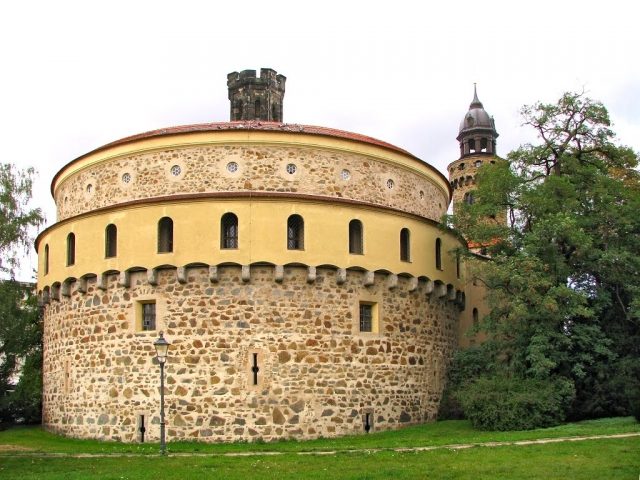
The Kaisertrutz is one of the once 32 bastions, of which four are still preserved today, which the city of Görlitz possessed for defense.
History+
In the area of older suburban wooden buildings (barns), a "very strong fortification" was erected in 1427 as part of the Budissin (Bautzen) or Reichenbach Gate. In 1490, the "great Reichenbach Rondell", which later received the name Kaisertrutz, was built as an advanced bastion of the double-walled city wall to secure the Via Regia trade route running through the city from the west. In the Thirty Years' War, the Kaisertrutz received its name in 1641. The city was occupied by the Swedes and defied the imperial and Saxon troops outside the city during a multi-week siege. In 1848, the Kaisertrutz was converted into the main guardhouse of the Prussian garrison after the connecting walls to the Reichenbach Tower and the city wall were demolished. Both the city moat around the Trutz and its basement were filled in. The new guardhouse received an arcaded portico and two flanking turrets. After extensive renovation work, the city history and pre- and early history of Upper Lusatia departments of the then Kaiser-Friedrich-Museum were opened in the Kaisertrutz in 1932. In 1948, the Kaisertrutz was reopened. The archaeological exhibition of the municipal museum was moved to the Baroque House Neißstraße 30 in favor of the new painting gallery. From 1998 to 1999, the filled basement was cleared, revealing a medieval wooden well from the 13th century under the foundations.
Source: Wikipedia · Licence: CC BY-SA 4.0 · Image: Rudolf Henkel
This description is a machine translation of an excerpt from the linked Wikipedia article. The source text was written by its authors, the translation is by Mobile History; like the original it is licensed under CC BY-SA 4.0.
Location: 51.1546, 14.9849