The Gate can be visited
Town FortificationStendal
Stendal Town Fortification - Tangermünde Gate
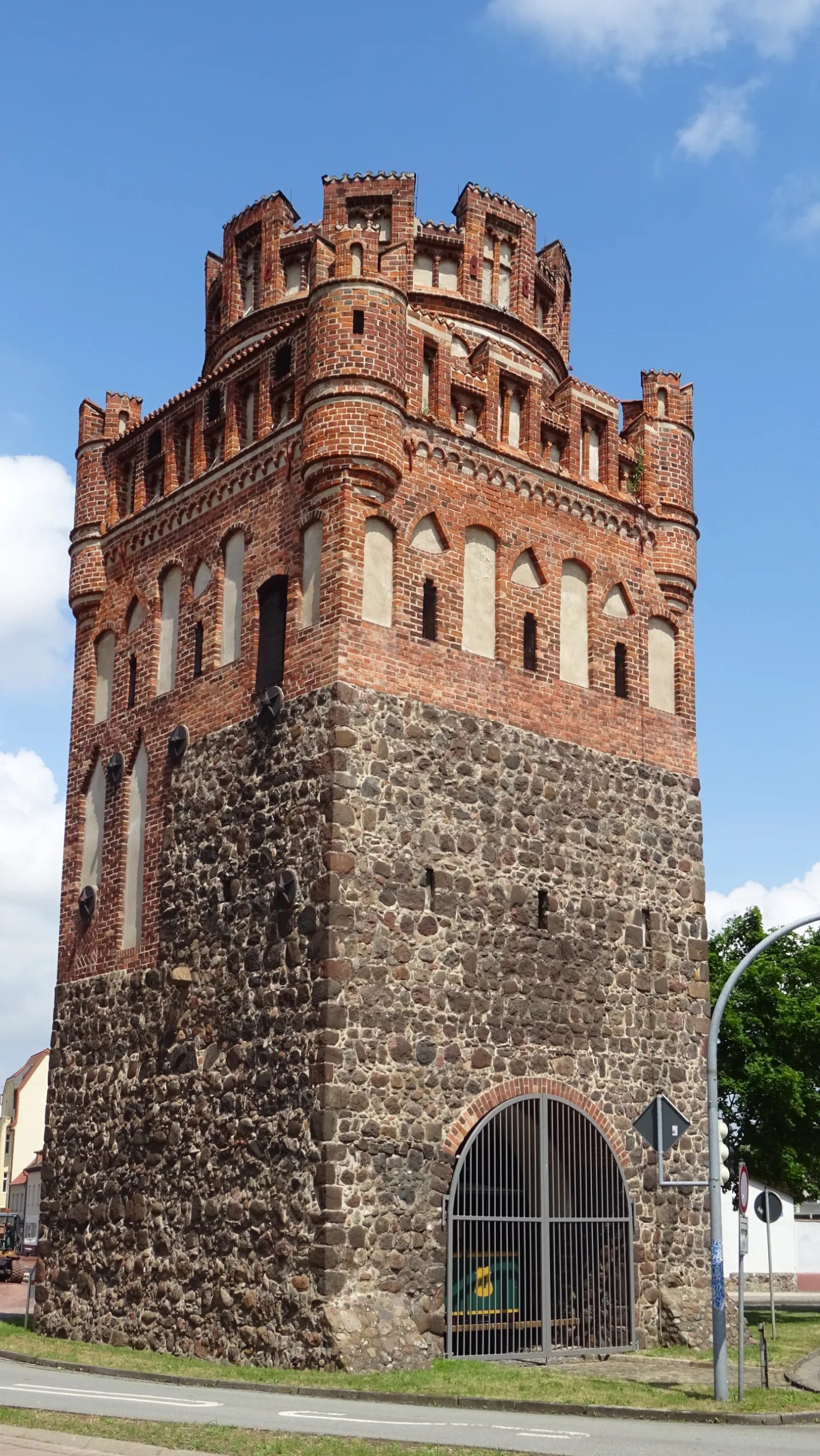
The Tangermünde Gate is one of two preserved city gates of Stendal. It was built as part of the Stendal fortifications in the 13th century and is the oldest gate building of a city fortification in Northern Germany. Only the tower of the main gate remains.
History+
Naming+
The road through the gate leads over the Uchte to the city of Tangermünde on the Elbe, located to the southeast.
Origin+
In the Middle Ages, Stendal had a continuous city wall with four city gates and several towers. They were still in use before the last city plague in 1682. Their demolition only began in 1718. Since the structure stands at the end of the former village of Schadewachten, it is assumed that the substructure of the gate was only begun in the early 13th century, when the Schadewachten was united with the city. The path to the gate led along the outer rampart past a stone round tower to a guardhouse. Only in 1872 was the bridge over the Uchte widened, provided with stone footpaths and a railing. Ramparts and walls were broken through and demolished. The cross-sections of the broken earthen rampart were supported by a Gothicizing wall each. The customs guardhouse Im Tangermünder Tor 1 was demolished in 1937.
Preservation+
In the second half of the 1980s, the Tangermünde Gate was last extensively restored and made accessible to the public.
20th Century+
In mid-April 1945, the white flags of surrender were hoisted and taken down several times on the Tangermünde Gate, on the church towers and from the residential buildings of the city, as the SS demanded, under threat of terror measures, that the white flags be taken down again.
Current Use+
To allow access to the tower, a historically controversial brick annex was built starting in 1987. In 2017, it was decided to install lighting in the gate and to store the horse-drawn tram of the traditional association "10. Husarenregiment" in the passage. In 2018, a statute was published regulating paid tower visits and ascents. In the summer of 2022, the lighting was switched off until further notice.
Description+
The Romanesque fieldstone plinth floor with a round-arched passage is preserved as the foundation of a late Gothic brick superstructure and is clearly recognizable. The superstructure with a crenellated platform, a round tower top and four corner turrets was built around 1440 and served, just like the Uenglinger Gate, representative purposes. Originally, the gate tower could only be accessed via the battlement of the city wall. After the removal of the city wall and rampart, the access was thus at a considerable height.
Take Mobile History with you
You are reading this text for free. Premium adds what matters on the road: descriptions read aloud, sites found through your camera, whole regions taken offline.
- Every description, including the ~17,700 Premium sites
- Audio guide: have descriptions read to you on location
- AR finder: see sites through your camera, with distance and bearing
- Unlimited saved sites
14 days free, then from €2.99 a month. Cancel anytime.
Source: Wikipedia · Licence: CC BY-SA 4.0 · Image: Foto: Jörg Heldt (Community)
This description is a machine translation of an excerpt from the linked Wikipedia article. The source text was written by its authors, the translation is by Mobile History; like the original it is licensed under CC BY-SA 4.0.
Location: 52.5996, 11.8641