Castle tours available
CastleStráž pod Ralskem (Wartenberg am Rollberg)
Vartenberk Castle
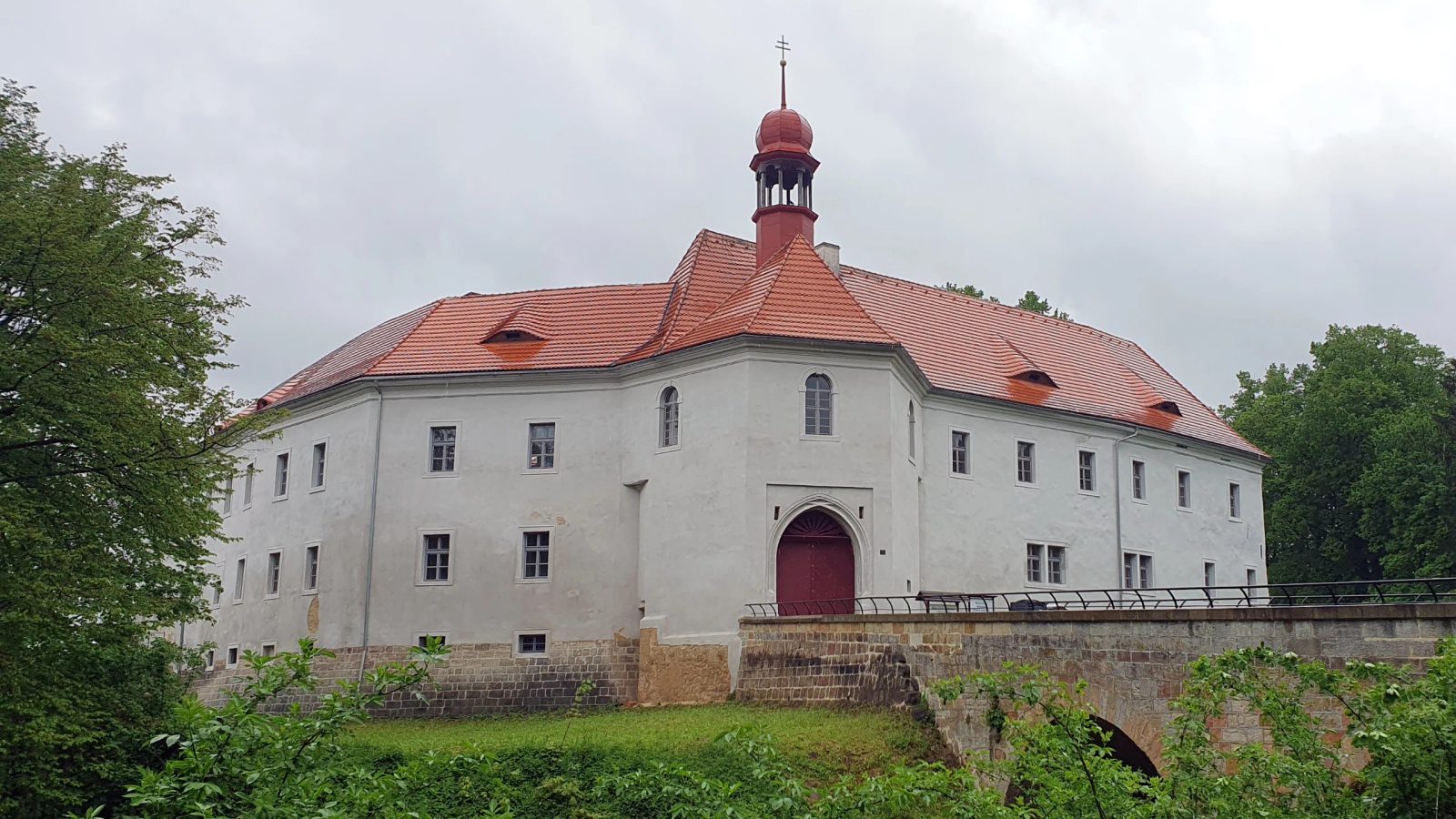
Vartenberk Castle (formerly also Vartemberk, German Wartenberg or Warttenberg) is located northeast of the North Bohemian small town of Stráž pod Ralskem on Zámecký vrch (352 m) above the Ploučnice valley. It was built at the end of the 15th century as a Renaissance castle on the foundations of a Gothic castle from the 12th to 13th centuries.
History+
Medieval Castle+
The original castle was first mentioned in 1281. It was located on the northwest side of the elongated hill, from which the castle tower once also protruded north from the outer bailey. Massive, ton-heavy vaults, walls and a moat surrounded the former bastion. On its east side was the castle gate with a drawbridge over the moat. It is assumed that the castle was founded by Marquard von Březno and his son Beneš von Vartemberk to protect the trade routes to Zittau. From that time, the writings of Marquard P. de Wartenberc have been preserved. The name of the castle "warta" or "varte" - the watchtower and "pork" or "berk" - the mountain, also gave its name to the nearby settlement and later town of Wartenberg (today Stráž pod Ralskem). The castle of Vartemberk, a former offshoot of the main Ralsko castle, served as a protective bastion "watchtower to the Rollburg" (stražna podrólski). In the 14th and 15th centuries, it developed into one of the most powerful noble houses in the Kingdom of Bohemia. The castle gate proudly displayed the gold and black coat of arms of the Princes of Vartemberk, entwined by a dragon. Lord of the castle Beneš became the Prague Burgrave and fathered four sons. These later founded the four most important branches of the House of Vartemberk - House Veselí von Vartemberk, House Kumburk von Vartemberk, House Kostel von Vartemberk and House Děčín von Vartemberk. During the Hussite campaigns in 1426 and 1427, the castle was besieged and occupied by the armies of the Orphan leader Jan Čapek ze Sán, who later converted back to Catholicism. Čapek was appointed the new lord of the castle at the time and gained even more power and influence in Bohemia with his rule over Vartemberk. Former servants and officials from the Vartemberk court joined his service. In 1438, the Vartemberk castle passed to the Moravian armies of Johann Sokol von Lamberg and after his death it passed into the Bohemian rule of Diepold von Riesenberg.
The Last Vartemberk+
The last Vartemberk at court and at the same time the last member of the Vartemberk family branch was Count Jan Jiří III. (Count Johann Georg III von Wartenberg und Roll), descendant of the high Prague court official Jan Jiří I, brother of Prince Děčín von Vartemberk, who resided in Vartenberk and Ralsko in the 13th century. The life of Jan Jiří III. was shaped by the Thirty Years' War. At that time, he allied himself with the rebellious peasants. As leader of a peasant army, he succeeded in regaining the Vartemberk castle rule for a short time. In the course of time, however, he had to accept the decline of the House of Vartemberk. The defeat in the Battle of White Mountain ultimately led to his banishment from the Vartemberk court. The Habsburg Emperor Ferdinand II expropriated him, his possessions were confiscated, and he fled into Saxon exile. He presumably died there in 1631 or 1647.
Conversion to a Renaissance Castle+
With the rule of the Hussites and the uprisings and campaigns of the Thirty Years' War, the lords of Vartenberk changed from year to year. As early as 1504, the Hirschperger von Königshain bought the originally Gothic castle. They repaired and enlarged it and gradually converted it into a Renaissance castle in the years up to 1563.
15th to 17th Century+
With the conversion and the rule of Hirschhorn, Vartenberk Castle passed into the possession of the noble houses of Liechtenstein and Hartig. For a short time, Prince Albrecht von Wallenstein also resided in the castle. In 1639, during the Thirty Years' War, Vartenberk Castle was plundered and devastated by Swedish troops. A few years later, the castle even went up in flames; in 1645, Swedish troops again stormed the court and set it on fire.
19th and Early 20th Century+
With the completion of construction work at Mimoň Castle, the Hartig owners moved from Vartenberk Castle to Mimoň Castle in 1830. However, the Hartigs remained present in the town and at Vartenberk Castle. They used it as a private guesthouse and for wine production. The administration of the Hartig winery took its central seat in Vartenberk Castle, and the Herwigsdorf botanist Heinrich Moritz Willkomm, who was friends with the Hartig family, lived and worked there until his death in 1895. In 1922, the castle was nationalized and the teacher and writer František Melichar from Unhošť (Unhoscht) took over the Hartigs' property for a symbolic price. He set up a classroom for teaching Czech children, but died only three years later.
1945 to Today+
After the Second World War, the castle was converted into a recreation facility for the ČKD Praha company. With the participation of the sculptor Olbram Zoubek, the Renaissance sgraffitos on the inner facade were restored. In 1969, the castle was taken over by the Soviet Army. The buildings were severely damaged by the presence of the soldiers and almost completely destroyed by a fire in 1987. After their withdrawal, the Soviet Army left behind only a dilapidated wasteland and a picture of devastation of Vartenberk Castle.
Renovation
The renovation of the castle proved to be a difficult task due to the financial situation and structural problems. Already in the 1990s, the first makeshift renovation and repair work began. A new roof structure was erected. The work was the financial and technical responsibility of the city of Stráž pod Ralskem and the Czech Ministry of Culture. In October 2010, there was a large fundraising appeal. The construction work for the external restoration of Vartenberk Castle lasted about 20 years. In May 2024, the castle was presented to the public for the first time again.
Take Mobile History with you
You are reading this text for free. Premium adds what matters on the road: descriptions read aloud, sites found through your camera, whole regions taken offline.
- Every description, including the ~17,700 Premium sites
- Audio guide: have descriptions read to you on location
- AR finder: see sites through your camera, with distance and bearing
- Unlimited saved sites
14 days free, then from €2.99 a month. Cancel anytime.
Source: Wikipedia · Licence: CC BY-SA 4.0 · Image: Foto: Jörg Heldt (Community)
This description is a machine translation of an excerpt from the linked Wikipedia article. The source text was written by its authors, the translation is by Mobile History; like the original it is licensed under CC BY-SA 4.0.
Location: 50.7054, 14.8007